
At a glance
- The benefits of living in the city—from accelerated career mobility to unmatched cultural and social capital—still outweigh the trade-offs, but only when the decision is anchored in a clear-eyed cost-benefit analysis of your specific priorities. This article breaks down the real pros and cons of city living with 2025–2026 data to help you determine whether an urban move will optimize your career trajectory and quality of life—or quietly erode both.
- The benefits of living in the city have never been more nuanced—or more decisive—for mid-career professionals. In 2026, with hybrid work reshaping where talent lives, the urban advantage remains powerful: denser job markets, higher earning potential, walkable transit, world-class culture, and diverse networks. Yet smaller spaces, noise, and costs demand honest math. Our guide cuts through outdated advice, a side-by-side urban-suburban-rural comparison, and an interactive cost-of-living calculator. You’ll also find a personalized decision framework scoring your priorities—career, space, schools, budget—plus real personas from remote workers to growing families. The pros and cons of city living are not abstract. Run the numbers, take the quiz, and decide before your next lease or offer expires. This is your 2025 reality check.
- What if the most underrated career move for a 35-to-45-year-old professional isn’t a certification or a side hustle, but a move to the city?
The reality check: While cities offer unmatched career acceleration and cultural access, they demand a “quiet cost” in the form of chronic environmental stressors and the erosion of acoustic privacy that can impact long-term cognitive focus.
Go deeper: Explore the evolving economic and lifestyle frameworks that define the modern urban advantage for established professionals.
Go Deeper
Career Capital in a Remote-First Era
In the 2026 labor market, the concept of “urban career capital” has transitioned from a vague preference for city life into a quantifiable economic asset. Economists now define this capital through three distinct lenses: the salary premium, network density, and the frequency of spontaneous collaboration. Proximity to major employers and industry-specific clients creates a measurable spread between metropolitan compensation and the pay for identical roles in secondary markets.
The value of this capital extends far beyond the monthly paycheck. It encompasses the “optionality” afforded to professionals who remain physically reachable when firms make rapid decisions regarding hiring or internal promotions. Being present when strategic acquisitions are discussed often places a professional at the center of the transition team, a position rarely offered to remote staff.
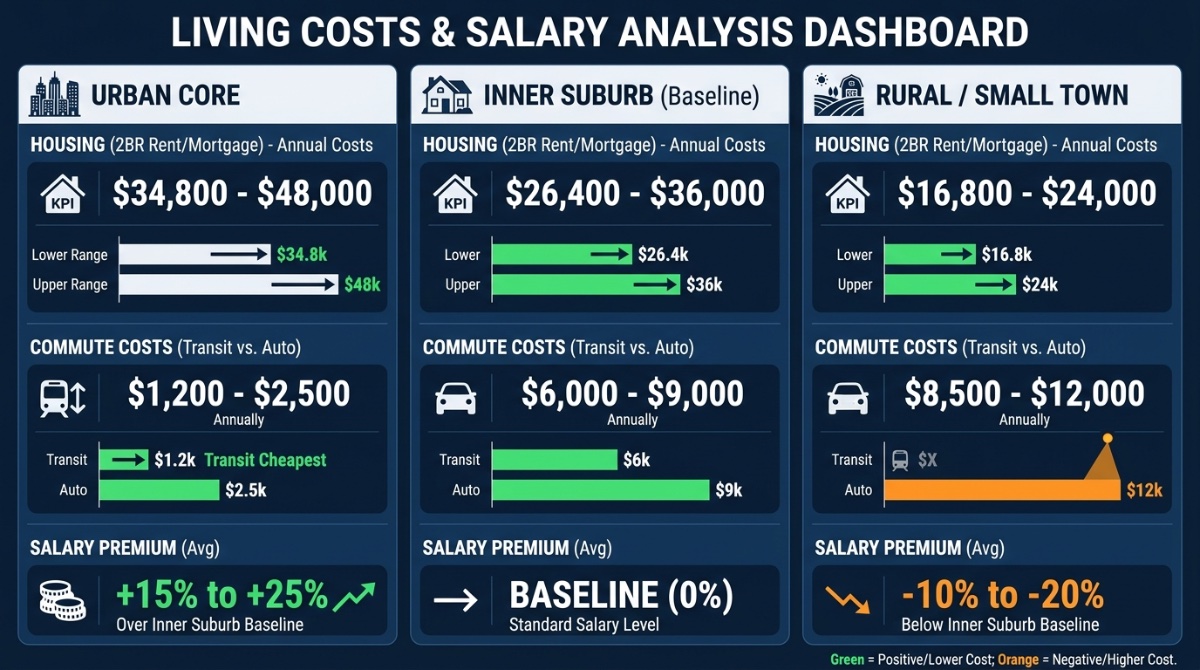
For mid-career professionals, particularly those in the 40-year-old demographic, this optionality compounds at an accelerated rate. In a dense urban environment, competing employers frequently bid for the same specialized skill sets. This concentration of opportunity fundamentally strengthens a professional’s negotiating position during annual reviews or contract renewals.
Market analysts suggest that this density transforms the process of job switching from a high-friction event involving relocation into a local transition. A professional can often secure a new role and complete the onboarding process within weeks while remaining in the same residence . This stability is a significant advantage for families with school-aged children who wish to avoid the disruption of moving.
The Access Dividend: Culture and Convenience
Urban density functions as a sophisticated economic mechanism that converts physical proximity into tangible value. For the modern professional, much of this value is not reflected in a standard salary but manifests through a high concentration of specialized assets. These include world-class galleries, medical sub-specialists, robust transit infrastructure, and dense professional networks .
These assets are situated within a constrained geographic radius, creating what economists call a localized economy of scale. As global populations continue to shift toward metropolitan centers, the ability to leverage these proximity-based assets has become a primary driver of quality of life. This is particularly true for mid-career professionals who must balance high-stakes roles with complex personal lives .
For households headed by individuals in their late thirties and forties, the primary advantages of urban residency often materialize as recovered time. In this specific life stage, professional responsibilities and family obligations frequently peak simultaneously. This creates a state of “time poverty,” where the margin for logistical error is razor-thin .

The efficiency of a dense city acts as a buffer against this logistical friction. Hours saved through efficient transit and localized services compound over weeks and months into significant gains in career flexibility and domestic stability. These gains often outweigh the direct increases in gross income found in less dense, car-dependent environments.
Space, Privacy, and the True Cost of Density
Urban residency has evolved into a high-stakes transaction where professionals increasingly swap square footage and acoustic privacy for the one commodity they cannot manufacture: time. For a 38-year-old managing a multi-national portfolio, the value of a home is no longer calculated solely by rent per square foot. Instead, it is measured by the degree to which the immediate environment preserves or drains their health and cognitive focus.
The benefits of the urban core are easily quantified. Shorter commutes, walkable access to essential services, and proximity to specialized medical facilities offer a clear logistical advantage . However, these perks often come with “quiet costs” that rarely appear on a standard lease agreement. Systemic stressors, including chronic noise and air pollution, are frequently omitted from the financial calculations made by those relocating to high-density areas.
Density offers unmatched efficiency but charges a significant premium in the form of personal space. Many mid-career professionals now categorize a quiet, private room as a non-negotiable asset rather than a discretionary luxury. High-density living environments expose residents to elevated levels of particulate matter and persistent noise . For a remote worker in a compact apartment, these environmental factors can turn the home into a space where mental resources must be strictly rationed.
Raising Children in the City vs. the Suburbs
For mid-career parents, the choice of where to plant roots is a complex, multi-variable calculation involving residential stability, career trajectory, and the evolving developmental needs of children. While the suburban landscape remains the traditional default, offering a predictable ratio of square footage to cost, the modern family must weigh these benefits against the high-density advantages of urban living.

Suburbs historically provide a buffer against the friction and unpredictability of high-density environments. They offer reduced noise levels, lower traffic volumes in residential zones, and a sense of permanence. For a parent managing a demanding professional life, the quiet of a cul-de-sac often represents a necessary sanctuary from the pressures of the office or the digital workplace.
However, urban centers maintain a distinct competitive edge that suburban developments cannot easily replicate. Cities function as high-density hubs of professional and educational opportunity, providing a concentration of resources that are often unavailable in the periphery. This geographic tension forces families to choose between the controlled, curated environment of the suburbs and the resource-rich nature of the city.
The Structural Shift: From Requirement to Discretion
The fundamental value proposition of the modern metropolis is undergoing a structural transformation. For decades, the concentration of labor and capital in urban centers made city living a prerequisite for high-trajectory careers. In sectors like finance, media, and technology, physical presence was the price of admission. To reach the upper echelons of these industries, professionals had to be “in the room where it happened.”
Today, while urban environments continue to offer unparalleled career density and cultural access, the nature of the “urban premium” has fundamentally changed. For the burgeoning class of remote-first professionals, the decision to reside in a major city has shifted from a career requirement to a discretionary lifestyle purchase. This transition marks a significant departure from the industrial and early information ages.
In previous eras, geographic proximity to a central business district was the primary determinant of economic opportunity. Now, the city must compete as a product rather than a mandatory platform. This evolution from a production hub to a consumption hub suggests that the benefits of density are no longer distributed equally across all professions. The high cost of urban residency—once viewed as a necessary investment in professional human capital—is increasingly scrutinized as a personal consumption choice.
Frequently Asked Questions
Is the urban salary premium still relevant in a remote-work economy?
Yes, while remote work is common, “urban career capital” still commands a 15-25% premium due to network density and the “optionality” of being physically present for high-stakes executive decisions and acquisitions.
How does city living impact the “time poverty” of mid-career professionals?
City living acts as a strategic buffer by reducing commute times and providing localized access to services, effectively “buying back” hours that would otherwise be lost to car-dependent logistics in suburban areas.
What are the primary “quiet costs” of urban density?
The primary quiet costs include chronic exposure to noise and air pollution, as well as the loss of acoustic privacy, which can increase cognitive load and blur the boundaries between professional and domestic life.
Does raising children in the city provide a long-term competitive advantage?
Urban environments offer children greater exposure to diverse social networks and specialized educational resources, though this is often balanced against the stability and increased physical space found in suburban settings.
References
City living offers career opportunities, cultural diversity, and convenience, making it ideal for.
The benefits of city living range from the obvious, like more job opportunities, to the unexpected,.
In short, city life opens doors to better employment opportunities, higher incomes, and stronger car.
United Nations Population Division. (2024). World Urbanization Prospects.
Glaeser, E. (2011). Triumph of the City: How Our Greatest Invention Makes Us Richer, Smarter, Greener, Healthier, and Happier.
Florida, R. (2017). The New Urban Crisis.
World Health Organization. (2023). Environmental Noise Guidelines for the European Region.
Bureau of Labor Statistics. (2024). Occupational Outlook Handbook: Metropolitan Area Estimates.
Moretti, E. (2012). The New Geography of Jobs.
References
[1] – City living offers career opportunities, cultural diversity, and convenience, making it ideal for.
[2] The benefits of city living range from the obvious, like more job opportunities, to the unexpected,.
[3] In short, city life opens doors to better employment opportunities, higher incomes, and stronger car.