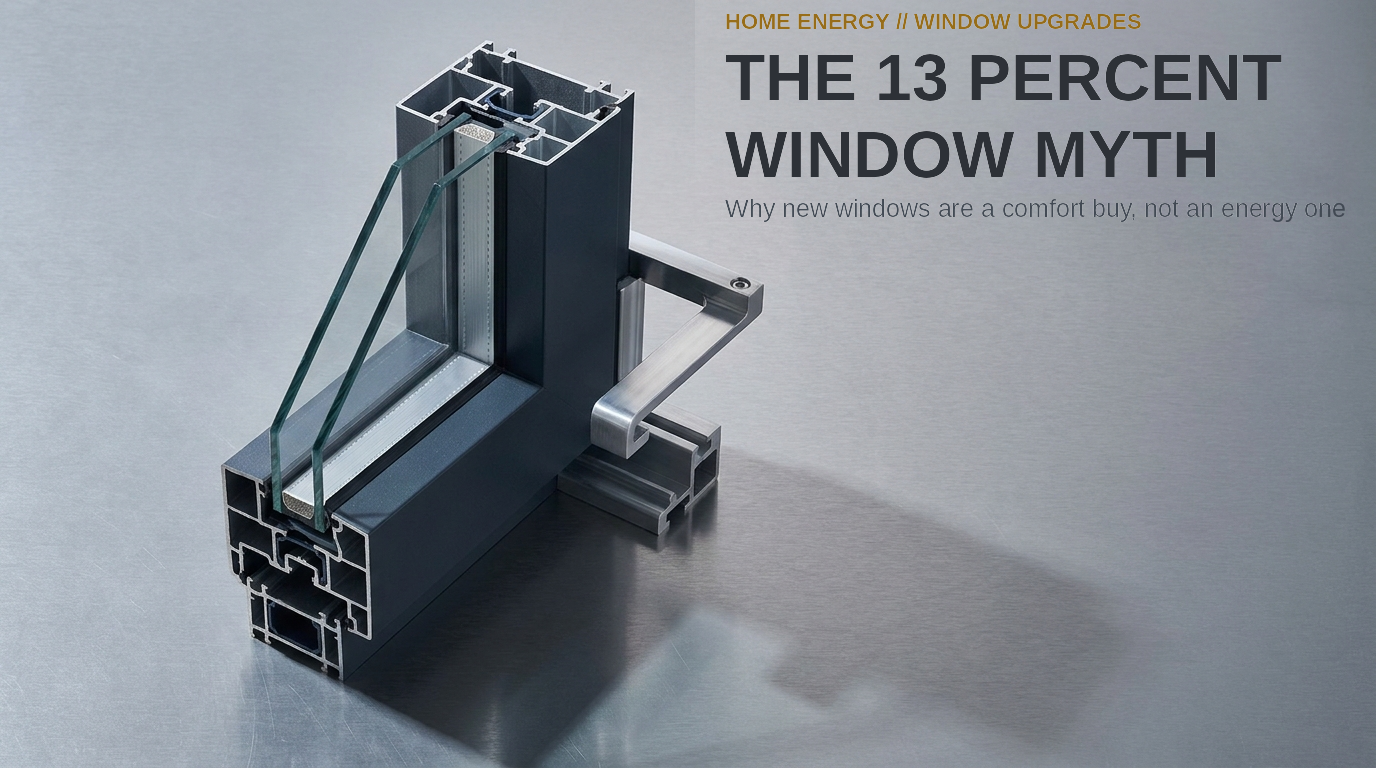
Windows: the 13 percent saving on a replacement label is the best case, not an average. The government states that top rate for swapping out single-pane glass, and counts it against heating and cooling costs rather than the whole bill [1].
The rest of a replacement is a comfort purchase wearing an energy number.
The big picture:
Makers sell windows with an energy figure. Owners buy them for comfort that the figure cannot describe.
Heating and air conditioning make up 52 percent of the power a US home uses in a year [2]. So a saving on heating and cooling lands on about half the bill before anyone fits a pane.
My read: a 13 percent cut to that slice works out near a 7 percent drop in total home energy. That is only in the house where the old glass was the worst on the market.
The fixture on the other side of the decision outlives most mortgages. Listed lifespans run 15 to 20 years for aluminum, 20 to 40 for vinyl and fiberglass, and 30 or more for wood [4].
That gap is the whole problem with a one-year number. A window is bought once and paid for over decades. The claim attached to it is priced on one season of heating and cooling.
So the useful question is not what the glass saves this winter. It is what the house feels like for the next owner.
By the numbers
- 13% — Top savings: the ceiling is “up to 13 percent nationwide when replacing single-pane windows”, and the same page states it a second way, against heating and cooling costs [1].
- Just over half — The target slice: space heating and air conditioning take 52 percent of a household’s yearly energy use, which is the whole base the saving is measured against [2].
- 17.30¢ — Home power rate: the 2025 average retail price of home electricity, against 13.63¢ across all customers [3].
- 15 to 40 years — Fixture life: aluminum windows 15 to 20 years, vinyl and fiberglass 20 to 40, wood 30 or more, and double-pane units 8 to 20 [4].
What I’d watch:
The reasons people sign show up nowhere in the payback math.
- The summer heat: a standard double-pane window lets in about 75 percent of the sun’s heat. That turns a west-facing room hot while the thermostat reads normal [1].
- The sun damage: coatings on certified glass cut sun fading by up to 75 percent. That protects floors and couches rather than saving power [1].
- The cold glass: a cold inner pane pulls heat off the body, so a room can feel cold at 70 degrees on the wall [1].
- The visible light: most certified units cut heat gain more than typical glass does, and they do not cut the light. That is the version of the claim a room notices [1].
- The aging houses: Harvard’s Joint Center for Housing Studies counts 145 million US homes. It says far more investment is needed to improve their energy use and storm resilience, against a remodeling market still above $600 billion a year [5].
What strikes me here: buyers sign for comfort and protection, and none of those five drives the official payback math.
The catch:
The advertised 13 percent is not a flat cut to your total power bill, and the page invites that exact mistake.
Its own two sentences clash on the baseline. One says “household energy bills”; the other says “heating and cooling costs” [1]. On the narrower reading the cash return shrinks fast.
I could be wrong, but a payback built from these figures alone is a trap. They are programme estimates rather than measured field results. The label has been on the market since March 1998, long enough for the top of the range to move [1].
No source in this set publishes a price to fit a window. Without that cost, no honest payback period can be worked out.
A window is replaced roughly once in the life of a house, with listed lives that stretch to 40 years [4]. The cost per opening for a full replacement is the number I would want answered, and it is published nowhere I can cite.
At a glance
- The Big Shift: The 13 percent saving on replacement windows is a best case, stated for swapping out single-pane glass and applied only to heating and cooling costs [1].
- Why It Matters: Heating and cooling are 52 percent of home energy use [2]. A saving on half the bill yields a much smaller total return, so a 15-to-40-year fixture is bought for comfort and quiet [1][4].
- What I’d Watch:
- The summer heat: standard double-pane windows let in about 75 percent of the sun’s heat, which makes west-facing rooms too hot in July [1].
- The fade protection: special coatings cut sun fading by up to 75 percent, which preserves floors and furniture [1].
- The fitting: even certified glass fails when it is installed poorly, so the fitting matters as much as the unit [1].
- The Catch: the published figures clash on whether the 13 percent applies to the whole bill or only to climate control, and no window price is published, so an honest payback period cannot be worked out.
Related reading
- Borrow at 8% to remodel, or let your battery earn on the grid — more on Energy & Efficiency
- California FAIR Plan Premiums Jump 29.1% Oct 15 — more on Energy & Efficiency
- Your Home Backup Battery Is Sized Against the Wrong Number — more on Energy & Efficiency
Sources
[1] ENERGY STAR (U.S. Environmental Protection Agency and Department of Energy programme), “Residential Windows, Doors, & Skylights.” https://www.energystar.gov/products/res_windows_doors_skylights [2] U.S. Energy Information Administration, “Use of energy in homes” (2020 end-use data; page updated December 18, 2023). https://www.eia.gov/energyexplained/use-of-energy/homes.php [3] U.S. Energy Information Administration, “Prices and factors affecting electricity prices” (2025 annual averages). https://www.eia.gov/energyexplained/electricity/prices-and-factors-affecting-prices.php [4] InterNACHI, “Standard Estimated Life Expectancy Chart for Homes” (Windows section). https://www.nachi.org/life-expectancy.htm [5] Harvard Joint Center for Housing Studies, “Improving America’s Housing 2025.” https://www.jchs.harvard.edu/improving-americas-housing-2025