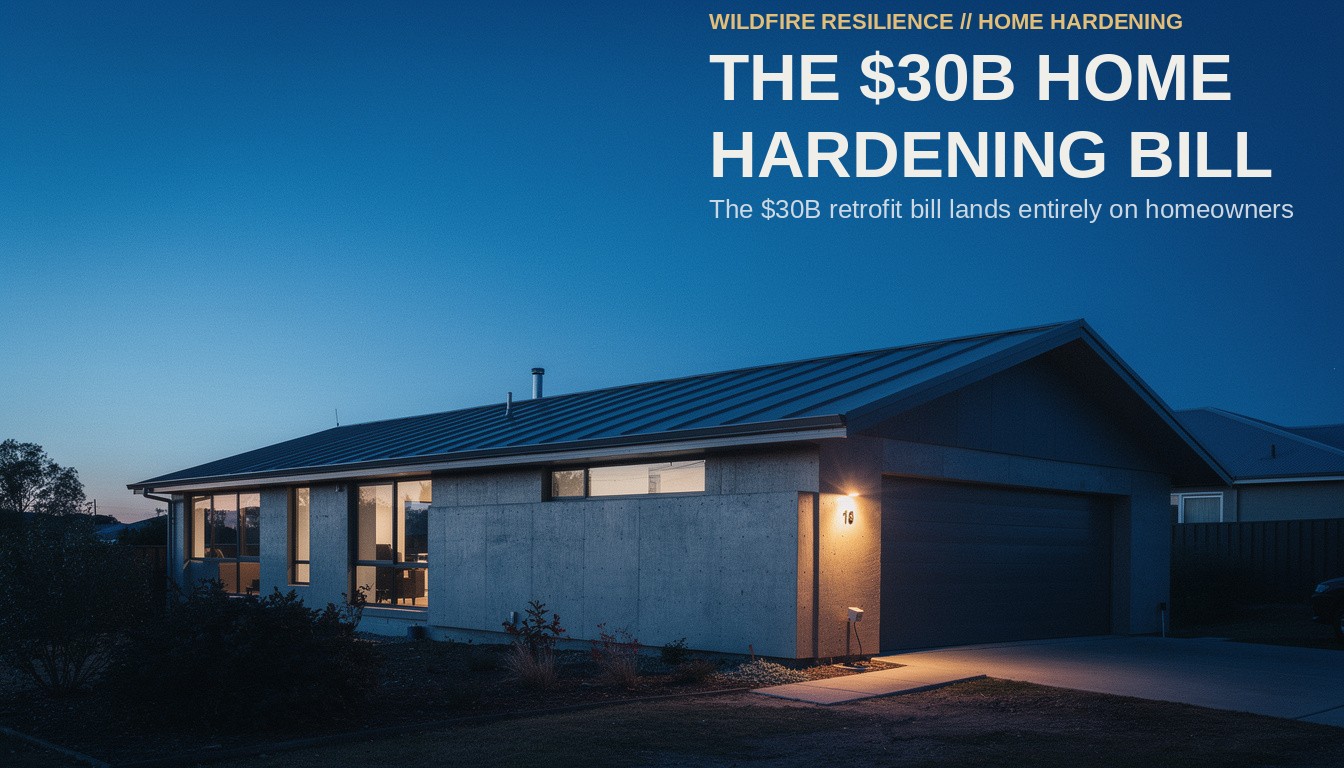
California’s own fire review says home hardening is the lagging half of wildfire risk. Closing that gap will cost $30 billion or more. The state keeps writing better building codes and hazard maps. Those efforts still fail to cut risk on the ground. The missing piece is the house itself. The grant meant to pay for these upgrades is practically empty, so your block’s hardening bill lands on individual owners.
The big picture:
Gov. Gavin Newsom hired the Fire Safety Research Institute (FSRI) to study the January 2025 fires. Their 723-page report is not about brush clearing. Embers, flames, and heat jumping from building to building played a “substantial role” in spreading the Palisades and Eaton fires [1][3].
Retrofits to homes trailed far behind the brush work around them. The report is blunt: no single owner’s retrofit could guarantee a house would survive. Survival was also “strongly influenced by surrounding conditions, neighborhood-scale exposure pathways, and defensive actions” [3].
The fix is real, and the effort is shared. The part I keep circling: the money is neither.
California’s Safe Homes grant, Assembly Bill (AB) 888, is law. Signed in October 2025, it covers a fire-rated roof and the critical five feet nearest the walls.
It also has no sign-up page. The $3 million set aside so far pays to build the program, not to pay grants. A grant tracker that cites an urban-policy group calls it setup money [4].
The federal tap is shut too. The Federal Emergency Management Agency (FEMA) closed its latest Building Resilient Infrastructure and Communities (BRIC) grant round on July 23. A billion dollars was on the table, but the agency has named no winners yet [6].
Sonoma County’s fire office read the same signals. It stopped taking applications for federally funded wildfire risk reduction after Sept. 1, once the state told the county that BRIC rollout money would not be awarded [5]. That award never covered work on private homes anyway [5].
The clock is running. On Oct. 14, the state began moving engines, aircraft, and crews into four Southern California counties for the season’s first Santa Ana wind event. Utilities warned that they could cut power to prevent new ignitions, and Los Angeles County told residents to learn their evacuation zones [9][10].
By the numbers
- $30 billion or more — Hardening bill: The California Earthquake Authority (CEA) estimate to harden every at-risk home in the state, cited by the Terner Center on Oct. 6 [2].
- $3 million — Safe Homes setup: The cash set aside for AB 888 so far. Grant trackers describe it as setup money rather than grant money, and the sign-up page remains closed [4].
- 40% — Grant funding source: The slice of premium taxes insurers pay that funds AB 888, measured above a 2023 baseline. It is a variable stream, not a fixed budget line [2].
- 85% — Expected loss growth: Climate change pushes the state’s yearly wildfire losses on owner-occupied homes 85% higher by 2047, reaching about $5 billion a year [2].
What I’d watch:
I keep circling where the available money is going, because it is not going to the house.
- The excluded line item: Sonoma County’s federal award pays for roadside brush work, shaded fuel breaks, and prescribed grazing. Its own page lists work on private homes as ineligible [5]. The half of the risk the state’s report calls lagging is the half the federal grant cannot buy.
- The closed sign-up page: The Safe Homes grant is the single program built for that gap. Right now, it has no page, no waitlist, no published grant size, and a tiny budget a grant tracker calls setup money [4].
- The open round: FEMA is scoring BRIC bids right now. Even if a county project wins, one county fire office has already been told by the state that its BRIC rollout money will not be awarded [5][6].
- The five-foot rule: The Board of Forestry adopted ember-zone rules on Aug. 19. The Board’s own page still says the review continues [7]; the state’s Office of Administrative Law (OAL) logs the package as pulled back on Sept. 8, and no refile sits in its queue [8]. With no filing, there is no state deadline and no ticking clock [11].
- The local tax route: Where a district already taxes itself for fire work, money exists today. Marin’s Measure C pays for countywide grants and inspections through a joint-powers agency [2].
The catch
My read is that two things get blended together here, and the mix is costly.
One is a safety standard. The other is a price cut. Insurance Business reported in August that the ember rule and the carrier discount are separate tools. Insurers check against their own filings, so meeting a five-foot standard does not by itself cut a premium [13].
Research the Terner Center cites found California’s discounts were applied unevenly and were too small to matter [2].
Two caveats sit on top. The FSRI report is a set of recommendations from a state-funded research group, not a regulation [3]. And $30 billion is a state total across every at-risk home, not a quote for your driveway.
Even the per-house figure sparks debate. The state’s own analysis pegs the work at about $960. A field group says the average runs past $2,500 [12].
At a glance
- The Big Shift: A post-fire review ordered by Gov. Newsom names home hardening as the lagging piece of wildfire risk. Four days later, Berkeley researchers priced the statewide fix at $30 billion or more.
- Why It Matters: The AB 888 Safe Homes grant built to pay for that work has a $3 million setup budget and no open sign-ups. The federal grant round that funded county risk reduction closed with no winners named, leaving the cost on homeowners.
- What I’d watch: The signals showing whether this stays a private purchase, and why each one matters.
- The Safe Homes page: When sign-ups open, the per-home cap, and the list of eligible work. This is the only state channel aimed at the house itself.
- FEMA’s BRIC picks: Whether the states and counties that applied get paid after the July 23 close, since that money funds neighborhood-scale work rather than one roof.
- A Board of Forestry refiling: A new OAL file number would restart the clock on the five-foot ember zone. Until then, no California homeowner has a state deadline.
- The Catch: The state report is just advice, the $30 billion is a statewide total rather than a per-house price, and a finished retrofit buys resilience rather than a guaranteed discount.
Related reading
- California Legalizes Plug-In Home Solar Panels — more on Energy & Efficiency
- Remodel That Pays You Back Isn’t the One You Want — more on Energy & Efficiency
- Borrow at 8% to remodel, or let your battery earn on the grid — more on Energy & Efficiency
Sources
[1] UL Research Institutes’ Fire Safety Research Institute, “Southern California Fires Incident Analysis Report Released,” Oct. 2, 2026 — https://fsri.org/research-update/southern-california-fires-incident-analysis-report-released [2] Terner Center for Housing Innovation, UC Berkeley, “Stabilizing Home Insurance and Enhancing Wildfire Resilience for Existing California Homes,” Oct. 6, 2026 — https://ternercenter.berkeley.edu/blog/stabilizing-home-insurance-and-enhancing-wildfire-resilience-for-existing-california-homes [3] CalMatters, “No single failure caused LA fires, report finds. Who fixes the system?,” Oct. 2, 2026 — https://calmatters.org/environment/wildfires/2026/10/palisades-eaton-fires-report-failure-newsom [4] Ready Fire One grant tracker, “AB 888 California Safe Homes Grant,” status checked Oct. 16, 2026 — https://readyfireone.com/grants/programs/ab-888-safe-homes [5] Permit Sonoma, “Hazardous Fuels Reduction Project,” project update 2026, checked Oct. 16, 2026 — https://permitsonoma.org/divisions/firepreventionandhazmat/socoadapts/hazardousfuelsreductionproject [6] U.S. Federal Emergency Management Agency, “Building Resilient Infrastructure and Communities,” FY2024/25 funding status, checked Oct. 16, 2026 — https://www.fema.gov/grants/mitigation/learn/building-resilient-infrastructure-communities [7] California Board of Forestry and Fire Protection, “Defensible Space Zones — 0, 1, and 2,” checked Oct. 16, 2026 — https://bof.fire.ca.gov/projects-and-programs/defensible-space-zones-0-1-and-2 [8] California Office of Administrative Law, “Recent Actions Taken On Emergency Regulations,” file 2026-0828-03E logged as withdrawn Sept. 8, 2026 — https://oal.ca.gov/emergency_regulations/recent_actions_taken_on_emergency_regulations [9] Office of Governor Gavin Newsom, “Governor Newsom directs early, proactive steps … ahead of dangerous Santa Ana winds and Red Flag Warnings,” Oct. 14, 2026 — https://www.gov.ca.gov/2026/10/14/governor-newsom-directs-early-proactive-steps-to-protect-california-communities-and-strengthen-local-fire-response-ahead-of-dangerous-santa-ana-winds-and-red-flag-warnings [10] County of Los Angeles, “Public Safety Agencies Urge Residents to Prepare for High Winds, Significant Fire Risk,” Oct. 14, 2026 — https://content.govdelivery.com/accounts/CALACOUNTY/bulletins/42f1288 [11] FlyCRE, “California Zone 0 Rules, Where They Stand in October 2026,” Oct. 13, 2026 — https://www.flycre.com/blog/zone-0-california-guide.html [12] Wildfire Los Angeles (MySafe:LA), “Zone 0 Regulations Withdrawn from OAL Review — What Happens Next?,” Sept. 11, 2026 — https://www.wildfirela.org/2026/09/11/zone-0-regulations-withdrawn-from-oal-review-what-happens-next [13] Insurance Business, “California sets first statewide Zone 0 wildfire standard — but compliance does not guarantee a discount,” Aug. 20, 2026 — https://www.insurancebusinessmag.com/us/news/catastrophe/california-sets-first-statewide-zone-0-wildfire-standard–but-compliance-does-not-guarantee-a-disco-586877.aspx