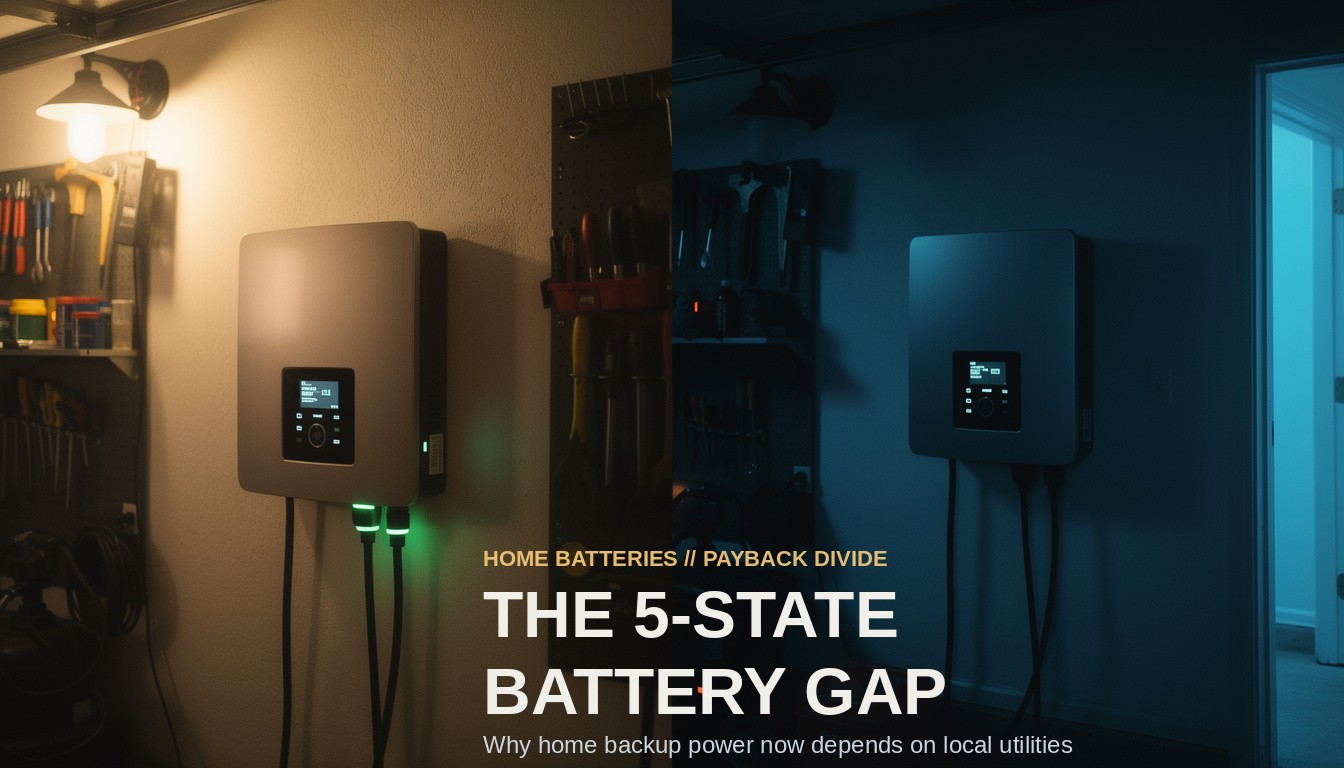
Two-thirds of U.S. homeowners lost power in 2026. The average home went dark three times, and the last outage ran five and a half hours. In the same month, the storage industry’s own report said the home battery market will shrink 4% this year. It also said five states take 88% of all installs. The fear is everywhere. The money is not. [1] [2]
The big picture:
The home battery is no longer a simple way to cut your monthly bill. Its two halves are now priced in different places.
Demand spans the whole country. A Talker Research poll of 2,000 homeowners, paid for by the battery seller Sunrun, found that 47% name backup power as the single upgrade that would make them feel most secure. That was the top answer. It beat the next choice by 18 points. [1]
Nearly half of the homes that lost power had already changed something. On readiness, owners graded themselves 6.6 out of 10. [1]
The dark hours cost real things. Of the homes that lost power, 57% lost heating or cooling. Another 48% threw out food, and 44% lost internet or cell service. Nearly a third slept somewhere else. [1]
About 28% of homes run medical gear on the grid. Of those, 39% keep medication cold, 36% use a CPAP (a sleep apnea breathing machine), and 30% run oxygen equipment. [1]
The cash to stop this stays local. Crews put in 676 megawatts of home storage in the second quarter of 2026, the fourth-biggest quarter on record. That was down 15% from the first quarter and up 3% from a year earlier. Five markets took 88% of those batteries: California, Texas, Puerto Rico, Arizona and Illinois. Every one of them fell from the prior quarter. [2]
My read: the math changed when the federal tax credit ran out on December 31, 2025. That perk covered 30% of a project, up to $2,000. Its loss is what drives the expected 4% drop. [2] [4]
To fill the gap, utilities are stepping in as the buyer of last resort. They are building virtual power plants (VPPs) — fleets of home batteries that a utility pays to draw from when grid demand spikes. [2]
By the numbers
- 66% — Outage rate: two-thirds of U.S. homeowners lost power in 2026, averaging three outages per home, the last one lasting 5.5 hours [1].
- 88% — Top market share: California, Texas, Puerto Rico, Arizona and Illinois claimed 88% of all home storage installed in the second quarter, and all five fell from the first [2].
- 46% — Battery attach rate: the share of new solar systems paired with storage rose to 46%, from 41% a year earlier [2].
- $500 to $300 — Cut utility check: SMUD (the Sacramento Municipal Utility District) dropped its battery buy-down to $300 per kilowatt-hour; a 13.5 kilowatt-hour Powerwall’s check fell from $5,400 to $3,240 [3].
What I’d watch:
I’ve been watching three metrics that decide whether a battery is a real asset or an expensive wall piece.
- The buy-down floor: utilities are cutting their upfront cash deals. SMUD dropped its sign-up check by 40% and set a deadline: owners had to file grid hookup forms by September 22 and enroll by December 31, 2026 to hold the old rate [3].
- The utility’s bid: VPP payouts are the newest path to payback, and the report calls them the growth channel. The catch is that a VPP pays a household to drain the battery for the grid, not to save power for its own outage. SMUD keeps a 20% reserve in the battery for that [2] [3].
- The attach rate: nearly half of all new solar arrays now ship with a battery. Owners are voting for storage wherever the local backup math holds up [2].
The catch
Two identical battery setups now offer completely different paybacks based on where they sit.
A home in one of the five big markets buys a battery with a working local cash perk and a utility ready to buy its power. A home in the next state over buys the same box at the same price, with no program to help pay it off.
One detail I keep circling is the source of the outage data. Sunrun, a large solar and battery seller, paid for the homeowner poll. The methods are public, so I read the results for the broad trend rather than the exact decimals. [1]
The industry does not expect the slump to last. Forecasters think the home market will bounce back and grow about 9% a year between 2027 and 2031. [2]
Utility-scale battery prices also fell 2%, to $916 per kilowatt. The raw parts keep getting cheaper. What I want to see next is whether cheaper parts close the gap left by fading utility payouts. [2]
At a glance
- The Big Shift: Two-thirds of U.S. homeowners lost power in 2026, yet home battery sales are shrinking because five states claim 88% of all installs.
- Why It Matters: The federal tax credit ran out in 2025, leaving utilities to fund the difference. Your chance to pay off a home battery now depends fully on your local grid’s cash programs.
- What I’d Watch: the shifting utility deals and how often solar is sold with storage attached.
- VPP payments: money a utility pays a home for pulling power from its battery during peak grid events.
- Enrollment incentives: a one-time utility cash check to help cover the upfront hardware cost.
- Attachment rate: the share of new solar systems sold with a battery included.
- The Catch: The outage poll was paid for by a battery seller, and local utility rate cuts are already shrinking the available cash payouts.
Related reading
- Borrow at 8% to remodel, or let your battery earn on the grid — more on Energy & Efficiency
- Your EV Is Now a Home Battery — more on Energy & Efficiency
- Your Home Backup Battery Is Sized Against the Wrong Number — more on Energy & Efficiency
Sources
[1] Sunrun Inc. — “Two-Thirds of American Homeowners Have Experienced a Power Outage This Year” (Talker Research survey of 2,000 homeowners, fielded Aug 18–24, 2026) (https://investors.sunrun.com/news-events/press-releases/detail/380/two-thirds-of-american-homeowners-have-experienced-a-power) [2] American Clean Power and Wood Mackenzie — “U.S. Energy Storage Market Posts Record 18.9 GWh in Q2 as Longer-Duration Systems Drive Growth” (U.S. Energy Storage Monitor, Q3 2026 edition) (https://cleanpower.org/news/usesm-q3-2026) [3] Sacramento Municipal Utility District — “Battery storage for homeowners: My Energy Optimizer Partner+” (incentive step-down effective Sept 23, 2026) (https://www.smud.org/Going-Green/Battery-storage/Homeowner) [4] Rewiring America — “25C Heat Pump Federal Tax Credits” (credit expired Dec 31, 2025) (https://homes.rewiringamerica.org/federal-incentives/25c-heat-pump-tax-credits)