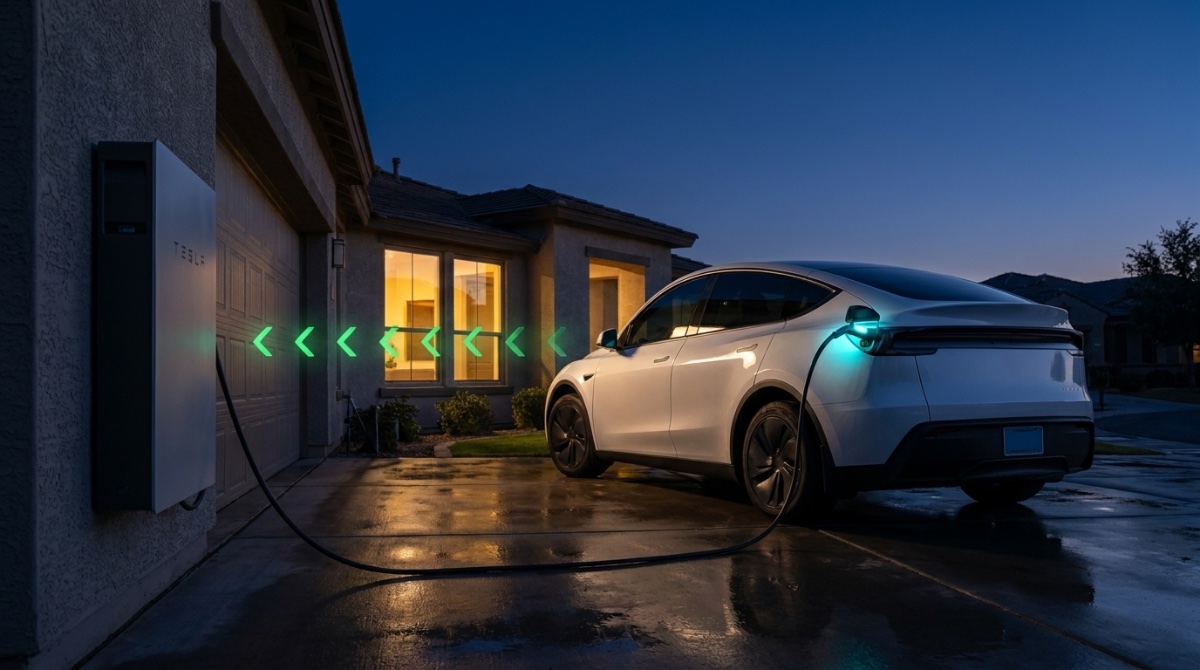
Tesla just turned its two best-selling cars into backup batteries for your house.
The Model 3 and Model Y can now power a home without the costly wall charger that every other system requires [1][3]. The change covers cars ordered in the United States after Oct. 1, 2026, turning the electric vehicle (EV) in millions of driveways into a backup battery [1].
The barrier sits a few feet away in the garage. To send that power into a home, owners must buy a Tesla Powerwall 3, a home battery that costs $8,200 before installation [3].
The big picture:
The cheapest new home grid capacity is already parked in the driveway, but a wall battery acts as the gatekeeper.
Power bills are climbing fast, and the grid is struggling to keep up. The average U.S. home price for power hit 18.44 cents per kilowatt-hour in May 2026, a 6.2% jump from a year earlier [6]. Utilities asked for more than $18 billion in rate increases this year. Diesel hit an all-time high in late September [5][4].
At the same time, California has 22 gigawatts of clean energy and batteries stuck behind transmission lines it has not built [7]. I have been watching the home-energy market all year. This is the first time a giant hardware fix and a glaring grid problem have landed in the same month.
Tesla delivered its fix on Oct. 6 [1]. Most vehicle-to-home (V2H) systems need a separate box on the wall, a direct-current (DC) charger that runs $6,500 to $10,000 [3].
Tesla pushed that cost into the car instead. The battery already converts wall power to DC to charge, so it can run the same job in reverse [3].
By the numbers
-
11.5 kilowatts — Home backup draw: The maximum power a Model 3 or Model Y can push into a house, beating several rivals [2].
-
$8,200 — Powerwall 3: The home battery required to make the setup work, before installation costs that can reach five figures [2][3].
-
18.44¢/kWh — U.S. residential price: The national average power cost in May 2026, up 6.2% year over year [6].
-
$18.6 billion — Rate requests: The record amount utilities asked regulators to approve in the first half of 2026 [5].
What I’d watch:
-
The retrofit path: Tesla’s service notes detail a draft process to upgrade older Model Y cars to the new hardware [2]. I want to see if Tesla offers that upgrade to current owners, or keeps it locked to the factory.
-
Older Powerwalls: The new feature only works with the Powerwall 3 today [2]. Tesla says support for older models is coming soon, but until then, early buyers are locked out [2].
-
Utility programs: Pacific Gas & Electric (PG&E) is testing home backup with Tesla’s system [3]. The utility says the $10,000 to $15,000 cost of standard DC setups keeps many customers out [3].
-
The grid question: Only California and Maryland let homes send power back to the wider grid outside pilot programs [3]. Tesla has not turned on grid export for these cars yet, so for now the car only backs up the house [3].
The catch
This system is a perk for people who already bought a home battery, not a cheap shortcut to get one.
The car does not replace the Powerwall 3. It acts as a backup to the backup [2]. During a blackout, the home battery drains first. The car then refills it while keeping the house running [2]. That design keeps the car from being tied to the house for days.
But the price of entry remains steep. The extra days of power only help households that can already afford an $8,200 battery plus installation. My read on this gap: the homes most squeezed by rising power bills are the least likely to own the battery required to unlock the car.
The potential scale remains massive. One study found California could meet a third of its grid storage goals by enrolling just 10% of its EVs [8]. That is the promise. Right now, it sits behind a paywall.
At a glance
-
The Big Shift: Tesla enabled the Model 3 and Model Y to power a home by moving the power conversion inside the car, skipping the pricey wall charger [1][3].
-
Why It Matters: Household power prices jumped 6.2% year over year as utilities seek record rate hikes, so home backup is worth more. But the feature only works if the household already owns an $8,200 Powerwall 3 [3][6].
-
What I’d Watch:
-
The retrofit: Whether Tesla lets current owners upgrade older Model 3 and Model Y cars to the new hardware [2].
-
Older Powerwalls: When Tesla rolls out support for earlier models, opening the feature to past battery buyers [2].
-
Grid rules: Whether more states beyond California and Maryland let homes send power back to the wider grid [3].
-
The Catch: The car backs up the home battery rather than replacing it, so the real price of entry is still the $8,200 wall battery plus installation [2][3].
Related reading
-
Borrow at 8% to remodel, or let your battery earn on the grid — more on Energy & Efficiency
-
California Legalizes Plug-In Home Solar Panels — more on Energy & Efficiency
-
Heat Pumps Just Got Cheaper to Run — more on Energy & Efficiency
Sources
[1] https://www.tesla.com/powershare [2] https://www.caranddriver.com/news/a74078638/tesla-model-3-model-y-powershare-home-backup-v2h [3] https://www.canarymedia.com/articles/electric-vehicles/tesla-evs-as-home-battery [4] https://www.canarymedia.com/articles/affordability/why-energy-bills-are-going-up [5] https://powerlines.org/utilities-request-18-6-billion-in-rate-increases-in-first-half-of-2026/ [6] https://www.eia.gov/electricity/monthly/update/end-use.php [7] https://www.canarymedia.com/articles/transmission/california-amps-grid-upgrades [8] https://pv-magazine-usa.com/2026/08/18/enrolling-10-of-california-evs-in-vehicle-to-grid-programs-by-2036-could-deliver-a-third-of-the-states-energy-storage-goals/