The choice at the hardware store follows directly from this flaw. Buy the pin meter for bare wood, and pick up the pinless meter for a painted wall where holes are not welcome. Skip the two-in-one model, since it costs more than the pair and adds no new scale.
| Product | Price (2026-10-25) | What the listing says |
|---|---|---|
| Klein ET140 pinless moisture meter | $49.97 | 3/4-inch (1.9 cm) reading depth, nine-bar screen, tuned for four materials only [1][4] |
| Klein ET150 pin moisture meter | $34.98 | 8 mm pins you can change, 3/8-inch (1 cm) depth, wood to plus or minus 2% [2][5] |
| Triplett MS150 pin and pinless meter | $109.99 | both sensors, pin mode 1.5 to 33% in building materials, pinless 6 to 99.9% relative [3] |
The big picture:
My read starts with how these tools work, because retail prices mean little until we know what each one measures.
A pin meter pushes current through the wall and reads the resistance, so it only sees the path between its two metal probes [6]. A pinless meter sends out a wave and reads what bounces back from the space under its pad, which is why makers list its deep range [4]. Neither tool is tuned for drywall the way it is tuned for wood.
The field write-up puts it plainly: pinless meters work best on the material they were designed for, wood, and on anything thinner than three-quarters of an inch the user has to know what sits behind it [6]. Klein’s own data sheet agrees, listing the ET140 as calibrated for drywall, masonry, hardwood and softwood, and nothing else [4].
By the numbers
- $84.95 — The pair against the two-in-one: The two separate Klein tools cost $84.95 together, while the Triplett carrying both sensors lists at $109.99, leaving the single-body version with a $25.04 markup [1][2][3].
- 0.5% — The safe line for drywall: Wallboard holding up to about 0.5% moisture content by weight is fine, 0.5% to 1% is a warning zone, and anything over 1% is a fail [6].
- 0.0 to 8.5% — A true drywall scale: This narrow range ties to the American Society for Testing and Materials (ASTM) standard C1789, and none of the three meters in this table carries it [7].
- 1 to 100 — The relative scale: The reference scale only ranks wetness from low to high, meaning its numbers are useless unless checked next to a dry patch of the exact same wall [6].
What I’d watch:
What strikes me here is that three specific limits change the buying choice, and none of them involve the price tag.
- Depth against the wall backing: The pad reaches 0.75 inches and the pins reach 0.38 inches, so the pad looks roughly twice as deep [4][5]. On a bare stud wall that depth finds water sitting in the gap, but on a finished wall the wave picks up hidden steel edges or foil instead [6]. One pro maker sells a dual-depth pinless tool with a shallow 9 mm setting to cut that noise, but cheap tools lack this switch [7].
- A real percentage against a basic index: The ET150’s accuracy line reads “Wood: ± 2%, Drywall & Masonry: Relative Readings”, and its drywall range is printed as a relative-humidity scale, 0% to 100%, rather than a moisture content [5]. The ET140 claims plus or minus 4% across a simple 0 to 100 scale [4]. The number on a painted wall just marks a spot on a basic scale, so only the wood mode gives a hard fact.
- One body against two: The Triplett holds both sensors, and its pin side prints the widest range of the three, spanning 1.5 to 33% in building materials against 5 to 50% in wood [3]. It still fails to add a true drywall scale. This means the extra cash buys one tool in the hand rather than a better number on the wall.
I keep coming back to what a free baseline check buys instead. Reading a patch of the same wall known to be dry, then checking the suspect spot, is the exact practice the field report describes [6]. Users pair this with repeated checks near the floor, around doors, and at pipe entries where water actually gets in [6].
That baseline costs nothing and does roughly what a tuned scale does, minus a hard rule to test.
The catch
My view is that the honest choice is far narrower than a simple shopping list.
None of these three retail tools will tell a homeowner whether a wall sits at 0.4% or 1.2%, and that is the exact band where a wall that feels dry is either perfectly fine or needs opening. A pro tool with a drywall-tuned pin scale does report that exact water level, making it a completely different class of purchase from a hardware-store toy.
| The situation | What I would buy |
|---|---|
| Framing, subfloor, base plates or firewood | The pin meter, the only one here with a true wood reading and pins you can change |
| A painted wall, a stain, and no wish to cut holes | The pinless meter, swept against a known-dry patch, then checked with pins at the bad spot |
| Both jobs in one day, one tool in the bag | The two-in-one, accepting it costs more than the pair and adds no scale |
| A wall already open, or a claim being filed | Neither. A meter with a drywall scale, because the number has to survive a conversation with an adjuster |
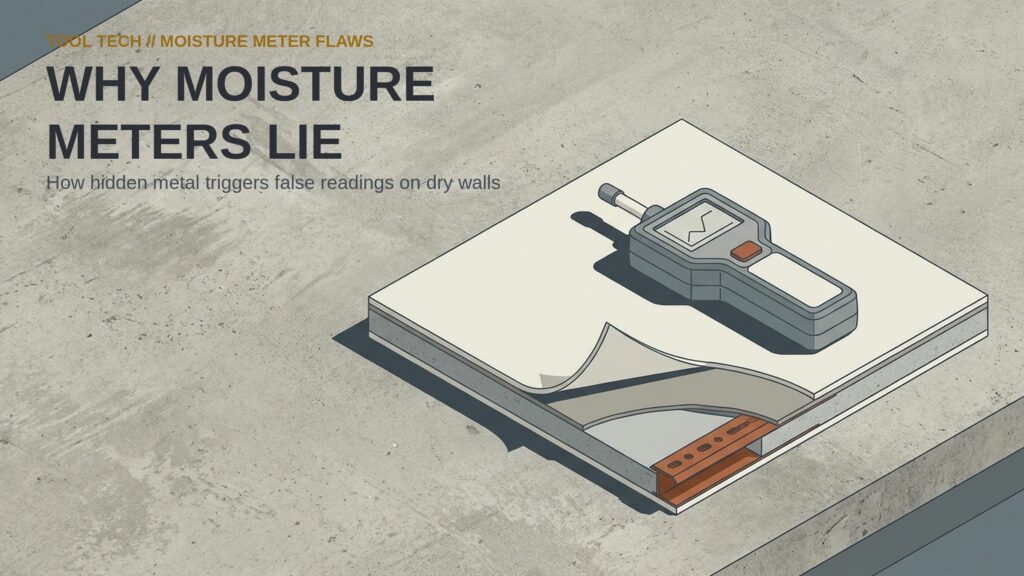
The trap is shared by all three tools. Metal inside the wall easily throws off a pinless reading, which is exactly how a corner with a steel edge screams while the board behind it stays bone dry [6]. A pin reading, meanwhile, leaves two holes in the finished paint [6]. The cheap fix is the same for every tool here: a dry baseline, and a pattern of readings rather than one dramatic number.
This review draws from four makers’ spec sheets, one building expert’s field report, and three store price pages. I did not handle the tools for this report and read no physical walls. For the final choice underneath, whether the wall repair or the tool is the better spend this season, the desk’s ownership cost model prices the whole job, and the home diagnostics hub carries the rest of the beat.
At a glance
- The Big Shift: A cheap moisture meter bought for a painted wall reports a relative index rather than a true percentage, meaning the number on the screen just marks a place on a scale.
- Why It Matters: These hardware-store tools force users to split the job in two, using a pinless sweep to find the wet patch without damage and pins to put a number on it, and buying both separate tools costs less than the two-in-one model.
- What I’d Watch: How each reading was taken, and what sat behind the surface.
- Baseline reading: A patch of the same wall known to be dry, taken before scanning any bad area.
- Sensing depth: 0.75 inches on the pad against 0.38 inches on the pins, which decides exactly what the wave reaches.
- Wall backing: Hidden steel edges, metal studs, and foil backing all distort a pinless reading.
- The Catch: None of the three retail tools carries a true drywall scale, so a high reading is just a sign to look closer, never a hard water level to quote.
Related reading
- Hidden Lien Clock Behind Your Remodel Payments — more on Tools & Equipment
Sources
- Haus of Tools — Klein Tools ET140 Pinless Moisture Meter (price and feature list): https://hausoftools.com/products/klein-tools-et140-pinless-moisture-meter
- Haus of Tools — Klein Tools ET150 Pin Moisture Meter (price and feature list): https://hausoftools.com/products/klein-tools-et150-pin-moisture-meter
- Triplett — MS150 Pin and Pinless Moisture Meter (price and description): https://www.triplett.com/products/ms150-pin-pinless-moisture-meter-with-audible-indicator
- Klein Tools — ET140 Pinless Moisture Meter, specification table: https://www.kleintools.com/catalog/environmental-testers/pinless-moisture-meter
- Klein Tools — ET150 Pin Moisture Meter, specification table: https://www.kleintools.com/catalog/environmental-testers/pin-moisture-meter
- GreenBuildingAdvisor — “Pinless Moisture Meters” by Peter Yost: https://www.greenbuildingadvisor.com/article/pinless-moisture-meters
- Tramex — “What is an acceptable moisture level for drywall?”: https://tramexmeters.com/learn/acceptable-moisture-readings-in-drywall-tramex-meters