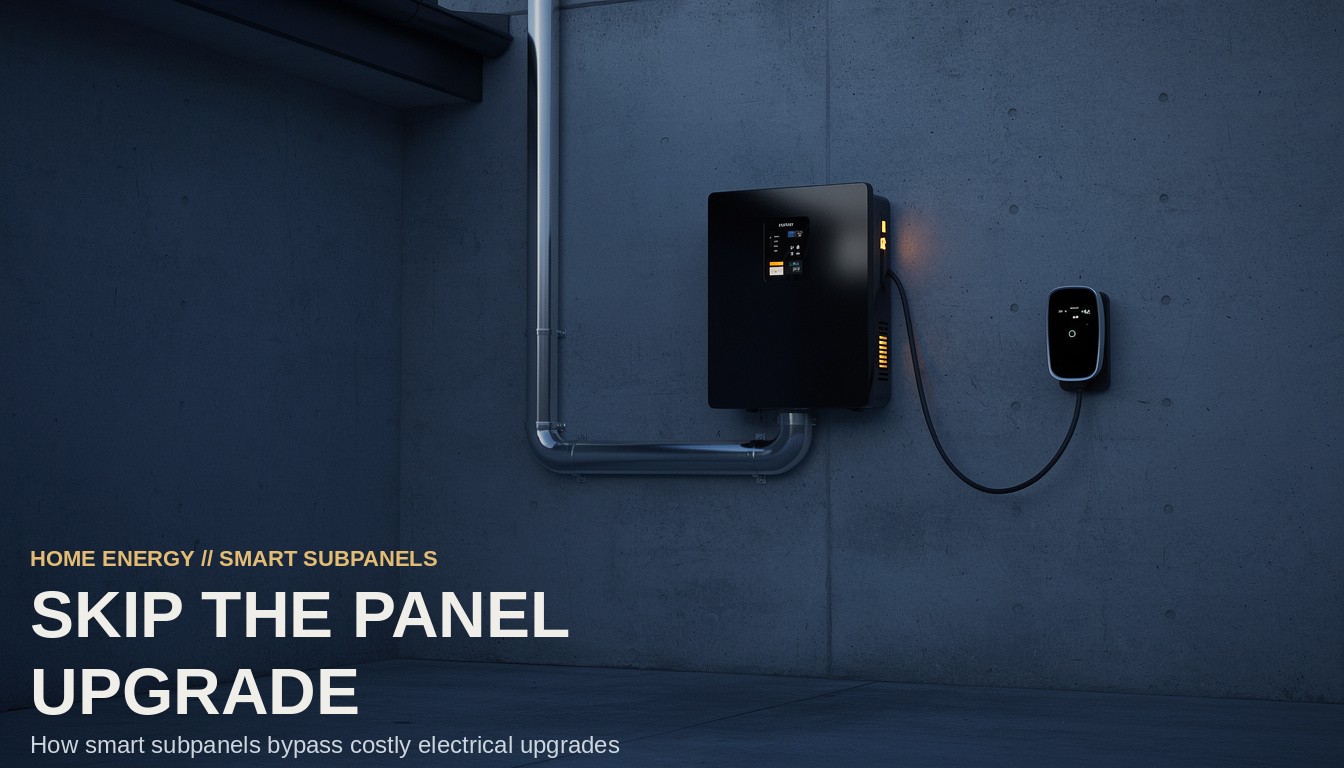
A homeowner recently bypassed a seven-month wait and an $11,200 quote to upgrade a 200-amp panel to 400 amps [6]. They installed a $4,200 smart subpanel instead [6]. The gap between those two numbers is not a discount. It is the difference between sizing a house on the worst case and sizing it on the 80 percent line. That line is what the code sets, and an owner’s own meter can check it.
The big picture:
Every “you need more amps” verdict starts with math, not a physical reading. Electrical codes say a home’s calculated load must stay under about 80 percent of the panel’s rating [1]. Cross that line, and the standard answer is a bigger service.
This math assumes the worst-case scenario. The dryer, range, air conditioner, and car charger all count as if they run at the exact same moment. Codes work this way to prevent fires. Yet this same math decides who pays $8,000 to $10,000 for a new panel and who skips the upgrade.
The load most owners add today is smaller than the fear suggests. A typical 240-volt home charger, wired to its own circuit, pulls 30 amps and delivers 7.2 kilowatts (kW) [2]. Against a 200-amp service, that is a rounding error on paper and mostly a scheduling problem in practice.
I keep coming back to how much of this decision is paperwork. The device manages the power. The calculation dictates whether you are allowed to buy it.
By the numbers
- 80% — The upgrade line: A home’s calculated load has to stay under about 80 percent of its panel capacity, or the standard answer becomes a service upgrade [1].
- $8,000 to $10,000 — Smart panel swap: That is the all-in price of fitting a new smart panel, compared to roughly $1,000 per controlled circuit for load management on your existing panel [1].
- 7.2 kW — Typical charger load: A standard Level 2 home unit runs 30 amps on a 40-amp circuit, while the broader class spans 2.9 to 19.2 kW [2].
- $199.99 — The reading cost: A mains-plus-16-branch monitor bundle lists at $199.99, sampling 24,000 times a second at plus or minus 2 percent accuracy [4].
What I’d watch:
The hardware is not the interesting part. The open question is who holds the number when the electrician’s math and the owner’s meter disagree.
- The existing headroom: Emporia’s own worked example shows a house drawing 80 amps of a 100-amp service, leaving about 20 amps for a car charger [3]. The charger slows down, but it still operates.
- The fixed install rate: Set once on the worst case, a charger is often limited to 24 to 40 amps, or 5.7 to 9.6 kW. A charger tied to a managing panel holds up to 48 amps, or 11.5 kW, easing off when the house needs power [5].
- The listing requirement: I’d watch whether the hardware is a listed energy-management system. Inspectors accept these systems when properly listed and installed, which is what allows a managed load to be discounted in the math [1].
- The smaller services: Homes can go fully electric on services as small as 150 amps once real usage patterns and load management are counted [1]. Upgrades still earn their place when a service is unsafe, worn out, or when big loads genuinely run together daily [1].
What I expect next is a shift in sequencing. A load manager and a meter cost less than a panel quote, and their readings offer the only evidence that is not a worst-case guess.
The catch
The 80 percent figure is a code rule, not a reading of your house. The pages that state it explain the rule, but they do not test homes against it [1]. My read: it is the gate to clear, never proof of what a service can actually carry.
The prices require the same care. The $8,000-to-$10,000 panel figure, the $1,000-per-circuit estimate, and the $780 device price all come from a webinar run by the firm selling the load manager. These are list prices and vendor answers, not market averages [1].
The manager’s job is also narrower than the pitch. It sheds or slows the load you put behind it. That is fine for a charger that fills overnight, but annoying if your peak overlap happens every day.
Two more limits sit in the hardware. A subpanel adds breaker slots, not ampacity — the total amps a service can carry — so it does not make a service bigger [1]. And the meter that sizes the job is a consumer monitor at plus or minus 2 percent, not a utility revenue meter [4]. That is good enough to settle a home decision, but not good enough to argue with a utility.
At a glance
- The Big Shift: A “you need a bigger panel” verdict comes from a worst-case calculation, as codes only require an upgrade when the calculated load crosses about 80 percent of panel capacity [1].
- Why It Matters: The gap is five figures. A smart-panel swap runs about $8,000 to $10,000 fitted, while a load manager that controls the same circuits lists at $780, and a monitor at $199.99 [1][4].
- What I’d Watch: Whether owners bring their own peak reading to the quote talk, or accept the worst case.
- The 80 percent line: The code threshold a load calculation has to clear before an upgrade becomes the standard answer [1].
- The 100-amp example: A house drawing 80 amps of a 100-amp service leaves about 20 amps of room, enough for a charger at a lower rate [3].
- The listing question: Whether the load manager is a listed energy-management system, since that listing is what inspectors accept to discount a managed load [1].
- The Catch: The threshold is code math, not a measured result. The prices are vendor list prices, a subpanel adds slots rather than ampacity, and the sizing monitor is a consumer device [1][4].
Related reading
- Emporia Vue: How to Cut Energy Bills — more on Smart Home & Security
- A Cloud Patch Bricked the Fridge. Local-First Just Stopped… — more on Smart Home & Security
- local-first smart home cost squeeze — more on Smart Home & Security
Sources
[1] GreenHome Institute — “Your Electric Panel, Demystified: Load Management for Home Electrification” (article and transcribed webinar, 1 March 2026) — https://greenhomeinstitute.org/your-electric-panel-demystified-load-management-for-home-electrification [2] U.S. Department of Energy, Alternative Fuels Data Center — “Electric Vehicle Charging Stations” — https://afdc.energy.gov/vehicles/electric_charging.html [3] Emporia Energy — “What Is Load Management? How It Saves You From Expensive Electrical Panel Upgrades” (30 October 2025) — https://www.emporiaenergy.com/blog/what-is-load-management [4] Emporia Energy — “Emporia Vue Energy Monitor” product page — https://www.emporiaenergy.com/energy-monitors [5] SPAN — “SPAN Drive” product page — https://www.span.io/drive [6] Editorial-factory field notes, smart_home_telemetry Anecdote 3 (internal) — context/growth_os/customer-truth.md