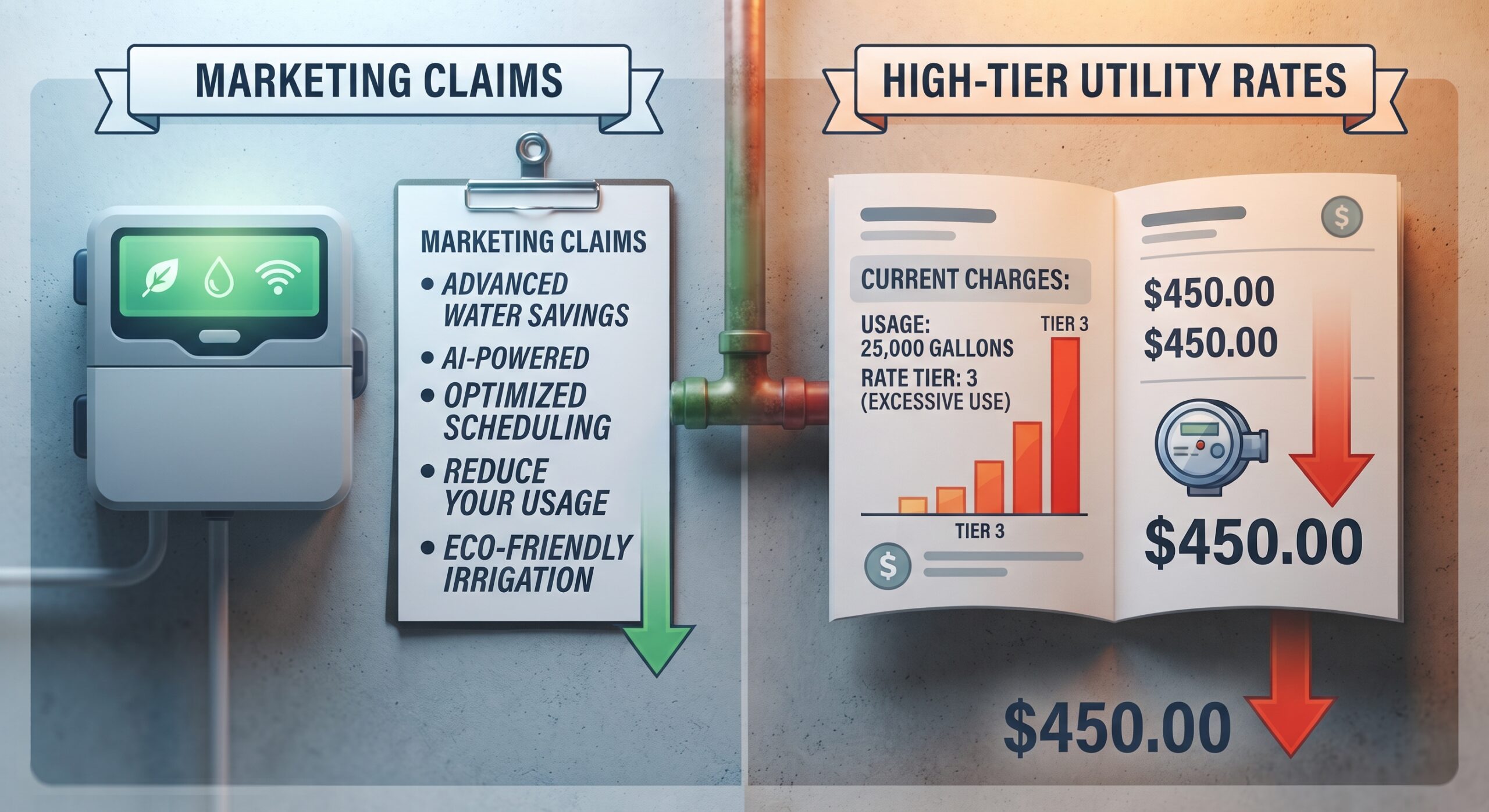
A smart sprinkler box claims to save “up to 15,000 gallons” of water a year [5]. Yet a U.S. Department of Energy (DOE) review shows real-world yard setups save closer to 10%, missing the 40% to 70% goal [1].
The big picture:
The hardware is cheap, but the payback math rests on two missing numbers. The first is your current waste. A standard clock timer runs whether it rains or not, while a smart unit tracks the weather.
Savings only come from the water a smart schedule skips. This means bad yards save a lot, and good yards save a little. Right now, the average U.S. home pours 58,000 gallons a year onto the grass [4].
The part I keep circling is the second number: the price of the next 1,000 gallons. Your local water utility’s top tier sets the true cash value of every saved drop.
By the numbers
- 10% — Realized field savings: The DOE review, citing a University of Florida study, shows smart units need perfect setup to hit their 40% to 70% goal, landing instead at “the realized savings of 10% typical of large pilot projects” [1].
- 38% and 15% — Device types: A Lawrence Berkeley National Laboratory (LBNL) review of 47 papers found 38% savings for soil-moisture units and 15% for weather-based ones [2].
- 17% — Measured field result: Homes in Spanish Fork, Utah, got a free smart unit, pro setup, and a locked schedule. They cut outdoor piped water by 17% on average in 2018 [8].
- $9.58 vs $4.20 — The tier spread: Westminster, Colorado charges $4.20 per 1,000 gallons up to 8,000 gallons for 2026. That rate jumps to $9.58 once you pass 41,000 gallons [9].
What I’d watch:
The pros in this space read their water bills before the spec sheets. What strikes me is how fast the payback shifts when you run the real math.
- The utility test beds: Spanish Fork’s free-unit rollout kept total water demand mostly flat, even as new home hookups grew 4% [8].
- The ceiling estimates: The U.S. Environmental Protection Agency (EPA) pairs its “up to 15,000 gallons” claim with a national guess of $4.5 billion in saved water costs if every home upgraded [5]. Its weather-based page cites “nearly 7,600 gallons” [6].
- The tier multiplier: Westminster, Colorado charges $4.20 per 1,000 gallons up to 8,000 gallons for 2026, a rate that climbs past $9.58 above 41,000, so the same saved gallon is worth more at the top [9]. Hopkins, Minnesota runs a 2026 schedule of $4.56 to $6.02 per 1,000 gallons, with metered lawn irrigation at $5.45 [10].
- The sleeper leaks: The EPA notes that fixing simple house leaks cuts about 10% from a water bill before you even buy a smart box [7].
My read: Payback rests entirely on how much water the yard wastes and what the utility charges at the top tier. I would want the field-study number, not the box label, before counting on a fast return.
The catch:
The savings are tied to human habits.
Lab tests found 50% water savings, while real-world case studies on homes and business yards found just 30% [3]. A smart box left on its base schedule often saves nothing, and some homes end up using more water than before.
The gear also has to make financial sense. A new unit costs a few hundred dollars to buy and install. I keep seeing fast paybacks in dry states with high tiered rates, but the math falls apart where water is cheap.
At a glance
- The Big Shift: Smart sprinklers claim “up to 15,000 gallons” in savings, but the DOE finds large yard programs see about 10% savings against a 40% to 70% goal [1][5].
- Why It Matters: The true payback rests on how much water the yard was wasting and the price of the top water tier, which often costs twice as much as the base rate [3][9].
- What I’d Watch:
- The field number: Whether real savings from utility rollouts keep landing near 10% to 17% rather than the 30% to 50% seen in lab tests [1][3][8].
- The tier placement: Whether a saved gallon is priced at the first water tier or the last, which drives the financial return [9][10].
- The leak leg: Whether leak shutoffs get bundled into the purchase, since fixing easy leaks cuts water bills by 10% on its own [7].
- The Catch: Savings rely entirely on good habits, and the hardware needs a local rebate or a high top-tier water rate to pay back inside a season [1][3].
Related reading
- Heat Pumps Just Got Cheaper to Run — more on Energy & Efficiency
- Heat Pumps Just Got Cheaper to Run — more on Energy & Efficiency
- Borrow at 8% to remodel, or let your battery earn on the grid — more on Energy & Efficiency
Sources
[1] U.S. Department of Energy (FEMP) — “Water-Efficient Technology Opportunity: Advanced Irrigation Controls” (University of Florida study): https://www.energy.gov/cmei/femp/water-efficient-technology-opportunity-advanced-irrigation-controls [2] U.S. Department of Energy (FEMP) — “Advanced Irrigation Controls” (Lawrence Berkeley National Laboratory literature review, 47 references): https://www.energy.gov/cmei/femp/water-efficient-technology-opportunity-advanced-irrigation-controls [3] U.S. Department of Energy (FEMP) — “Advanced Irrigation Controls” (American Society of Agricultural and Biological Engineers review): https://www.energy.gov/cmei/femp/water-efficient-technology-opportunity-advanced-irrigation-controls [4] U.S. Department of Energy (FEMP) — “Advanced Irrigation Controls” (LBNL: average outdoor water use 58,000 gallons per household per year): https://www.energy.gov/cmei/femp/water-efficient-technology-opportunity-advanced-irrigation-controls [5] U.S. Environmental Protection Agency (EPA) WaterSense — “WaterSense Labeled Controllers”: https://www.epa.gov/watersense/watersense-labeled-controllers [6] U.S. Environmental Protection Agency (EPA) WaterSense — “Weather-Based Irrigation Controllers”: https://www.epa.gov/watersense/weather-based-irrigation-controllers [7] U.S. Environmental Protection Agency (EPA) WaterSense — “Fix a Leak Week”: https://www.epa.gov/watersense/fix-leak-week [8] Healthy Green Spaces Coalition — “Free Smart Irrigation Controllers Reduced Outdoor Water Use by 17% in Spanish Fork, Utah”: https://greenspacescoalition.org/spanish-fork-smart-controller-case-study [9] City of Westminster, CO — “Water Rates” (2026 schedule): https://www.westminsterco.gov/317/Water-Rates [10] City of Hopkins, MN — “Water Fees on Your Utility Bill” (2026 rates): https://www.hopkinsmn.com/492/Water-Fees-on-Your-Utility-Bill