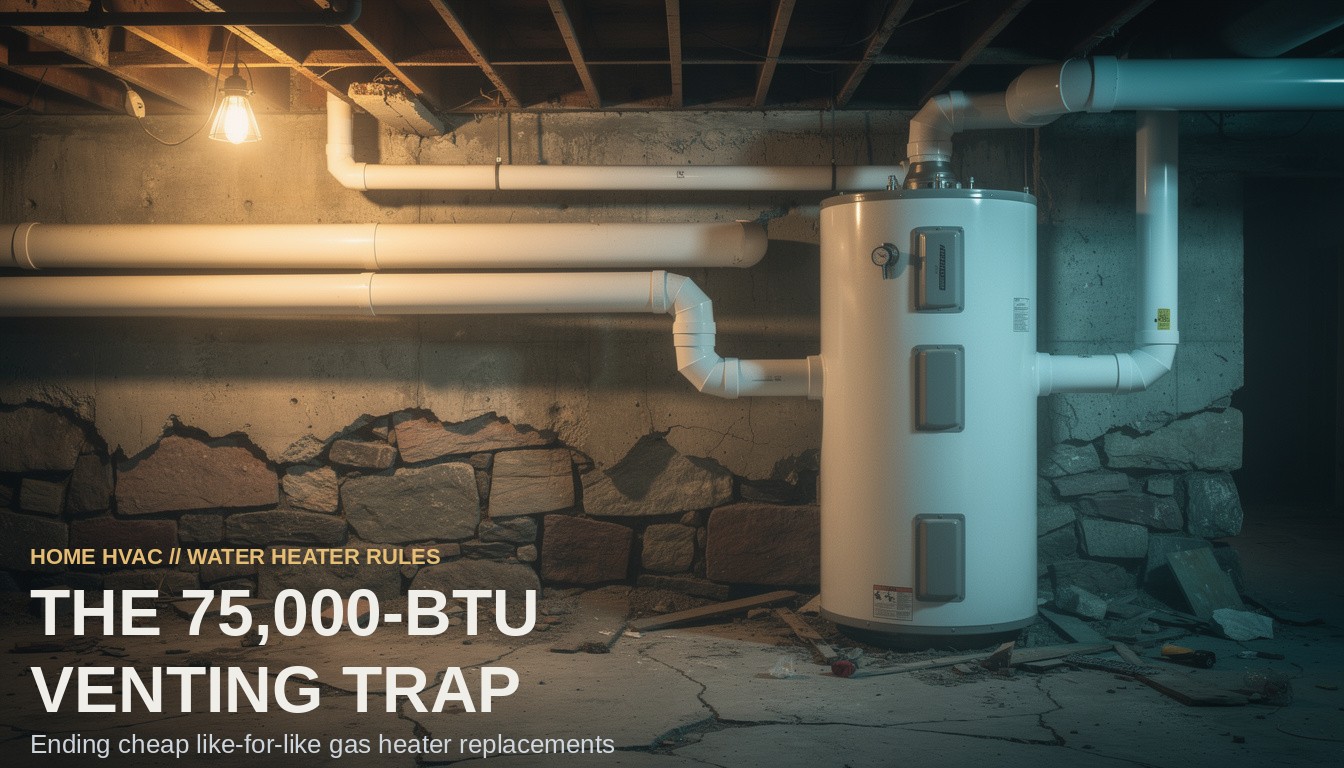
The cheap, like-for-like swap for gas water heaters above 75,000 British thermal units per hour (Btu/hr) ended on October 6. The trap is not the tank’s sticker price.
The efficiency floor for this class jumped from 0.5922 to 0.8622 at 75 gallons [1]. A plain tank cannot hit that mark. The replacement is a condensing unit, and it needs new venting and a drain for the acidic water it makes [5].
The big picture:
The rule is old. The date is new.
The Department of Energy (DOE) set this standard in October 2023 [2]. Any unit built on or after October 6, 2026 must meet it [2]. The rule covers a small, common group: gas storage heaters from 75,000 to 105,000 Btu/hr, with tanks up to 120 gallons [1].
Makers say many of these high-input units heat ordinary homes [5]. Bradford White has stopped making its plain 55, 75 and 100-gallon models [5]. Its plain 50-gallon models stay on sale.
What strikes me here is the gap between the DOE’s cost case and a homeowner’s week. The DOE says the rule saves money over a unit’s life. It also admits the figure is an average that mixes winners and losers [2]. An average says nothing to the owner whose tank dies on a Sunday.
A Harvard Joint Center for Housing Studies paper from October 1 adds the other half [6]. Its subject is the retrofit gap: the owners with the highest bills do the least energy work on their homes.
The split is sharp. Owners earning $150,000 or more did 39.5 percent of the $139.1 billion spent on energy upgrades in 2023 [6]. They were 9.9 percent of the energy-insecure. Owners under $30,000 did 8.9 percent of the spending. They were 25.6 percent of the energy-insecure [6].
Water heaters sit in that squeeze. The average water-heater job ran $1,490 in 2023, for $5.9 billion nationwide [6]. Add a venting project to that job and it lands further out of reach for a tight budget.
By the numbers
- 0.5922 to 0.8622 — Efficiency floor jump: the new level for 75-gallon equipment made after October 6, 2026 [1].
- 75,000 Btu/hr — The class line: above this input rating, a gas storage heater needs condensing gear [5].
- 39.5% vs 9.9% — Spending against exposure: the share of upgrade dollars from owners earning $150,000 or more, against their share of the energy-insecure [6].
- $1,490 — Average water-heater job: the 2023 spend per owner who did the work, across $5.9 billion in total [6].
What I’d watch:
The part I keep circling is the input rating on the quote. A plain 50-gallon tank is still legal to buy and fit. If that size meets the home’s hot water demand, the venting work goes away [5].
- The vent route: a condensing unit cannot share the old metal flue. The installer runs plastic or stainless pipe to a side wall, or relines the chimney [2][5].
- The drain path: these units give off acidic water. It has to drain away or be pumped out, and the DOE counts pumps and neutralisers as install items [2].
- The fallback shapes: tankless with a storage tank, a volume heater, or a boiler with an indirect tank all meet the rule [5]. They move the work. They do not remove it.
- The price hikes: October brought another round of maker increases, mostly 3 to 6 percent [7]. Linesets rose 12.9 percent on average, and one controls maker went as high as 15 percent.
- The delayed swaps: owners under $30,000 put 6.3 percent of income into energy work. Owners at $150,000 or more put in 0.8 percent [6]. That gap means older, cheaper homes wait for a failure.
The catch
The savings are real, and they are slow.
Moving the class from 80 to 95 percent thermal efficiency cuts the fuel needed for heat by about a sixth [5]. Inspectors expect a tank to last 7 to 12 years, so the payback runs in years [9]. And spending on gas heat is forecast to fall 9 percent this winter, which stretches it further [8].
The rule may also move again. The DOE has said it will not seek fines for the thermal-efficiency standards through October 2027 [3]. Gas groups have asked for a 2030 date while the Supreme Court reviews the case [4].
My read: the pause is written around the thermal-efficiency standards, a different paragraph from the efficiency-factor standard for this class [1][3]. That is a reading of two documents, not a legal opinion.
Either way, the build date has passed. Dealers can still sell and fit units made before it. Those plain tanks will thin out on a schedule nobody publishes.
At a glance
- The Big Shift: The efficiency floor for large gas water heaters rose on October 6, so any replacement in that class now uses condensing gear. A plain tank swap has become a venting project.
- Why It Matters: The change lands on a 7-to-12-year asset. The owners least able to fund the upfront work already carry the highest energy bills.
- What I’d Watch: How the new exhaust gets routed, and who puts the job off.
- Input rating: the Btu/hr figure on the old unit decides whether the venting scope applies.
- The 50-gallon route: plain 50-gallon tanks stay legal, so one cheaper path remains open if the load fits.
- The court case: a pending petition and Supreme Court review could push the date back.
- The Catch: The upgrade saves about a sixth of the fuel, so a venting job takes years to repay. The DOE cost case is a national average that hides the individual bill.
Related reading
- Cheap Gas, $20,000 Pipe — more on Energy & Efficiency
- A Smart Sprinkler Pays Back at Your Top Water Tier, Not the… — more on Energy & Efficiency
- California FAIR Plan Premiums Jump 29.1% Oct 15 — more on Energy & Efficiency
Sources
[1] 10 CFR 431.110 — energy conservation standards and effective dates (Table 2, residential-duty commercial water heaters) — https://www.ecfr.gov/current/title-10/chapter-II/subchapter-D/part-431/subpart-G/section-431.110 [2] Federal Register, 88 FR 69686, Energy Conservation Program: Energy Conservation Standards for Commercial Water Heating Equipment (2023-10-06) — https://www.federalregister.gov/documents/2023/10/06/2023-20392/energy-conservation-program-energy-conservation-standards-for-commercial-water-heating-equipment [3] U.S. Department of Energy, Enforcement Policy Statement — Commercial Water Heaters (2026-04-24) — https://www.energy.gov/documents/2026-cwh-enforcement-policypdf [4] Federal Register, 91 FR 22477, Notification of Petition for Rulemaking (2026-04-27) — https://www.federalregister.gov/documents/2026/04/27/2026-08145/energy-conservation-program-notification-of-petition-for-rulemaking [5] Bradford White, DOE commercial water-heater standards transition page — https://www.bradfordwhite.com/doe-landing [6] Wedeen, Bogardus Drew and Hernández, The Retrofit Gap: Disparities in Homeowner Energy Insecurity and Energy-Related Remodeling, Joint Center for Housing Studies, October 2026 — https://www.jchs.harvard.edu/sites/default/files/research/files/Harvard_JCHS_Energy_Insecurity_Wedeen_et_al_2026_1.pdf [7] ACHR News, HVAC Price Increase List: October 2026 (2026-10-07) — https://www.achrnews.com/articles/166764-hvac-price-increase-list-october-2026 [8] U.S. Energy Information Administration, EIA expects a mixed picture for winter fuel costs this year (2026-10-06) — https://www.eia.gov/pressroom/releases/press593.php [9] InterNACHI, Standard Estimated Life Expectancy Chart for Homes — https://www.trademarkinspectionservices.com/wp-content/uploads/2022/06/Life-Expectancy-Chart.pdf