The big picture:
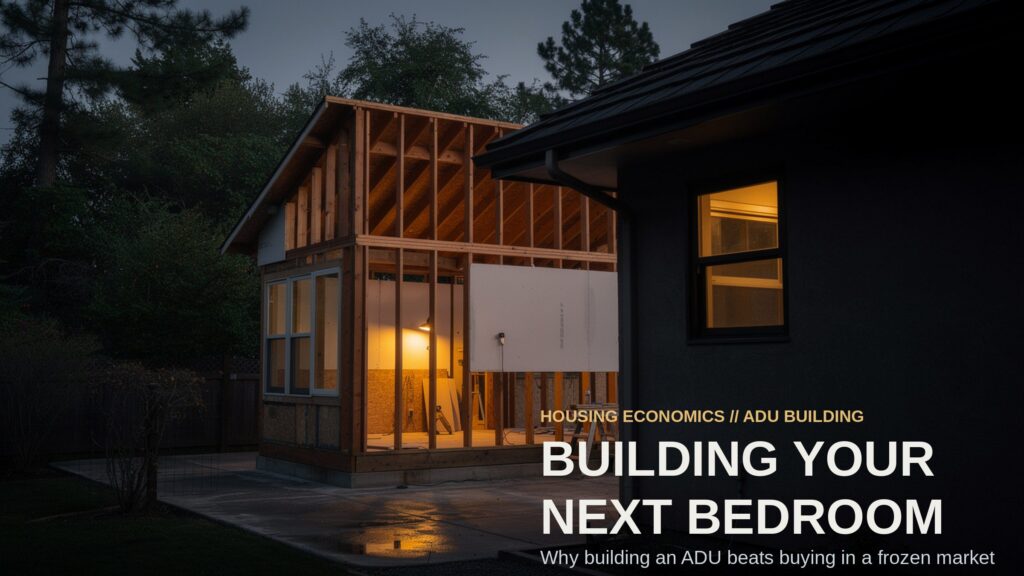
My read is that the permit and the purchase have split apart. Pew Charitable Trusts read the zoning codes of every U.S. city above 100,000 people and found that 80% allow an accessory dwelling unit (ADU), adding that “legalization is no longer the binding constraint to ADU development in most large American cities” [3]. The National Association of Realtors (NAR) said the same week that deals under contract fell in all four regions [1].
So the buy side is priced and stuck while the build side is allowed and unpriced, since no national data says what an ADU costs or what it rents for. The lending layer moved this month without much notice. Fannie Mae’s wider ADU rules work only on appraisals delivered in the new Uniform Appraisal Dataset (UAD) format, which becomes required on 2 November 2026 [5].
The gap is the size of the choice. A purchase mortgage at 7.41% is a thirty-year promise at a price the market is no longer clearing, and the fixed rate did ease from 7.50% in the week to 23 October, its first weekly drop in more than two months [6]. Purchase loan requests still ran 18% below last year’s pace [6]. A rate that slips without drawing buyers has not yet moved the decision.
By the numbers
- 80% — Cities that allow it: 276 of the 346 cities above 100,000 people let an owner build an ADU and rent it out, and at least 266 of them wrote or rewrote the rule since 2016 [3].
- 81 per 100,000 — Permits where it is easy: cities with easy rules issued 81 ADU permits per 100,000 people in 2025, more than 11 times the rate in cities with tight rules and over 75 times the rate where no rule exists [3].
- 43% — Local rules that still bite: 118 of the 276 carry at least one real limit. Owners must live on site in 71 cities, parking is required in 81, a special permit is needed in 27, and 49 bar ADUs from their main single-family zones [3].
- $417,500 — The rival price: the median existing-home sale in September, up 1.3% in a year, on 3.99 million sales and 1.60 million homes listed for sale [2].
What I’d watch:
What strikes me is that the fight has moved off zoning and onto paper. Pew’s own closing line is that the work left is “removing common restrictions that make building an ADU difficult and expensive,” and that loans are part of the fix [3].
- The 2 November flip: Fannie’s wider ADU rules work only on appraisals delivered in the UAD 3.6 format, required that day, and in that format the unit’s rent sits inside the main report rather than on the old rent sheet that retires with it [5].
- The 30% ceiling: ADU rent counts toward the income a lender weighs only from one unit, only on a home you live in, only on a purchase or a limited cash-out refinance, and only up to 30% of that income [4]. It is a loan test, not a build loan, and it does not enlarge a home equity line of credit (HELOC) used to pay for the work.
- The three clauses that decide it: owner-occupancy, parking and permit type are what split an easy city from a tight one, and the permit gap between them runs more than elevenfold [3]. All three are readable before a builder quotes anything.
- The rate side of the trade: the average HELOC sat at 8.130% on 12 October, down from 8.195% a week earlier [7], while remodeling spend growth is forecast to slow from 2.4% in the fourth quarter to 1.5% by the third quarter of 2027 [8]. A trade expecting less work next year bargains harder this winter.
The catch
The honest gap is that nobody has printed the number this choice turns on. Pew prices the permit, not the build, and its fixes — wider loan options, preapproved plans — are ideas rather than reported costs [3]. The price pages that fill that space are ads from the firms selling the build. So the payback stays local: what a unit costs in your city, what it rents for on your street, and what a permitted build does to the bill, which is worked through in 3% Cap Never Covers Your Addition.
Two headline stats carry caveats a budget should inherit. The 22 states with override laws are states that had passed them by August 2026, not states enforcing them, 17 of them requiring by-right approval, and Pew notes that four had not taken effect when its review closed in April [3]. The permit rate leans heavily on California, which builds far more ADUs than any other state. Outside it, easy cities issued 26 ADU permits per 100,000 people — still more than three times the tight-city rate, but roughly a third of the headline [3].
I could be wrong about how much the loan change matters in practice. Fannie’s rule covers loans it buys, so a family paying cash, or borrowing through a builder’s own program, never meets it. What the rule says is narrower than the ads suggest, and it is a test of income, not a green light.
At a glance
- The Big Shift: Permission to build a second dwelling on your own lot is now near-universal in big U.S. cities, at the moment the resale market has stopped making units to buy, and the appraisal format that lets a lender count the new unit’s rent becomes required on 2 November 2026.
- Why It Matters: A family that needs another bedroom is choosing between a $417,500 purchase in a market whose deal count is down 11.3% in a year and a build on land it already owns, and only one of those two pays rent while it sits there.
- What I’d Watch: I am watching whether the paper catches up with the permit.
- The 2 November mandate: The date appraisals must arrive in the new format, which is also when Fannie Mae’s wider ADU rules become usable in practice.
- The 30% ceiling: The cap on how much ADU rent can count toward the income a lender weighs, applied to one unit on a home you live in.
- The three clauses: Owner-occupancy, parking and permit type, the local rules that split cities issuing 81 ADU permits per 100,000 people from those issuing a fraction of that.
- The Catch: No national figure exists for what an ADU costs or rents for, the 22-state count measures laws passed rather than enforced, and the permit-rate gap leans heavily on California.
Related reading
- Energy & Efficiency — more on Energy & Efficiency
- 3% Cap Never Covers Your Addition — more on Energy & Efficiency
- Your Nonrenewal Isn’t Final — more on Home Cost Decisions
Sources
[1] National Association of Realtors — “Pending Home Sales Decreased 7.3% in September” (20 October 2026) — https://www.nar.realtor/newsroom/pending-home-sales-decreased-7-3-percent-in-september [2] National Association of Realtors — “Existing-Home Sales Increased 1.5% in September, According to NAR Report” (13 October 2026) — https://www.nar.realtor/newsroom/existing-home-sales-increased-1-5-in-september-according-to-nar-report [3] Pew Charitable Trusts — “Accessory Dwelling Units Can Meaningfully Boost Housing Supply” (report, 21 October 2026) — https://www.pew.org/en/research-and-analysis/reports/2026/10/accessory-dwelling-units-can-meaningfully-boost-housing-supply [4] Fannie Mae Selling Guide, B3-3.8-02 “Rental Income from the Subject Property” (2 September 2026) — https://selling-guide.fanniemae.com/sel/b3-3.8-02/rental-income-subject-property [5] Fannie Mae — “Appraiser Update” (first 2026 edition) — https://singlefamily.fanniemae.com/originating-underwriting/appraisers/appraiser-update-march-2026 [6] Mortgage News Daily — “Mortgage Applications Aren’t Ready to Rebound Just Yet” (23 October 2026) — https://www.mortgagenewsdaily.com/news/10232026-mortgage-applications-mba [7] Fortune — “Today’s home equity loan and HELOC rates, Oct. 12, 2026” — https://fortune.com/article/home-equity-rates-10-12-2026 [8] Harvard Joint Center for Housing Studies — “Remodeling Spending Continues to Stagnate” (22 October 2026) — https://www.jchs.harvard.edu/blog/remodeling-spending-continues-stagnate