The big picture:
Asphalt covers roughly 80% of US home roofs, which makes the shingle the main shield against a storm [3].
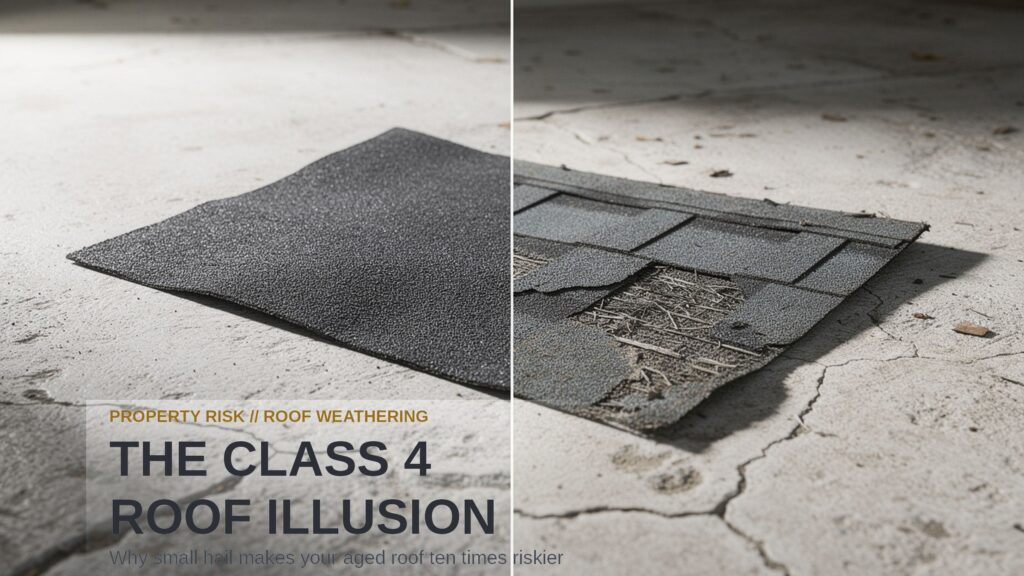
A roof gets picked once and then sits outside for fifteen years taking damage from ordinary weather. The UL 2218 test looks at a clean sample, while the Insurance Institute for Business & Home Safety (IBHS) notes that current rules skip how goods age [2]. What I cannot get past is that almost no owner ever sees this gap.
The wear adds up quietly, because small stones under an inch wide fall far more often than the huge chunks that make the news [2]. Each pass knocks off the granules that block the sun, and two simulated small-hail events on top of normal weather left aged panels far more fragile than new ones [2]. The class printed on a box and the real state of a roof answer two different questions.
None of that makes the class useless, which is the part that gets lost in both directions. A carrier still sets the test it will accept, and the class is the only label it names, so it stays the entry ticket for a credit even where the credit is small [1]. The argument is about what the ticket is worth, not whether it gets you in.
By the numbers
- 2218 — UL test standard: this impact test decides whether a covering earns a Texas discount, and it is keyed to the standard rather than to a brand or a retail price [1].
- 2.8% — wind-and-hail claim rate: wind and hail is the largest single cause of home claims, with that share of insured homes filing such a loss in 2018-2022, against an average $20,062 paid per claim in 2023 [6].
- 902 — Texas hail events: hail an inch or more across was logged 902 times in Texas in 2025, more than any other state, against 244 in Colorado and 5,432 nationally, up from 5,373 in 2024 [5].
What I’d watch:
What I’ve been watching is the paperwork. That is where a qualifying product turns into money, and it is the step homeowners meet last.
- The five label items: since 1999, a maker has had to print the UL label, the class, its own name, the year made, and the brand on the shingle [1].
- The installer’s form: once the roof sits on the house, a contractor files Texas Department of Insurance (TDI) form PC068 to turn a passing product into a real bill credit [1].
- The side-by-side rating: IBHS buys shingles at the store and ranks them so buyers can see the performance gaps between brands and product years [3].
- The aged-panel question: the 2026 field season ran new shingles and one-year-aged modified shingles through repeated hail to track wear over time [4].
The catch
The huge jump in risk comes from a lab test between worn panels and fresh new shingles, rather than a recorded failure rate on a real house [2]. What I find hard to square is that no maker prints a true long-term rating for their goods. A buyer weighing two Class 4 products has no measured facts to lean on beyond the store-bought tests that IBHS runs.
A second limit cuts against the case for a pricey upgrade, and it is the one that decides the money. The bill discount gets priced by the carrier, so the payback hangs on a rate filing rather than on the physical shingle. When that credit comes in small or missing, the label protects the house instead of lowering the premium — which is the same split I found on the discount side of a roof file.
At a glance
The shift: Roofing is sold by impact class, which measures a new sample, not the aged roof hail hits. The number: Up to ten times — IBHS’s weathered, twice-hit panels against new shingles. The risk: No test certifies how a Class 4 product ages, and carriers price the credit.
Related reading
- Your Tank’s Class Costs $55 — more on Energy & Efficiency
- Your Upgrade’s $9 Silent Reset — more on Energy & Efficiency
- Windows: 13% Is the Best Case, Not Average — more on Energy & Efficiency
Sources
[1] Texas Department of Insurance, “Products qualifying for impact-resistant roofing credits” (As of February 24, 2023) — https://www.tdi.texas.gov/company/roofing-discounts.html [2] Insurance Institute for Business & Home Safety, “Impact Testing of High Concentrations of Small Hail” — https://ibhs.org/hail/impact-testing-of-high-concentrations-of-small-hail/ [3] Insurance Institute for Business & Home Safety, “Relative Hail Impact Resistance of Asphalt Shingles” — https://ibhs.org/hail/relative-impact-resistance-of-asphalt-shingles/ [4] Insurance Institute for Business & Home Safety, “Hailstones: Field Research” (2026 season) — https://ibhs.org/hail/hailstones/ [5] Insurance Information Institute (Triple-I), “Facts + Statistics: Hail” (NOAA Storm Prediction Center counts, 2025) — https://www.iii.org/fact-statistic/facts-statistics-hail [6] Insurance Information Institute (Triple-I), “Facts + Statistics: Homeowners and renters insurance” (ISO claim data) — https://www.iii.org/fact-statistic/facts-statistics-homeowners-and-renters-insurance