What the signature transfers
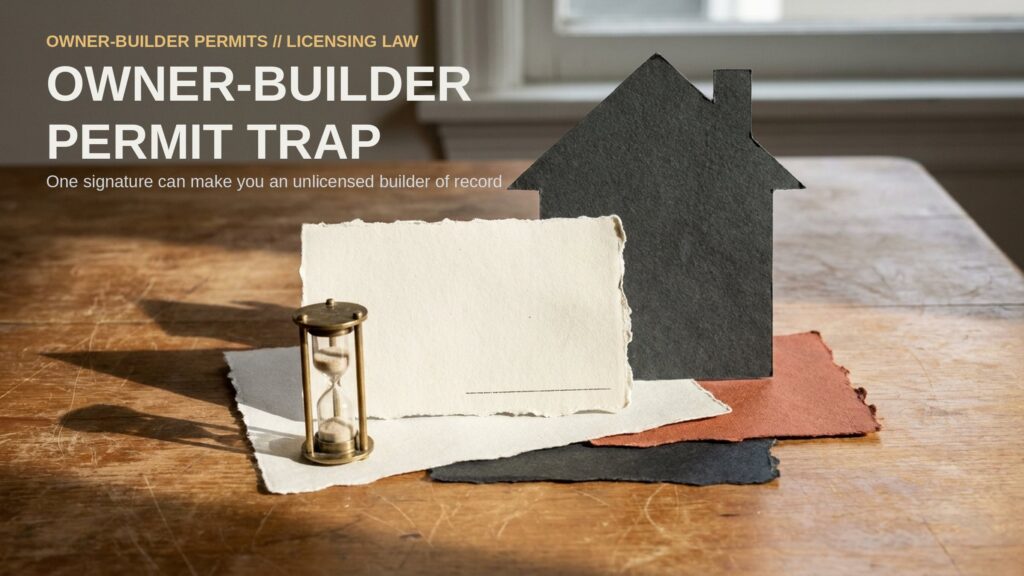
The permit is not a pass. It is a hole cut in a licensing law, and each state cuts it differently.
California’s simplest route covers only work the owner does in person, or work done by the owner’s own staff with wages as their only pay [3]. A framing crew paid by the square foot is usually neither. That route can close the moment one shows up.
Florida wants the owner to watch every part of the job not done by a licensed contractor [6], and to sign the form in person [7]. Its own form then names the pattern from the state’s side. Unlicensed people often have the owner get the permit, it reads, which implies the owner is supplying the labor and the supplies [8]. The trades still show up, and the paperwork just carries the owner’s name.
That same page is blunter about the cost. A worker without a license has to be on the owner’s payroll, with tax withholding and injury coverage [8], and the owner’s home policy may not cover injuries to those workers [8].
I read that line as the state saying the gap is real, in writing, before any work begins.
By the numbers
- Four homes a year — California’s resale cap: An owner who hires licensed trades directly is exempt only up to four single-family homes offered for sale in a calendar year, and hiring a general contractor closes that route [1].
- Three homes — Oregon’s limit: Oregon exempts an owner who hires licensed contractors on no more than three existing homes in the same year, but not for work that needs a permit unless a residential general contractor runs it [10][11].
- Five hundred dollars — Washington’s floor: Washington calls work casual and minor only where the whole job lands under five hundred dollars, and the same rule drops any job that is part of a bigger one [13].
Where the resale window bites
The resale rules decide whether the permit lives past the project. California treats a sale, or even a listing, within a year of completion as an assumption that the home was built to sell [4]. The owner can argue with that one, and the burden is his.
Five or more homes sold inside the same year is a hard assumption in California, one the owner cannot argue with [16]. Florida writes its version into the form the owner signs. A home sold or leased inside one year is presumed built for sale or lease, which breaks the permit [9].
Oregon comes at the same fact from the other end. An owner who does not move into the finished home has given evidence, on its face, of a plan to sell [12]. Washington sets a clock instead. The permit does not reach anyone doing builder work to lease or sell property owned for under twelve months [14], and it is withheld outright when the work is aimed at selling, tearing down or leasing the property [15].
What I would watch is how those clauses meet a normal move. An owner who adds a wing and stays for ten years never meets one. The one who takes a job transfer two summers later does. The form signed at the counter then decides which story the state believes.
The catch
None of this makes the form wrong to sign. An owner who does the work, lives in the house and stays is the person these rules were written for, and the statutes read as kind to that owner.
The harm sits in the middle case. An owner signs, hires the trades the builder picked, and never learns if those trades were licensed or on payroll. The statutes do not chase that deal. They just stop covering it.
I could be wrong, but the disclosure pages read as the honest paper in the pile, because they describe the role instead of the fee. The other risk, work done with no permit at all, runs the other way. This site’s unpermitted work calculator works the permit-now, fix-later and sell-as-is math.
At a glance
The shift: An owner-builder permit moves the builder’s role onto the owner, with watching, hiring and resale conditions attached. The number: Four homes a year in California, three in Oregon, five hundred dollars of casual work in Washington. The risk: A resale inside the window turns the permit into evidence of unlicensed building.
Related reading
- Retainage Trap: 5 Percent, Not 15 — more on Tools & Equipment
- 3 Days to Kill Your Deposit — more on Tools & Equipment
- Hidden Lien Clock Behind Your Remodel Payments — more on Tools & Equipment
Sources
[1] California Business and Professions Code § 7044(a)(2)(B) — exemption for an owner who contracts directly with licensees; four-structure cap, and the carve-out when a general contractor is hired. https://california.public.law/codes/ca_bus_and_prof_code_section_7044 [2] California Business and Professions Code § 7044(a)(3)(B) — principal place of residence; 12 months’ actual residence before completion. https://california.public.law/codes/ca_bus_and_prof_code_section_7044 [3] California Business and Professions Code § 7044(a)(1)(B) — owner-builder exemption; work performed by the owner or the owner’s employees with wages as their sole compensation. https://california.public.law/codes/ca_bus_and_prof_code_section_7044 [4] California Business and Professions Code § 7044(b)(1) — sale or offer for sale within one year as a rebuttable presumption of purpose to sell. https://california.public.law/codes/ca_bus_and_prof_code_section_7044 [5] Florida Statutes § 489.103(7)(a)1 — owner-builder exemption; one-family or two-family residence for the owner’s occupancy, commercial building at a cost not to exceed $75,000. https://www.flsenate.gov/Laws/Statutes/2026/489.103 [6] Florida Statutes § 489.103(7)(a) — owners acting as their own contractor must provide direct, onsite supervision of all work not performed by licensed contractors. https://www.flsenate.gov/Laws/Statutes/2026/489.103 [7] Florida Statutes § 489.103(7)(c) — the owner must personally appear and sign the building permit application, and a violation lets the permitting agency withhold final approval, revoke the permit, or pursue an unlicensed-activity remedy. https://www.flsenate.gov/Laws/Statutes/2026/489.103 [8] Florida Statutes § 489.103 — owner-builder disclosure statement, items 6 to 8: the frequent practice of unlicensed persons having the owner obtain the permit; the requirement that an unlicensed worker be employed by the owner, with withholding and workers’ compensation; and the statement that homeowner insurance may not cover injuries to those workers. https://www.flsenate.gov/Laws/Statutes/2026/489.103 [9] Florida Statutes § 489.103 — owner-builder disclosure statement, item 4: a building sold or leased within 1 year after completion is presumed built for sale or lease, which violates the exemption. https://www.flsenate.gov/Laws/Statutes/2026/489.103 [10] Oregon Revised Statutes ORS 701.010(6) — exemption for an owner who contracts with licensed contractors on not more than three existing residential structures in the same calendar year. https://oregon.public.law/statutes/ors_701.010 [11] Oregon Revised Statutes ORS 701.010(6) — the exemption does not apply to work that requires a building permit unless a residential general contractor performs or directs it. https://oregon.public.law/statutes/ors_701.010 [12] Oregon Revised Statutes ORS 701.010(5) — prima facie evidence of an intent to sell where the owner does not occupy the structure after completion. https://oregon.public.law/statutes/ors_701.010 [13] Revised Code of Washington RCW 18.27.090(9) — casual, minor or inconsequential work under five hundred dollars, excluding work that is part of a larger operation. https://app.leg.wa.gov/rcw/default.aspx?cite=18.27.090 [14] Revised Code of Washington RCW 18.27.090(11) — the owner exemption does not apply to contractor activity to lease or sell improved property owned for less than twelve months. https://app.leg.wa.gov/rcw/default.aspx?cite=18.27.090 [15] Revised Code of Washington RCW 18.27.090(12) — the own-property exemption does not cover contractor activity for the purpose of selling, demolishing or leasing the property. https://app.leg.wa.gov/rcw/default.aspx?cite=18.27.090 [16] California Business and Professions Code § 7044(b)(2) — sale or offer for sale of five or more structures within one year as a conclusive presumption of purpose to sell. https://california.public.law/codes/ca_bus_and_prof_code_section_7044