The big picture:
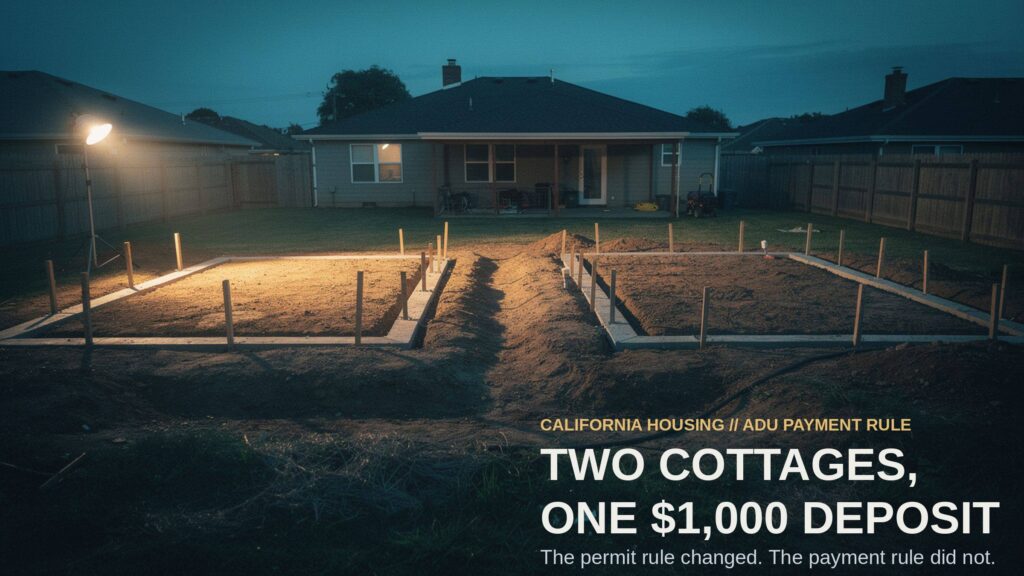
Assembly Bill (AB) 956 does not add a fifth home to a California lot; the promised total stays four. What changes is the mix, because two detached cottages can now replace the in-law suite inside the house [4]. From January 1, the state guarantees two detached new builds that each respect four-foot side and rear setbacks. Once both stand, a city no longer has to permit a junior accessory dwelling unit (JADU) on that lot.
On paper, this swap looks like a minor footnote. On the ground, it is a different job. A JADU is a room inside the house with a small kitchen, while the new version creates two distinct buildings that each need their own slab, power panel, water line, and set of checks. The pace surprises people: the state housing department counts 30,354 permits in 2024 against 1,336 in 2016, and these units made up over 26.6% of all homes permitted in the state that year [3].
What strikes me is that none of this touches the money. The bill amends three code sections, all of them about deed limits and local approval, and none about payment [4]. The newest by-right project in the state still runs on a rule written for a kitchen remodel, and the board used its October release to remind builders what that rule says [1].
By the numbers
- $1,000 — Deposit cap: The Contractors State License Board (CSLB) repeated the rule as a lesser-of pair. The limit is no more than $1,000 or 10% of the total cost, with later draws capped at the value of work done or goods delivered [1].
- 35 felony counts — Alleged theft: Colton and Austin Paulhus each face 33 counts of diverting construction funds, one of conspiracy, and one of wage theft after a probe that led to a criminal case [1].
- 200+ complaints — 18 counties: The board’s account lists abandoned jobs, unpaid subs, and payments made ahead of work that was performed, or often never performed [1].
- 26.6% — Share of permits: These units ran from 1,336 permits in 2016 to 30,354 in 2024, and were over a quarter of all homes permitted in the state in 2024 [3].
What I’d watch:
The gap this case shows is not a missing law. It is a rule that shows up after the money is gone. The board pulled the company’s license in November 2024, but the charges surfaced on October 9, nearly two years later. The next court date is Jan. 12, and an owner who pays a deposit in March is not waiting on that clock [1][5]. What I am watching next is how cities use the local control they still hold.
- The first city rules: A city may cap each unit at 800 square feet of living space, and many will, because the cap is the cheapest way to stop a two-unit lot from turning into a small apartment block [4].
- Fire walls, not state law: The statute sets four-foot setbacks and says nothing about the gap between two buildings. Fire-rated walls and fire-truck access still decide whether a plan fits, for instance, a lot 50 feet wide and 120 feet deep.
- What a builder asks for at signing: The board’s own sample schedule starts at 5% for start-up and ends at 2% on key handover, a useful yardstick for any request that lands before the first site check [2].
- Unpaid subs: Suppliers went unpaid while owners had already paid, the pattern that puts a lien on a house whose owner did nothing wrong. The lien clock behind remodel payments is the part of that failure that outlives the builder.
The catch
Two things cut against the scary reading. The first is that this is one firm, and the charges are just charges. No plea had been entered at the October 14 hearing, and the brothers are presumed innocent while the case runs [6]. The second is that a deposit cap is not a test of whether a builder has money. A firm that cannot carry two units to the first draw is exactly the firm that wants a big down payment, and no statute turns a thin balance sheet into a thick one.
Where I’ve landed: the useful control here is about order, not law. A draw schedule tied to site checks, a licensed general contractor with enough cash to reach them, and a written deal that names each step do more than a complaint filed after the fact. The state has spent a decade making the permit easier and has not made the money safer. AB 956 pushes more backyard work into the version of the job with the most cash out before the first check.
At a glance
- The Big Shift: From Jan. 1, 2027, cities must clear two detached backyard homes on a single-family lot, trading the promised in-house junior unit for a second structure [4].
- Why It Matters: The payment rule did not change, so a two-building job still runs on a down payment capped at $1,000 or 10% and later checks tied to finished work [1].
- What I’d Watch: How the first city rules use the 800-square-foot cap, what builders ask for at signing, and the Jan. 12 court date in the state’s largest backyard-home fraud case.
- Ministerial process: A decision made against fixed rules, with no hearing and no room to weigh a neighbor’s protest.
- Draw schedule: The list of payments tied to finished stages, the tool that keeps money behind work.
- Construction fund charge: The count filed when cash meant for one job is used for something else.
- The Catch: The case is one firm and the charges are unproven, a deposit cap cannot make a weak builder solvent, and a two-unit lot adds fire-wall and utility costs that no state statute models.
Related reading
- Tools & Equipment — more on Tools & Equipment
- Your 49% Discount Isn’t All Roof — more on Home Cost Decisions
- Your Block’s $30B Hardening Bill — more on Energy & Efficiency
Sources
[1] Contractors State License Board, “Former Contractors Behind Anchored Tiny Homes Face 35 Felony Charges,” CSLB #26-02, 2026-10-20. https://www.cslb.ca.gov/Resources/PressReleases/2026/Anchored%20Tiny%20Homes.FINAL.pdf [2] Contractors State License Board, “Fast Facts: Tips for Building a Residential Accessory Dwelling Unit (ADU),” rev. 11/2025. https://www.cslb.ca.gov/Resources/GuidesAndPublications/2025/FastFacts_ADU.pdf [3] California Department of Housing and Community Development, “Accessory Dwelling Unit Handbook,” March 2026. https://www.hcd.ca.gov/sites/default/files/docs/policy-and-research/adu-handbook-update.pdf [4] California Legislative Information, “AB-956 Accessory dwelling units and junior accessory dwelling units,” Chapter 791, Statutes of 2026, chaptered 2026-09-29. https://leginfo.legislature.ca.gov/faces/billTextClient.xhtml?bill_id=202520260AB956 [5] KCRA 3, “Sacramento County DA’s Office files charges against Anchored Tiny Home co-founders,” updated 2026-10-09. https://www.kcra.com/article/sacramento-county-da-files-charges-anchored-tiny-homes/74096522 [6] NBC Bay Area, “Defunct tiny home builder’s customers say prosecutors are ‘angry for us,'” 2026-10-14. https://www.nbcbayarea.com/investigations/tiny-home-builders-customers-prosecutors-angry/4158224