At a glance
- The shift: A lamp tester shows the pattern a fake ground makes, the pattern of a real one.
- The number: $159.99 buys a load test and no fake-ground claim.
- The risk: A reversed bootleg puts line voltage on the metal yoke while the lamp says fine.
Why lamp patterns miss the jumper
A three-lamp tester is three small voltage sensors sharing one plug. Each lamp answers a single question about one pair of slots: neutral-to-ground, neutral-to-hot, and hot-to-ground [7]. The chart on the front turns that pattern into words.
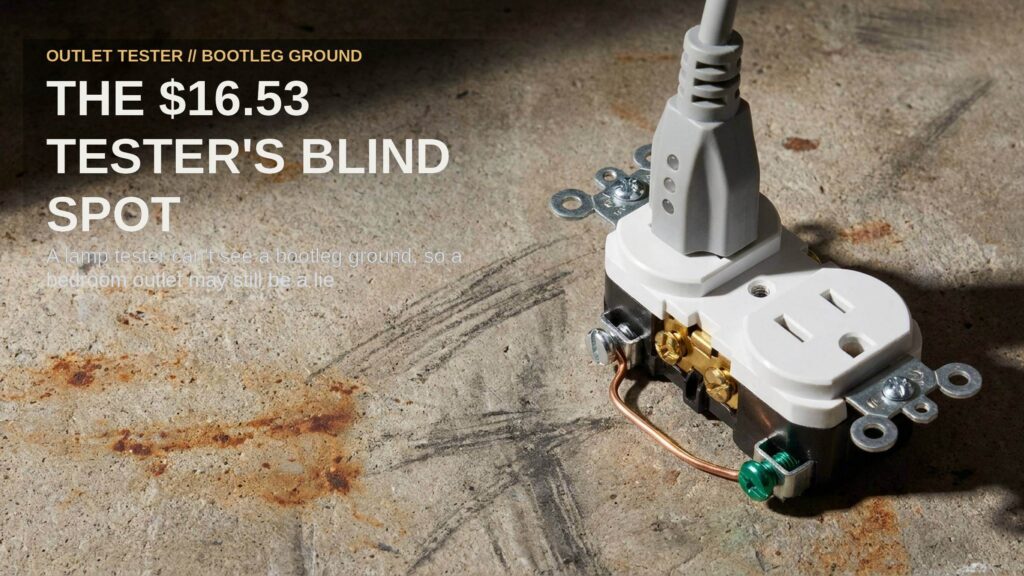
A jumper between the grounding screw and the neutral screw collapses two of those questions into one. The hot slot now drives both the neutral slot and the ground slot, so the tester reads the pattern it calls correct wiring [7]. What strikes me here: nothing in the device is broken. The fault sits in a wire the plug cannot reach.
The reversed version is the one that hurts. With a faked ground and reversed polarity, the outlet’s metal mounting yoke sits at 120 volts, and so does the frame of anything plugged into it, while the tester still shows correct wiring [7]. Mike Twitty, a licensed electrician and code inspector who wrote the guide for home inspectors, adds that no lights do not mean the outlet is dead [7].
| Unit | Price | Claimed | What it measures | Fails at |
|---|---|---|---|---|
| Klein RT210 | $16.53 | five wiring conditions from a lamp chart [1] | voltage between three slot pairs | any fault that makes two slots equal |
| Klein RT250 | $36.46 | voltage readout and a ground-fault trip timer [2] | the same three voltages, plus a timer | the same blind spot, with a number on it |
| Klein RT390 | $159.99 | load tests and arc-fault inspection [3] | voltage sag under load | the maker claims no fake-ground detection |
By the numbers
- $19.93: The step from the RT210 to the RT250 buys a voltage readout and a ground-fault trip timer, and adds no ground check [2].
- Five conditions: What the RT210’s lamp chart can report, and a fake ground is not one of them [4].
- 1,440 watts: What a heater pulls on a bedroom circuit, the load class the analyzer’s smallest test simulates [6].
What the load test sees
What I keep returning to is which question the RT390 actually answers. It applies a load at three settings and reports the percentage voltage drop — how far the voltage sags when a heavy appliance pulls current [6]. It also measures trip time for ground-fault and arc-fault circuit interrupters, and flags a fault where both neutral and ground paths are open [6].
That sag reading previews what the wiring does once the load arrives, which is the question in a house about to carry two heaters. A one-heater load is the smallest of its three test settings.
What it does not do is make the fake-ground call. Klein’s page for the RT390 lists wiring faults, the dual open-neutral/open-ground fault, both device inspections and voltage-drop tests, and no fake-ground row appears in that list [6]. The RT210’s page is the same: five conditions, no fake ground [4]. The RT250 adds a display and a trip timer, states that arc-fault testing is not included, and adds nothing on the ground [5].
The one class that advertises the call is the Ideal Electrical SureTest. Its feature list says it identifies false grounds and reads ground impedance — resistance in the ground path — down to a hundredth of an ohm [8]. It also reads ground-to-neutral voltage and tests a ground-fault device at a measured current [8]. A trade review of the successor model describes the same load tests and adds that the resistance of the hot, neutral and ground wires is measured and displayed [11].
That series is listed at $421.33 by a distributor [8]. The maker’s own page for that model says it has been discontinued [10]. The ceiling of this comparison is an outgoing unit at twenty-five times the price of the tester, sold on a claim whose accuracy nobody here publishes.
The catch
The catch is structural. Every tester here is a two-terminal device: it can only compare the slots to each other, and a bootleg jumper makes two of those comparisons identical, so no plug-in instrument settles the ground question on its own. That is why the honest test for one house is not a purchase.
Twitty’s guidance is to read the panel first: in an older home with apparently grounded outlets, look for the equipment grounding wires, and if none or very few are present, expect bootlegging [7]. Twitty then says to pull one cover off and look for the jumper [7].
That is a screwdriver, ten minutes, and no instrument at all. The cheap tester stays worth carrying, because it catches the faults the lamps can see — an open ground, reversed polarity, an open hot, an open neutral, hot and ground reversed [4] — and because a ground-fault circuit interrupter outlet still has to be tripped once a year. What it cannot do is certify a ground, and nothing in this comparison certifies one at any price. The way I read these choices: the money buys better readings of a different question, not a better answer to the ground question.
What we did not test
This review is built from three Klein Tools specification tables, four retailer price pages, one licensed electrician’s published guide for home inspectors and one trade review of a successor analyzer. We held no unit, plugged nothing in, and opened no outlet for this review. Every price is a standing retail figure read on 2026-11-08, and no source in this set measures any of these devices against a known fake ground.
Which one, by situation
| If this is your situation | Closest fit |
|---|---|
| Older house, three-prong outlets, one heater going in | Klein RT210 as the sweep tool, then the panel read and one outlet cover check [1] |
| You want a voltage number and a trip time on the same walk | Klein RT250, knowing the ground question is unchanged [2] |
| A whole house about to be loaded, and you want a drop reading per circuit | Klein RT390 [3] |
| You need the false-ground call itself, on many properties | Ideal Electrical SureTest, current model, above the discontinued listing [10] |
The RT210 remains the sweep tool in all four cases. The imager piece on what conditions do to a reading makes the same point about a different instrument: a number is only as good as the conditions it was taken in. The home diagnostics hub carries the rest of this vertical’s instruments. For the arithmetic on what a diagnostic habit costs against what it prevents, the true-cost-of-ownership calculator runs that comparison.
Related reading
- Your 512×384 Camera’s 10x Illusion — more on Home Diagnostic Tools
- Your Slab Leak: 15% Blind Spot — more on Home Diagnostic Tools
Sources
- [1] Elliott Electric Supply, “Klein RT210 GFCI Outlet Tester” — https://www.elliottelectric.com/P/Item/KLE/RT210
- [2] Elliott Electric Supply, “Klein RT250 GFCI Receptacle Tester with LCD” — https://www.elliottelectric.com/P/Item/KLE/RT250
- [3] Haus of Tools, “Klein Tools RT390 Circuit Analyzer” — https://hausoftools.com/products/klein-tools-rt390-circuit-analyzer
- [4] Klein Tools, “RT210 GFCI Outlet Tester, specifications” — https://www.kleintools.com/catalog/electrical-testers/gfci-outlet-tester
- [5] Klein Tools, “RT250 GFCI Receptacle Tester with LCD, specifications” — https://www.kleintools.com/catalog/electrical-testers/gfci-receptacle-tester-lcd
- [6] Klein Tools, “RT390 Circuit Analyzer, specifications” — https://www.kleintools.com/catalog/electrical-testers/circuit-analyzer
- [7] Mike Twitty, “The Inconvenient Truth About Three-Light Receptacle Testers”, Working RE — https://www.workingre.com/the-inconvenient-truth-about-three-light-receptacle-testers
- [8] Licensed Electrician, “Ideal SureTest Circuit Analyzers 61-165 and 61-164” — https://www.licensedelectrician.com/Store/ID/SureTest_Analyzers.htm
- [9] Test Equipment Depot, “Ideal Electrical 61-164 SureTest Circuit Analyzer” — https://www.testequipmentdepot.com/ideal-electrical-61-164-suretest-circuit-analyzer.html
- [10] Ideal Electrical, “SureTest Circuit Analyzer”, model 61-164, discontinued — https://idealelectricalinc.com/product/suretest-circuit-analyzer
- [11] Pro Tool Reviews, “Ideal Suretest Digital Analyzer 61-165” — https://www.protoolreviews.com/ideal-suretest-digital-analyzer-61-165
- [12] Elliott Electric Supply, “Klein RT390 Circuit Analyzer” — https://www.elliottelectric.com/P/Item/KLE/RT390