What the 4.3% averages
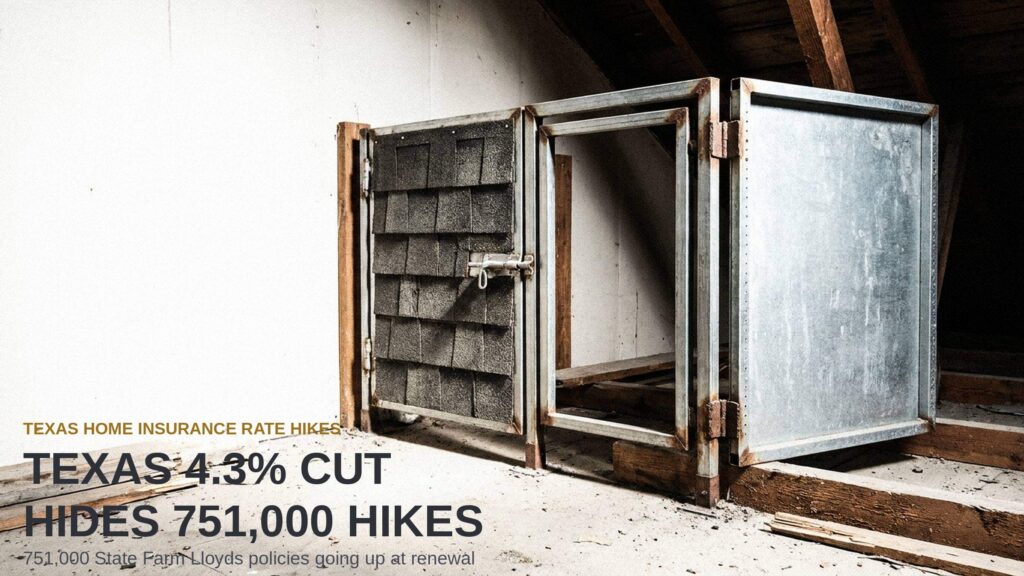
The number is real, and it is a mean of filings rather than of households. TDI’s spokesperson told 13 Investigates that the 4.3% is a simple average in which every company counts once, however many homes it covers [2]. Over the same window, carriers filed 26 home decreases and five increases [2]. State Farm’s was one of the five, and its own filing memo put the need at 10.9% before the company settled on 4% [2]. The trade press carried the figure the next morning without the weighting caveat [7].
What I keep returning to is the size of the bill being averaged. The average annual Texas home premium reached $3,489 in 2025, against $2,795 two years earlier [5]. That is a rise of about a quarter in two years, and it is the base every percentage in this story is measured against.
A mean of unlike filings tells you what the state looks like. It does not tell you what your street looks like, because the carrier that writes your policy is one line in the average, and its filing is the only number that reaches your mailbox.
By the numbers
- 4.3% — Unweighted filing average: Each company’s filing counts once, so the smallest carrier in the state weighs as much as the largest [2].
- 751,000 — Policies going up: State Farm’s increase reaches more Texas homes than the 700,000 that the state counted as getting cuts [1][2].
- $150 — A year on the average bill: 4.3% of $3,489, which is what the average is worth to a home that sits exactly on the average [1][5].
Where the roof question moved
The Texas Register of 9 October carried TDI’s proposed changes to a rule that already says most of what it is about to say more plainly [3]. The text reads that a carrier may not refuse to write a home policy because of the age of the property, or of any of its individual parts or materials [4]. The list it names now puts siding beside wiring, heating, air conditioning, plumbing and roofing [4].
The same part of the rule keeps the exception that decides the outcome. A carrier may still refuse cover based on the physical condition of the property, or of any of its individual parts or materials [4]. TDI says outright that the rewrite does not change the rule’s meaning or application [4]. It asks for written comments by 5:00 p.m. central time on 9 November, and it holds a hearing on 3 November under Docket No. 2874 [4].
What I take from that is where the argument now sits. A roof’s age is out of the cover decision, and its condition is the whole of it. The papers that travel with the house are then an inspection, a receipt and photographs, not a build year. That is a quieter change than a new right, and a more demanding one for anyone who has been keeping the shingles alive on a budget.
The credit side has no schedule at all. TDI’s bulletin of 16 September asks carriers to develop meaningful, actuarially supported discounts for storm and wildfire hardening [6]. It names no percentage anywhere in its text. A company that wants one files it, and the rate you are quoted reflects whatever it filed [6].
Where a state does publish a schedule, the number is fixed by zone and can be large. That is how Louisiana’s benchmark works, and it is what this desk reported when the benchmark took effect: Your 49% Discount Isn’t All Roof.
The catch
A clarification is not relief, and TDI says as much in its own filing [4]. The condition exception is also wider than it sounds, because any single part or material can be the reason a policy is refused, and a worn roof is one of those parts [4]. The 4.3% average can be perfectly accurate and still describe nobody, which is the ordinary fate of a mean of unlike things.
I could be wrong about the size of the gap. A carrier may have filed a mitigation credit and applied it to your renewal without the state ever publishing the schedule. The gap is not that the discount is fake. It is that you cannot see it from outside the filing, and condition is the part a reviewer can see.
At a glance
The shift: Texas averaged a 4.3% rate cut one day before restating that roof age cannot bar you. The number: 751,000 State Farm policies rise from 1 November, more than the 700,000 counted as getting cuts. The risk: The credit for a new roof has no published amount, and condition can still bar you.
Related reading
- Your 49% Discount Isn’t All Roof — more on Home Cost Decisions
- Your 5% Deductible Risks Your Claim — more on Home Cost Decisions
- Your Adjuster Hides a 25% Gap — more on Home Cost Decisions
Sources
[1] Texas Department of Insurance, “Home and auto insurance rates trending down for many Texans,” 8 October 2026. https://www.tdi.texas.gov/news/2026/tdi10082026.html [2] Keaton Fox, “Texas says insurance rates are trending down. State records show a more complicated picture,” ABC13, 9 October 2026. https://abc13.com/post/texas-says-insurance-rates-are-trending-down-state-records-show-more-complicated-picture/19925756 [3] Texas Register, volume 51, number 41, 9 October 2026, 51 TexReg 7027. https://www.sos.state.tx.us/texreg/pdf/backview/1009/1009is.pdf [4] Texas Department of Insurance, proposed amendments to 28 Texas Administrative Code §21.1006, issued 29 September 2026. https://www.tdi.texas.gov/rules/2026/documents/211006proposal.pdf [5] Texas Department of Insurance, “Texas homeowners insurance market overview.” https://www.tdi.texas.gov/general/texas-homeowners-insurance-market-overview.html [6] Texas Department of Insurance, Commissioner’s Bulletin B-0008-26, 16 September 2026. https://www.tdi.texas.gov/bulletins/2026/commissioners-bulletin-b-0008-26.html [7] Insurance Journal, “Texas Reports Homeowners and Auto Rate Decreases,” 9 October 2026. https://www.insurancejournal.com/news/southcentral/2026/10/09/888630.htm