The line is a moving target
The test uses replacement value at the time of loss, not the value at the time the policy was written [3]. That one clause carries most of the risk. Rebuild costs move with lumber, labour, and building code. The limit on the declarations page moves only when a renewal notice changes it. A house insured to the line in one year can sit under it a few years later, with no claim and no improvement.
I’ve been watching the math on that example. The line sits at $480,000, and the limit covers 87.5 percent of it. My read is that the ratio is the part people miss. The same fraction applies to a small kitchen fire as to a burned-out second floor, so the penalty grows with the damage instead of arriving as a step.
Which of the two numbers binds depends on wear. Older work carries a low actual cash value, so the ratio is the larger number and sets the payout. Newer work carries little depreciation, so actual cash value can come close to the repair bill and bind instead. Either way the insurer pays no more than the limit, and that matters most in the case nobody wants to run. A total loss leaves $180,000 short — the whole distance between the limit and the rebuild — and no ratio softens it.
By the numbers
- $8,000 versus $5,000 — One roof, two settlements: The Texas Department of Insurance’s guide prices a $10,000 replacement. With a $2,000 deductible, a replacement-cost policy pays $8,000; the same roof at an actual cash value of $7,000 pays $5,000 [2].
- 75% — The ratio in a worked claim: where the limit is three-quarters of the required amount, a $49,000 loss after the deductible settles at $36,750, and the remainder is the owner’s [4][5].
- $20,062 — Average paid claim (2023): the industry’s mean homeowners claim in 2023, at a frequency of 5.33 claims per 100 house-years. That is the size of loss the ratio runs on day to day [6].
Where the trade looks first
The people who price these policies start with a rebuild estimate, not the sale price on the listing. The trade paper Adjusting Today explains why [4]. Coverage is measured against repair or replacement with like kind and quality — materials and workmanship of a similar standard. It is not the same as market value, which moves with the housing market rather than with labour and materials [4]. Two houses on one street can need different limits for that reason alone.
The next check is the size of the correction. Moving the limit up to the line is a $60,000 increase in Coverage A, or 14.3 percent more dwelling coverage. It turns every partial loss from a discounted payout into a full one. What the extra cover costs in premium is a carrier-rate question, and no regulator page on this beat prices it, so the owner weighs the increase against a quote.
What I keep circling: how little of the decision is about the disaster. A homeowner who clears the line buys a full payout on the small claims that actually arrive. The large claim is the one that would otherwise leave a gap.
The catch
I’d flag two limits on this analysis. The greater-of rule is the standard form’s loss-settlement condition — the clause that says how a claim is paid — and Texas regulators describe the threshold while the adjusting trade quotes the rule itself [3][4]. Forms differ. The same order notes that one alternative form pays less when the owner elects not to repair, so the policy in hand governs, not the summary [3]. The clause also says nothing about what a carrier will charge for the extra limit, and an owner who clears the line pays for cover on a loss that may never come.
My read on the trade: the line is a floor for full replacement-cost settlement, not a recommendation. An owner can reasonably choose a lower limit and accept a reduced payout on ordinary damage. What is hard to defend is carrying the total-loss gap by accident, because that shortfall is the whole distance between the limit and the rebuild, and it arrives with no formula to argue about. The choice is whether that gap is accidental or accepted. The coverage-gap calculator runs the same ratio on a reader’s own limit.
At a glance
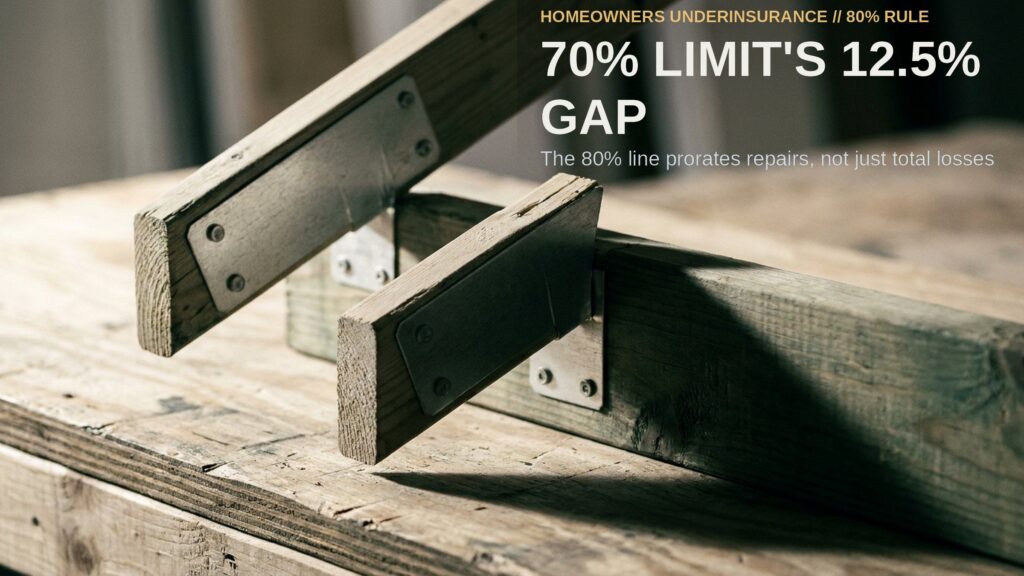
The shift: Below the 80 percent line, a claim settles on the greater of two numbers, not a flat penalty. The number: A 70 percent limit still pays 87.5 percent of a partial repair. The risk: The same limit leaves the total-loss gap uncovered.
Related reading
- Your 4.3% Cut Hides 751,000 Hikes — more on Home Cost Decisions
- Home Cost Decisions — more on Home Cost Decisions
- Your 49% Discount Isn’t All Roof — more on Home Cost Decisions
Sources
[1] Texas Department of Insurance, “Home insurance guide” (consumer publication), retrieved 2026-11-04. https://www.tdi.texas.gov/pubs/consumer/cb025.html [2] Texas Department of Insurance, “Home insurance guide”, replacement-cost versus actual-cash-value example, retrieved 2026-11-04. https://www.tdi.texas.gov/pubs/consumer/cb025.html [3] Texas Department of Insurance, Commissioner’s order approving the new residential property policy forms, loss-settlement discussion, retrieved 2026-11-04. https://www.tdi.texas.gov/orders/co020741.html [4] Robert J. Prahl, “Coinsurance / Insurance to Value Revisited”, Adjusting Today (Adjusters International), retrieved 2026-11-04. https://www.adjustersinternational.com/pubs/adjusting-today/coinsurance-insurance-to-value-revisited/index.html [5] Same Adjusting Today article, worked coinsurance example, retrieved 2026-11-04. https://www.adjustersinternational.com/pubs/adjusting-today/coinsurance-insurance-to-value-revisited/index.html [6] Insurance Information Institute, “Facts + Statistics: Homeowners and renters insurance” (homeowners loss data as of accident year 2023), retrieved 2026-11-04. https://www.iii.org/fact-statistic/facts-statistics-homeowners-and-renters-insurance