At a glance
- The shift: Pressure above 80 psi now means a valve, not a preference.
- The number: 1.29× is the flow multiplier at 100 psi against a 60 psi rating.
- The risk: The valve closes the system, so the heater needs a tank.
Why the ceiling exists
The rule is old, and its age is the argument. The same section sits in the 2011 Ohio code [1]. It survives, in substance, in the 2021 Hawaii code [2]. It also appears in the 2024 residential code Texas uses for windstorm-rated building [3]. Code text that lasts across three publishers for more than a decade is not a vendor’s taste. It is the settled view of the people who inspect the work.
The reason behind it is math. Fixtures carry a top flow rate, stated against a stated pressure, and the code’s own table prints them that way: a private lavatory at 2.2 gallons a minute at 60 psi [1]. Water pushed through a fixed opening speeds up with the square root of the pressure behind it. A house at 100 psi therefore moves about 1.29 times as much water through that opening as one at 60 psi, and a house at 120 psi moves 1.41 times as much. None of that extra water shows up as a pressure reading on any app. It just arrives faster, hits the shutoff harder, and works the supply hoses and valve seats past the rate the fixture was built for.
What I find hard to square is how far this sits from the dashboard. A local-first home can chart a hundred values and still not know the pressure in its own pipes, because the meters sold for the job measure flow. A flow meter answers whether water is moving, which is the leak question, and a leak monitor’s flow threshold is the right tool for that. Pressure answers a different question: what the pipes are being asked to hold while nothing moves.
By the numbers
- 80 psi static: The pressure above which a regulator is required rather than recommended [2].
- 2.5 gallons a minute: The top flow of a standard showerhead, against 2.0 for a labeled one [4].
- 82 gallons a day: What one American uses at home, on the agency’s citation of federal survey data [5].
What the valve drags in
The valve is the narrower half of the code. Where pressure runs over the ceiling, the valve must be a listed type with a strainer ahead of it, so grit from the main does not chew the seat [1]. It must also fail open. The section asks for a design that keeps water flowing if the valve’s own parts give out, which is the gap between a house with a pressure problem and a house with no water at all [1].
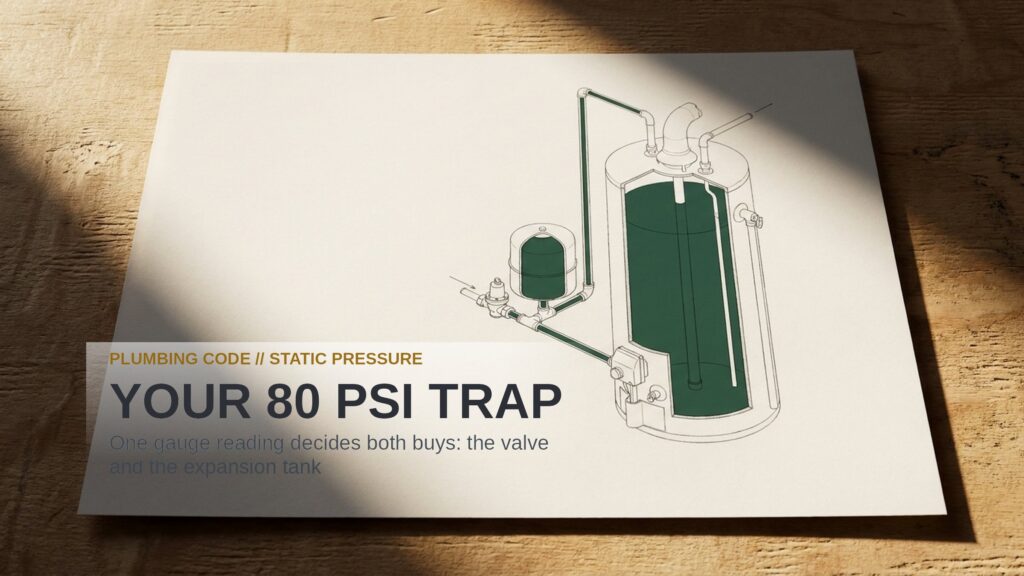
Then the second half shows up. A regulator blocks flow in both directions in practice, so the pipes below it become a closed system, and water heated in a tank expands with nowhere to go. The fix is written in the same family of codes. An approved expansion tank goes in the cold line below each regulator, placed to keep thermal growth from lifting the regulator’s setting [2]. Where a backflow device, a check valve or anything similar sits on a system with a storage water heater, a pressure-control device is required again, on the same logic [3]. A plan stamped by a registered design professional can swap a relief valve for the tank, but only with the relief setting held at 100 psi or less [2], which is a narrower path that needs a signature on it.
Two details decide whether the job is sound or merely present. The first is place. The tank belongs below every check valve between the regulator and the heater, which is the step a rushed install misses when a shutoff sits between them [2]. The second is size, because the code tells the pipe tables to use 80 percent of the reduced pressure, so a plumber who sizes the branches off street pressure and then fits a valve has sized the job twice [2].
I read the temperature-and-pressure relief valve on the heater as the part that reports on all of this. It is set to open before the tank fails, so a relief valve that weeps is not a bad valve. It is the one pressure gauge in the system that talks, and on a closed system with no tank, that weep is the tank’s absence saying so.
The catch
Three limits keep this from being a clean rule. The ceiling is model code, and cities and states amend model codes, so the number that governs a house is the one printed in the edition its permit is issued under. Aerators and flow limiters blunt the square-root multiplier, which means the flow math gives the direction and the rough size of the effect, not the exact gallons a faucet will pour. And a gauge on a hose bib reads static pressure only when nothing in the house is running, so a reading taken at mid-morning with a dishwasher going is a different quantity from one taken at 3 a.m.
The gauge is the cheap part. A hose-bibb gauge and a phone photo of it before the house wakes up tells an owner more about this value than any product I could confirm this round. No maker of valves, tanks or gauges, and no contractor page I probed, would answer a plain fetch with a real spec. What the valve costs, and what the tank adds, is a quote the owner gathers, not a figure this piece can hand over honestly.
That leaves the choice where it belongs. The reading is free and takes a minute. The valve is a plumber’s afternoon. The tank is the part that decides whether the valve was worth doing at all, and a house that gets the valve and skips the tank bought half a fix and moved the failure onto the heater.
Related reading
- Your Camera Eats 66 GB — more on Smart Home & Security
- Smart Home & Security — more on Smart Home & Security
- Your 1-Acre Mower’s 0.4-Acre Trap — more on Yard Robots & Automation
Sources
- [1] Ohio Plumbing Code 2011, §604.8 “Water-Pressure Reducing Valve or Regulator” (UpCodes) — https://up.codes/s/design-of-building-waterdistribution-system
- [2] Hawaii Plumbing Code 2021, §608.2 “Excessive Water Pressure” (UpCodes) — https://up.codes/s/excessive-water-pressure
- [3] Texas Windstorm Insurance Association Residential Code 2024, §P2903.4 “Thermal Expansion Control” (UpCodes) — https://up.codes/s/thermal-expansion-control
- [4] U.S. Environmental Protection Agency, WaterSense, “Showerheads” (last updated March 3, 2026) — https://www.epa.gov/watersense/showerheads
- [5] U.S. Environmental Protection Agency, WaterSense, “Statistics and Facts” — https://www.epa.gov/watersense/statistics-and-facts