At a glance
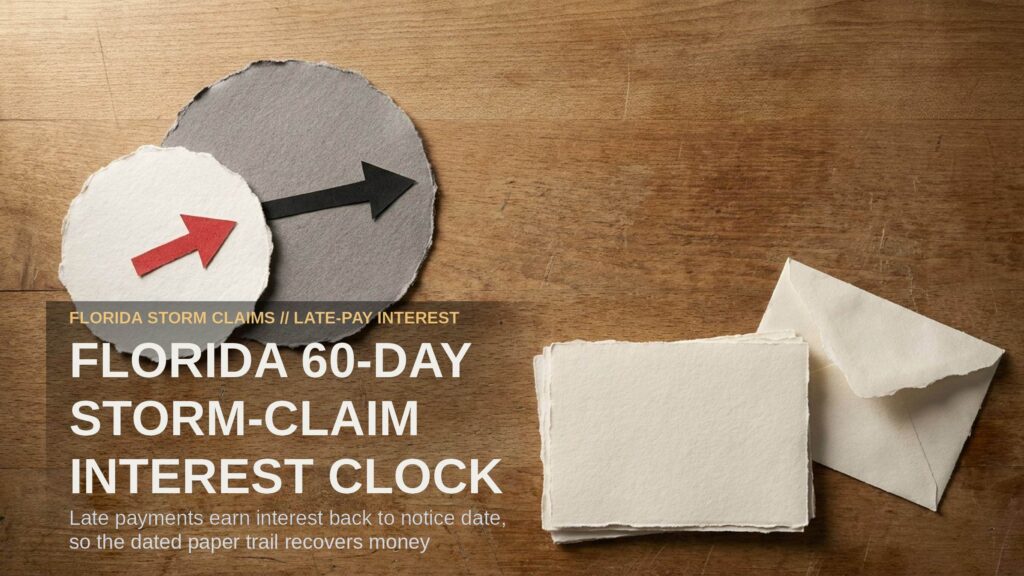
- The shift: Late claim payments now carry interest the policy cannot waive.
- The number: 7 days — the deadline to confirm a claim message.
- The risk: Miss the one-year notice bar and no payment clock protects you.
The homeowner’s clock and the carrier’s
The calendar starts with the storm, not the first phone call. Under Florida law a claim, or a claim the insurer closed and the owner reopens, is barred unless notice reaches the insurer within one year after the loss [6]. A follow-up claim, the second and often larger one a contractor finds once the drywall is open, is barred unless notice reaches the insurer within 18 months of the loss [6]. For a hurricane, windstorm or heavy-rain loss, the date of loss is the day the event is confirmed, not the day the roof let go [6]. Those are hard stops, and they sit on the homeowner’s side of the table. A family that waits for the contractor’s final invoice before filing can find the one-year window already closed, which is why the first notice should go out before the scope is settled.
The carrier’s clocks are shorter. They start when the claim arrives. The insurer must confirm the message, look into the loss once a proof of loss is filed, send someone out if the house needs looking at, and then pay or refuse [1]. The payment deadline is the one with teeth: money that arrives late pays interest from the day the insurer first had notice, and the policy cannot waive that [3]. No clause in a homeowner’s contract can write the clock out of the law.
I’ve been watching how those two clocks get argued. The design is on purpose. Lawmakers who wanted to ban slow payment would have banned it; Florida instead put a price on delay, and the price moves every quarter with interest rates [5]. The interest is meant to pay back a household carrying a hotel bill and a mortgage at the same time. That household is usually the last one to ask for that interest line.
By the numbers
- 400 basis points — the interest markup: Florida adds four points to the averaged New York Fed discount rate each quarter [5].
- Three business days — the check window: Washington calls it unfair to leave a settlement draft unhonored three business days after the bank’s notice [7].
- 18 months — the follow-up window: costs found after the first estimate must be noticed within 18 months of the loss [6].
What the carrier owes on paper
I keep coming back to the paper, because it is the thing a homeowner can actually push. Florida makes the insurer produce most of it on a calendar. The insurer must confirm a claim message within seven calendar days, and if that answer is not in writing the file has to note and date it, so the owner can later ask to see the record [1]. A visit to the house carries its own thirty-day limit, and the person who makes it must hand over paper with their name and state adjuster license number [2]. With that number an owner can check who is actually pricing the loss.
The insurer’s own detailed estimate is the document almost nobody asks for. A copy must reach the owner within seven days of the estimate being written, and that figure is what the rest of the claim gets argued against [1]. The law puts it in the homeowner’s hands long before any settlement offer. It also pairs with the second check in a replacement-cost claim — the money held back until the work is done.
Washington does the same job with conduct rules instead of a payment law. An insurer there must say within thirty calendar days whether a first-party claim, meaning the policy owner’s own claim against their insurer, is accepted or refused, then write again every thirty days while the file stays open [8]. The rule was amended this autumn: since 18 October 2026, an insurer that prices a loss from a database, survey or pricing software must tell the owner, on request, when the data was gathered, where it came from and which firms supplied it [8]. The same code says a reasonable investigation may not rest on a database alone [7]. An owner holding an estimate that looks nothing like the contractor’s bid has a request worth writing down.
The catch
None of these clocks forces a carrier to pay a disputed scope, and the interest is small money next to a rebuild. Florida’s own law says a missed payment clock is a breach of the insurance code. But it “does not form the sole basis for a private cause of action” [4]. So the honest use is an interest line on the payment and a complaint to the state insurance office, not a threat to sue.
The rules above are Florida’s and Washington’s, not a national standard. The type of request travels, but the deadlines do not, so an owner has to look up their own state’s version before quoting it to an adjuster. My read: the paperwork works as a test of the file, not a penalty. A claim that produces an estimate, a license number and a data source on request was always going to be documented. One that produces none of them has told the owner something more useful than a settlement figure.
Related reading
- Water Damage: Your $15,400 Silent Loss — more on Energy & Efficiency
- Borrow at 8% to remodel, or let your battery earn on the grid — more on Energy & Efficiency
- California FAIR Plan Premiums Jump 29.1% Oct 15 — more on Energy & Efficiency
Sources
- Florida Statutes § 627.70131, “Insurer’s duty to acknowledge communications regarding claims; investigation,” 2026 edition — https://www.flsenate.gov/Laws/Statutes/2026/627.70131
- Florida Statutes § 627.70131, subsection (3)(b), 2026 edition — https://www.flsenate.gov/Laws/Statutes/2026/627.70131
- Florida Statutes § 627.70131, subsection (7)(a), 2026 edition — https://www.flsenate.gov/Laws/Statutes/2026/627.70131
- Florida Statutes § 627.70131, enforcement sentence, 2026 edition — https://www.flsenate.gov/Laws/Statutes/2026/627.70131
- Florida Statutes § 55.03, “Judgments; rate of interest, generally,” 2026 edition — https://www.flsenate.gov/Laws/Statutes/2026/55.03
- Florida Statutes § 627.70132, “Notice of property insurance claim,” 2026 edition — https://www.flsenate.gov/Laws/Statutes/2026/627.70132
- Washington Administrative Code 284-30-330, “Specific unfair claims settlement practices defined” — https://app.leg.wa.gov/WAC/default.aspx?cite=284-30-330
- Washington Administrative Code 284-30-380, “Settlement standards applicable to all insurers,” as amended by WSR 26-17-089, effective 18 October 2026 — https://app.leg.wa.gov/WAC/default.aspx?cite=284-30-380