At a glance
- The shift: A failed liability bill made the meter the long-lead item in a home hardening plan.
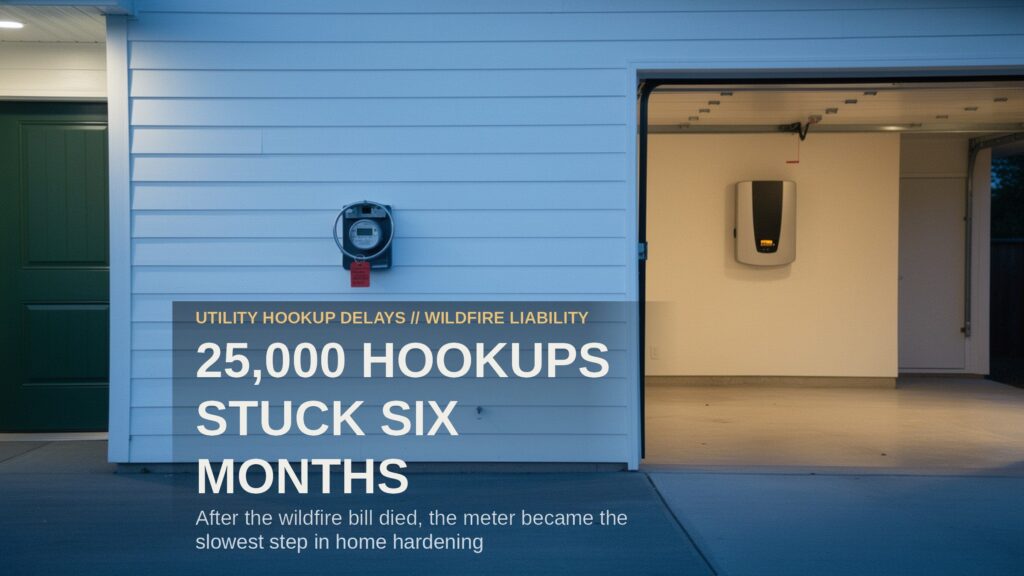
- The number: 25,000 hookups could wait six months past their scheduled date [1].
- The risk: The date a job runs now depends on a queue the household cannot see.
A liability bill hits your panel
The order of events matters, because each step was a choice. Lawmakers declined to vote on Senate Bill 492 on the final night of the session. The next day PG&E cut its 2027 building plan from $13.4 billion to $11.4 billion, a deferral of about $2 billion [4]. The company gives one reason: California’s “inverse condemnation” standard makes a utility pay for fire damage caused by its equipment, even when it followed the safety rules, and that exposure raises its borrowing costs [3]. What strikes me is that the dollar cut is not the fight. The argument lands on the remedy.
In October, the utility sent letters to about 25,000 prospective customers and said the wait could run six months beyond their scheduled connection dates [1]. The affected classes included data centers, larger residential developments, and clean-energy projects [1]. At a hearing on 28 October, a committee heard that more than 60 clean-power and storage projects due by 2030 now have no firm date [2]. Taken together, those projects represent at least 15 gigawatts [2]. Housing and office hookups are being quoted at one to six months [2]. City and county public works got a vaguer answer: 2027 and beyond [2].
That is where a home plan loses its footing. A family that wants to cut its own risk needs the utility to turn the work on. A heat pump, a battery, and a panel that can carry both all end at the meter. The same line holds the data centers and the solar farms, so the household is not racing a crew. It is waiting on a budget set by an argument it cannot join.
By the numbers
- 25,000 hookups: The prospective connections PG&E warned could come six months after their date [1].
- 15 gigawatts: Capacity in the 60-plus clean-power and storage projects now facing no firm date [2].
- $11.4 billion: PG&E’s 2027 building budget, down from $13.4 billion after the bill failed [4].
Where this bites a renovation
The people closest to the fight are arguing about who pays. Consumer Watchdog’s Jamie Court told NBC Bay Area (NBC) that the utility is using hookups as leverage, and he called it “pure, pure blackmail” [1]. The Utility Reform Network’s Mark Toney gave KTVU (a Bay Area television station) a narrower case. Burying line costs about $4 million a mile, he said, and insulated overhead line runs near one-fifth of that, so “ratepayers do pay the interest” either way [4]. PG&E answers that the delayed projects are not yet in customer rates, which is its reply to the claim that customers have already paid [3].
What I am watching is the second clock, the one that belongs to the projects themselves. A project that misses the 2030 tax-credit deadline faces “at least a 30% increase in the cost of those goods”, said Jan Smutny-Jones of the Independent Energy Producers Association [2]. He also said the state may have to keep more than 3 gigawatts of old coastal gas plants running, which is a maybe rather than a decision. For a household the useful part is narrower.
A service upgrade and the gear it feeds are usually bought as one job. The gear can sit in a garage for months while the meter waits. A homeowner can check the panel’s spare room before assuming it needs more amps; the sums behind the 80% test are set out in Your Panel Doesn’t Need More Amps: The 80% Test. A job that runs on the service already in place does not join the queue.
The catch
The bit that stuck with me is that the letters are a risk warning, not a list of missed dates. They do not show that 25,000 hookups have already slipped, and no public list says which projects moved. PG&E says its safety work is not delayed and that the deferred projects are not yet in customer rates [3]. A family cannot look up its place in the queue, cannot read the building plan, and cannot tell from a letter whether its own date will hold. What it can do is get the date in writing before it signs for equipment. That date is the one part of the job it does not control.
Related reading
- Your Battery Gap Is 85% — battery, outage and grid: why most storage sits on the wrong side of the meter
- Your Home Backup Battery Is Sized Against the Wrong Number — backup, critical loads and the panel that has to carry them
- Heat Pumps Just Got Cheaper to Run — and Pricier to Buy — heat pumps, equipment price and the service that feeds them
Sources
- NBC Bay Area — https://www.nbcbayarea.com/investigations/pge-electricity-service-delays/4162462/
- Canary Media — https://www.canarymedia.com/articles/utilities/pge-2b-cut-in-grid-investments
- PG&E — https://www.pge.com/en/newsroom/currents/future-of-energy/answers-to-common-questions-about-pg-e-s-revised-2027-investment.html
- KTVU FOX 2 — https://www.ktvu.com/news/pge-defer-2b-capital-investments-after-wildfire-reforms-collapse