The buyer still pays for the equipment. The saving lands on every meter, so what a buyer sees depends on a rate case — where a utility asks regulators to set prices — and that case has nothing to do with the machine in the basement. [1]
The bill driving the purchase keeps climbing. The average monthly electric bill reached $188 in the third quarter of 2026, up 5.6% from $178 a year earlier. [2]
The big picture:
Most American grids are built for a summer afternoon, not a January night. In the Southwest, the Upper Midwest, and the Northeast, demand peaks in July, so the plants and wires that carry it sit half-idle all winter. That spare room is the winter headroom the model uses, and by RMI’s count it holds 86 million more homes than the 23 million that have a heat pump today. [1]
Heat pumps fill that room with new use and no new power plant. The grid’s fixed cost then spreads across more units of power, which lowers the average price. What strikes me is how old the pattern is: from 1980 to 2000, demand rose more than 70% while inflation-adjusted rates fell about 26%, as the grid was used 18% more efficiently. [1]
Which heat pump goes in matters more than the sales sheet suggests. An all-electric unit carries the whole heating load; a hybrid keeps the furnace for the coldest hours. That second shape lets far more homes convert inside the same headroom — about 65% more in the model. Illinois shows the gap: all-electric units alone reach 30% of homes, while a mix reaches all of them, at 21% all-electric and 79% hybrid, on 8.9 gigawatts of spare winter capacity. [1]
By the numbers
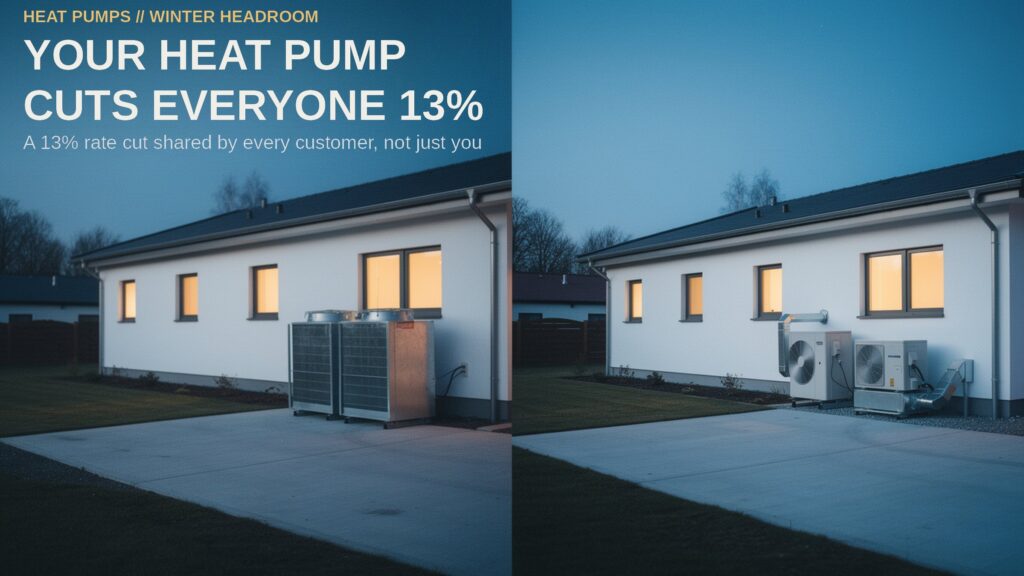
- 13% — Rate cut, mixed fleet: RMI’s mix of all-electric and hybrid units would cut home electric rates by 13% in summer-peaking states, worth $15.6 billion a year, or $200 per customer. [1]
- 6% — Rate cut, all-electric only: the same grid, filled only with all-electric units, would cut rates by 6%, worth $6.7 billion a year, or $86 per customer. [1]
- $188 — Average monthly electric bill: the third-quarter 2026 average, up 5.6% from $178 a year earlier. [2]
- 23% — Electric customers behind on payment: up from 22% a year earlier, with 22% of gas customers and 21% of water customers also owing a balance. [2]
What I’d watch:
I read the quote in front of a homeowner differently: it runs on other math. A contractor prices savings from the household’s own use and its own rate, which is right for a bill and wrong for a system gain. RMI’s third piece of advice is a rate redesign, not a bigger rebate, which says where the report thinks the value leaks away. [1]
The sizing choice is where the two meet. A hybrid often avoids the service upgrade an all-electric unit can force, and the capacity test behind that choice costs far less than the panel it may save. I worked through the 80% test before, and it is the math I would want in hand before signing.
Two signals would show whether the rate effect is real money or a quirk of the model. The first is whether state rate cases start crediting winter heat pump use when they set the fixed charge. A utility that recovers more cost in a monthly fee can cut the per-unit price and leave the buyer’s bill flat. [1]
The second signal is the bill: home electric rates have risen more than 8% in two years, and the share of customers behind on payment went from 22% to 23% in twelve months, which says the problem is arriving faster than the equipment. [1][2]
The catch
I keep circling how soft the central number is. The rate relief is an average from a model of whole states, and the report says its results are rough guides, not forecasts for any one utility. [1]
Who gets paid is the harder part. The buyer captures one customer’s share of a gain that the buyer paid the whole cost to create, and the neighbors capture the same for nothing. That is not a case against buying one, since comfort, cooling, and a hedge against the gas bill still belong to the household. It is a case against trusting a savings line that treats a public gain as a private one.
Timing is the last piece. The households already behind on the bill are the least able to fund the equipment that would lower everyone’s rate, so the help reaches them last. A hybrid still burns gas, and the report’s climate totals describe the whole system, not anything one home can claim.
At a glance
The shift: Heat pumps now count as grid capacity, not just a home appliance. The number: 13% — the modeled rate cut in summer-peaking states, at $200 per customer a year. The risk: Every customer shares the saving; the buyer carries the capital, on a rough model.
Related reading
- Swapping your gas furnace for a heat pump tax credit 2026 just… — more on Energy & Efficiency
- Borrow at 8% to remodel, or let your battery earn on the grid — more on Energy & Efficiency
- Cheap Gas, $20,000 Pipe — more on Energy & Efficiency
Sources
[1] RMI, “The Opportunity for Heat Pumps to Put Downward Pressure on Electricity Rates”, 2026-10-15 — https://rmi.org/resources/the-opportunity-for-heat-pumps-to-put-downward-pressure-on-electricity-rates [2] J.D. Power, “Quarterly Share of Wallet Tracker: U.S. Utilities – October 2026” (Q3 2026 wave) — https://www.jdpower.com/business/news/quarterly-share-of-wallet-tracker-u-s-utilities-october-2026