The big picture:
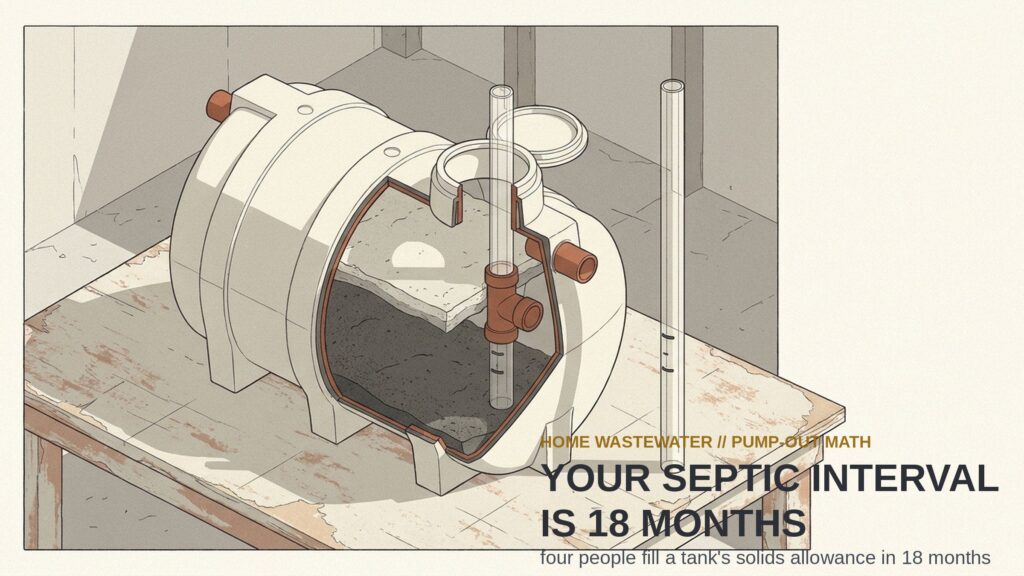
I’ve been collecting these numbers for a month, and what strikes me is how little the sources disagree about the tank itself. All of them describe one buried box: heavy solids sink into a sludge layer, grease and soap float into a scum layer, and a T-shaped outlet pulls the clearer liquid off the middle [2]. That liquid heads to a drainfield of pipe and gravel [2]. It is a settling tank, not a treatment plant, so it holds only so much between pump-outs. Once sludge climbs within 12 inches of the outlet, or scum drops within 6 inches of its bottom, the next flush carries solids out with the water [2].
The schedules part ways over the trigger, and each one states it in a different unit. The U.S. Environmental Protection Agency (EPA) writes it as a share of the tank’s liquid depth [2]; Penn State Extension writes it as a share of tank volume [3]. South Carolina’s environmental agency writes it as a fill range [4]. A depth share and a volume share are not the same thing, and each schedule also bakes in its own guess at how much waste one person makes. That is how three agency pages put the same tank’s interval anywhere from a year and a half to 12 years, depending on how many people live in the house [2][3][4].
What keeps the calendar alive is that no one can see the sludge layer. A receipt that says “pumped” carries no depth reading unless someone wrote one down, so the interval gets bought on trust. Trust defaults to the roundest number on offer.
By the numbers
- 90 gallons — Waste per adult, per year: Penn State Extension’s estimate of what one adult sends to the tank each year, before bacteria digest about 60 percent of it and leave roughly 60 gallons behind [3].
- 30% — Sludge and scum limit: the share of tank volume that sludge and scum may take before pumping, credited by the extension service to regulators and the pumping trade. That is the figure that turns a tank’s size into a countdown [3].
- 19 years — Longest rung in one state’s table: South Carolina’s interval for a 1,500-gallon tank with one resident, against 3 years for four residents on a 1,000-gallon tank [4].
- $15,000 — Top of the repair band: the high end of the EPA’s range for fixing or replacing a failed conventional septic system. The agency sets that against fees of $250 to $500 every few years — a repair bill 10 to 60 times the fee at the low and high ends [1].
What I’d watch:
What separates a scheduled pump-out from a guessed one is a measurement that costs nothing extra. A pumper who measures the sludge and scum levels — a clear tube pushed to the tank floor does the measuring — reads how deep each layer sits against the outlet tee [2]. Those two numbers are the only thing that moves the date. My read: the receipt is where this becomes evidence or fades, because a homeowner holding two readings a few years apart has what no published table can give.
- The two depths: sludge measured up from the floor, scum measured down from the outlet, both in inches and both against a fixed point the next reading can meet [2].
- The change between them: the inch difference across the years between two readings is that tank’s fill rate, and it turns a trigger depth into a date instead of a habit.
- The size underneath: the tank’s daily design flow — the wastewater volume it is sized around — runs 400 gallons for a three-bedroom home against a 900-gallon tank, rising to 500 gallons and 1,250 gallons at four bedrooms [3]. A house with more people than bedrooms is working a tank built for fewer.
- The failure that ends the argument: solids that leave the tank travel into the drainfield and clog the soil, which is why the federal agency puts a repair band beside the fee at all [1]. A septic failure that surfaces is water damage before it is a bill; Water Damage: Your $15,400 Silent Loss is the same failure seen from the far end.
- What the state tables show: South Carolina’s table makes residents, not tank size, the variable that stretches the interval [4].
The catch
The part I keep circling is that all of this assumes a tank that is not already leaking and a household at average use. A garbage disposal grinding food, a hot tub dumped into the system, a broken outlet baffle (the wall that holds scum back from the outlet), or a high water table all move the rate. Penn State Extension’s figure rests on four people at full occupancy — a retired couple with the same tank has years, not months [3]. South Carolina’s ladder says the same from the other side. Its trigger is a range of one-third to one-half of the tank rather than a single share, a useful reminder that none of these numbers were meant to be exact to the month [4].
There is a second limit no interval can fix: a sludge depth tells you when the tank is full, and nothing about whether the drainfield has already taken solids. I could be wrong about how many pumpers will hand the depths over without being asked. A number written on a receipt costs nothing and is the only part of this chain that is evidence rather than a rule of thumb.
At a glance
- The shift: the pump-out interval is math on tank size and household waste.
- The number: 18 months — the extension service’s fill time for a family of four.
- The risk: a measured interval says when the tank fills, not whether the drainfield is failing.
Related reading
- A Smart Sprinkler Pays Back at Your Top Water Tier, Not the… — more on Energy & Efficiency
- Your Heat Pump Cuts Everyone 13% — more on Energy & Efficiency
- Your Roof Claim’s Hidden Second Check — more on Energy & Efficiency
Sources
[1] U.S. Environmental Protection Agency — “Maintaining Your Septic System” — https://www.epa.gov/septic/why-maintain-your-septic-system [2] U.S. Environmental Protection Agency — “How to Care for Your Septic System” — https://www.epa.gov/septic/how-care-your-septic-system [3] Penn State Extension — “Septic Tank Pumping” — https://extension.psu.edu/septic-tank-pumping [4] South Carolina Department of Environmental Services — “Septic Tanks: Preventative Routine Maintenance” — https://des.sc.gov/permits-regulations/septic-tanks/homeowner-resources/septic-tanks-preventative-routine-maintenance