The big picture:
The tax code treats a rented dwelling as a business asset, so it spreads the cost across a useful life. For residential rental property that life is 27.5 years, longer than the appliances, the carpet or the tenant stay [1][5]. That schedule is the one place where a house’s wear is written down as a set number, and it reaches a single owner: the one who rents the space out.
What I find hardest to square is how small that split makes the benefit. A dollar spent on a kitchen you cook in is never deducted. The same kitchen above a rented unit becomes a deduction of a few cents on the dollar each year. The tax code is not rewarding a landlord. It is saying that a building wears out, and that wear on a business asset is a cost of earning the rent.
The timing matters more than the size. The write-off arrives slowly, it is often unusable in the years it builds up, and it is reversed at the sale. A homeowner who signs a lease to capture a tax break is buying the smallest part of the deal first.
By the numbers
- 3.64 percent — Annual slice: One divided by 27.5 is the share of a conversion the tax code lets an owner deduct each year, so that is $2,182 on a $60,000 build and $1,091 on a $30,000 one [1].
- $150,000 — Where the loss stops counting: A special $25,000 allowance for rental real estate falls by half of modified adjusted gross income above $100,000, hitting zero at $150,000. Above that line, the loss carries forward instead of lowering income [2].
- 25 percent — The rate on the way back: Depreciation taken on a dwelling is taxed at up to 25 percent on sale, not at the long-term capital gains rate [4].
What I’d watch:
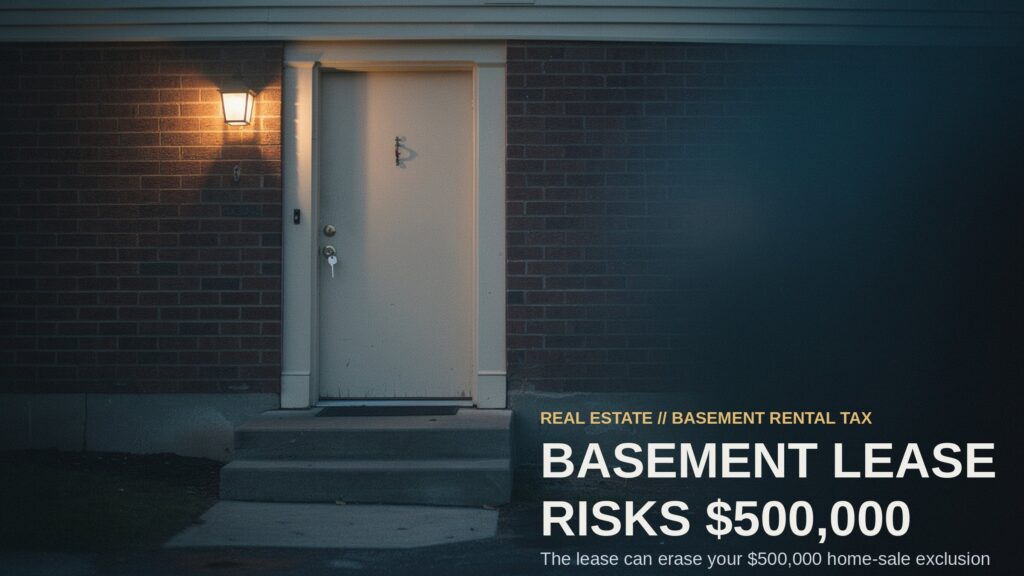
I keep circling the horizon, because it decides more than the deduction does. The exclusion needs the owner to have lived in the home for 2 of the last 5 years [3], which leaves roughly three years of renting before the test fails. Rent longer and the exclusion goes, and the rented years cut it even when the test still passes [3].
- Three years — The exclusion’s fuse: A lease that outlasts the residence test turns a gain that would have been tax-free into a taxable long-term gain [3].
- Five years — The parts inside the walls: Appliances and carpet in a rental run on five-year schedules while the building runs on 27.5, so a conversion quoted as one number is not one asset [1].
- Fair market value — The basis you actually get: At conversion the depreciable basis — the tax-cost number used to figure gain — is the lesser of fair market value or adjusted basis [1], so a soft market lowers the base you write off, not the price you paid.
- The $25,000 allowance — Who can use it: Above the income line the paper loss is suspended, so the deduction works against collected rent and never against a salary [2].
The build-versus-buy case for adding the unit already rested on a tenant, and that tenancy is what starts this clock. Nothing about the schedule changes the rent. It changes what the rent costs you later.
The catch
My read is that the deduction is close to a wash for most owners who chase it. At a 24 percent marginal rate the write-off saves $14,400 across the full schedule, and the recapture takes back a quarter of the same base at the sale, or $15,000 at the top rate. At 35 percent the owner keeps the gap, which comes to $6,000, or about $218 a year.
That is the honest size of the prize. The conversion should be justified by the rent, the space or the resale; the schedule changes timing rather than the verdict. Where it does change the verdict is at the exit. An owner who rents for a decade and then sells has turned a tax-free gain into a taxable one and paid the recapture in the same transaction.
Nothing here replaces an accountant reading the return. The rules above come from the 2025 editions of the IRS publications, so a reader filing later should check the current ones. The arithmetic is mine; the rules are theirs. The real decision is how long the lease runs, not how large the deduction looks.
At a glance
The shift: Renting a converted space turns a house into a business asset, and the write-off is smaller than the exclusion it endangers. The number: $2,182 a year, before it is taxed back at the sale. The risk: A lease past three years ends the residence test, and the exclusion goes.
Related reading
- Your Heat Pump Cuts Everyone 13% — more on Energy & Efficiency
- Borrow at 8% to remodel, or let your battery earn on the grid — more on Energy & Efficiency
- California Legalizes Plug-In Home Solar Panels — more on Energy & Efficiency
Sources
[1] Internal Revenue Service — Publication 527 (2025), Residential Rental Property (residential rental property depreciated over 27.5 years; appliances and carpet on five-year schedules; basis of property changed to rental use is the lesser of fair market value or adjusted basis): https://www.irs.gov/publications/p527 [2] Internal Revenue Service — Publication 925 (2025), Passive Activity and At-Risk Rules (special $25,000 allowance reduced by 50 percent of modified adjusted gross income above $100,000 and unavailable at $150,000 or more): https://www.irs.gov/publications/p925 [3] Internal Revenue Service — Publication 523 (2025), Selling Your Home (exclusion of $250,000, or $500,000 on a joint return; ownership and residence for 2 of the last 5 years; exclusion reduced to the extent of depreciation adjustments and cut for nonqualified use): https://www.irs.gov/publications/p523 [4] Cornell Law School, Legal Information Institute — 26 U.S.C. § 1(h)(1)(E), 25 percent rate on unrecaptured section 1250 gain: https://www.law.cornell.edu/uscode/text/26/1 [5] Cornell Law School, Legal Information Institute — 26 U.S.C. § 168(c), applicable recovery periods (residential rental property, 27.5 years): https://www.law.cornell.edu/uscode/text/26/168