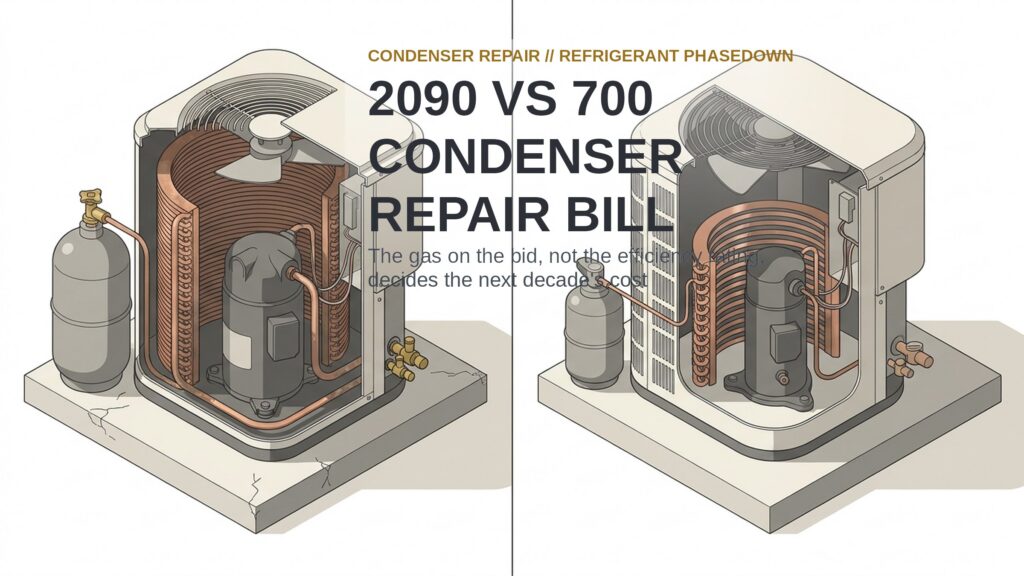
That gap changes the repair decision. A repair that refills an old coil puts money into a fluid whose national supply is being cut by statute, while a replacement has to use a fluid inside the 700 line. The number worth reading on a bid is the refrigerant, not the efficiency rating next to it.
At a glance
- The shift: the refrigerant class now sets a system’s service life, not the efficiency rating.
- The number: 2,090 — the warming potential of the gas in most older systems.
- The risk: the 700 ceiling governs new equipment, not the gas sold to service old systems.
The rule came before the price
Congress wrote the national hydrofluorocarbon phasedown into the American Innovation and Manufacturing (AIM) Act of 2020, and EPA published the implementing rule on October 24, 2023 [6]. The first date a homeowner would notice arrived on January 1, 2025, when the agency barred installing a residential or light-commercial air conditioner or heat pump with a fluid at a warming potential of 700 or above [7]. Then it let units built or imported before that 2025 cutoff be installed through the start of 2026, an allowance that kept stock from being stranded [6].
The cap works on supply, not on what a household already owns. It limits how much of these gases may be made or used in a year, measured against the average volume from 2011 through 2013 [5]. The permitted share is 60 percent through 2028 [5]. It falls to 30 percent from 2029 and reaches 15 percent from 2036 [5]. A coil that leaks in the next decade will draw on a smaller allowance, while the one it was built under is already gone. Nothing in that schedule asks how old the equipment is.
I had to read the allowance schedule twice to accept the 2029 step. The gap that matters is a matter of timing, because a system is built in one year and its gas gets scarce in another. It lands unevenly: an owner who replaces a working system pays once and steps off the schedule, while an owner who repairs a failed compressor is buying gas for a box with years left in it. The value of that repair now rests on a supply schedule written in Washington.
By the numbers
- 2,090 — the gas in the old box: R-410A’s warming potential, in safety group A1 [2].
- 470 — the gas in the replacement: R-454B’s warming potential, in the mildly flammable class (A2L) [3].
- 30 percent — the later allowance: the statute permits this share from 2029 through 2033 [5].
Where this bites in the quote
A bid turns on three details, and none of them is the efficiency rating. The first is the fluid named on the data plate, because R-410A and R-454B cannot be swapped. The second is the build date: a “new” R-410A system sold now can only be assembled from parts made or imported before the 2025 cutoff [7]. The install allowance for that older stock ran out at the start of 2026, and that cutoff is worth confirming on a bid [6]. Handling is the third, because the substitutes EPA lists for this subsector sit in the mildly flammable class (A2L), and the class changed the tools and the training around them [3]. The other substitute on that list is hydrofluorocarbon 32 (HFC-32), at 675 [4].
I keep the 2029 allowance step pinned because it is a fixed cut. It lands inside the service life of anything bought this year [5], and no bid will mention it. Variable refrigerant flow (VRF) equipment runs on a later schedule of its own, with the limit arriving in 2026 and pre-2026 parts installable through 2027 [7]. The agency reopened parts of the rule in May 2026, so the dates printed on a current bid deserve a second look [6].
A temperature split across the coil is the reading that separates a metering fault from a dead compressor, and it comes before any decision about what gas goes back in. 11 Degrees Kills the Compressor Quote walks through that split, and both questions land on the same work order.
The catch
What I find hard to square is how little of this restricts what a household may own. EPA still lists R-410A as an acceptable substitute, so recharging an existing system remains legal [2]. The 700 ceiling applies to making, importing, and installing new equipment, not to the gas sold to service an old one [1]. A reader who hears a ban on their own condenser has heard it wrong. The same table that carries the 2,090 figure also carries the word “acceptable” [2].
A household with a working system has nothing to decide until that system fails. But no public source prices the gas at the counter. The scarcity case rests on the statute’s own percentages, and a forecast of what the fluid will cost next winter would be the first number to go stale [5]. So the useful output is a question, not a number: which fluid the equipment takes. The agency did revisit parts of the rule in May 2026 [6].
Related reading
- 20% of Your AC Never Arrives — the factory efficiency rating measured against the ducts that deliver it
- Your Tank’s Class Costs $55 — the equipment class, not the fuel, sets the running bill
- Heat Pumps Just Got Cheaper to Run — running cost measured against equipment-price inflation
Sources
- [1] U.S. Environmental Protection Agency — “HFC Restrictions by Sector” — https://www.epa.gov/climate-hfcs-reduction/hfc-restrictions-sector
- [2] U.S. Environmental Protection Agency — “Substitutes in Residential and Light Commercial Air Conditioning and Heat Pumps” (R-410A row) — https://www.epa.gov/snap/substitutes-residential-and-light-commercial-air-conditioning-and-heat-pumps
- [3] U.S. Environmental Protection Agency — “Substitutes in Residential and Light Commercial Air Conditioning and Heat Pumps” (R-454B row) — https://www.epa.gov/snap/substitutes-residential-and-light-commercial-air-conditioning-and-heat-pumps
- [4] U.S. Environmental Protection Agency — “Substitutes in Residential and Light Commercial Air Conditioning and Heat Pumps” (HFC-32 row) — https://www.epa.gov/snap/substitutes-residential-and-light-commercial-air-conditioning-and-heat-pumps
- [5] 42 U.S.C. 7675 — “Phasedown of hydrofluorocarbons” — https://law.cornell.edu/uscode/text/42/7675
- [6] U.S. Environmental Protection Agency — “Regulatory Actions: Technology Transitions” — https://www.epa.gov/climate-hfcs-reduction/regulatory-actions-technology-transitions
- [7] 40 C.F.R. § 84.54 — “Restrictions on the use of hydrofluorocarbons” — https://www.ecfr.gov/current/title-40/chapter-I/subchapter-C/part-84/subpart-B