At a glance
Home Assistant’s 2026.11 release made Matter 1.5 cameras into local camera entities with a talk button in preview. This piece explains what that takes away from camera subscriptions, and which limits still apply.
The last paid feature
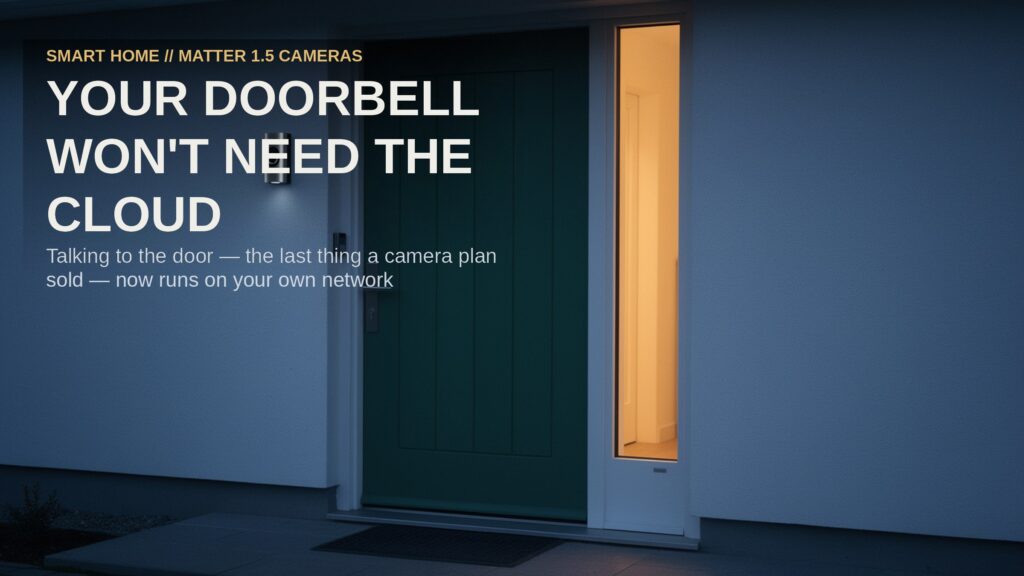
The groundwork sat in the hub’s server code for a while, doing work no one could see. This release brings it to the surface [3]. A camera plan sold three things at once. It kept your clips on someone else’s server, it relayed the video so your phone could reach home, and it carried your voice back to the door. The camera part of Matter turned the hardware into a plain, open definition, and this release pulls the interface onto the hub you already run [1]. The video no longer detours through a vendor’s server. The stream runs browser-to-camera over WebRTC, the direct peer-to-peer video connection, and the feed mirrors the camera’s own state [1]. That includes whether its privacy mode is on. I read the feature list twice before noticing which piece the standard swallowed last. Storage was already easy to replace in a house that keeps its data local — an earlier piece here counted what an always-recording camera can quietly fill [2] — but speaking through the door was the feature even skeptics paid for. The release notes put it plainly: a test feature called Two-way audio “adds a talk button to the live stream, so you can talk to whoever is near your camera or doorbell” [1].
By the numbers
- 2 camera paths: the talk button works with Matter cameras and with Reolink cameras, and nothing else yet [1].
- 1.5: the Matter spec release that moved cameras into the open standard [1].
What the makers decide next
Only two kinds of camera reach the button today. Matter cameras work out of the box, and Reolink cameras work when set to their direct streaming mode, because the older streaming formats cannot carry sound back to the camera [1]. A Matter camera also needs a Matter server new enough for the job. Home Assistant finds cameras only when the server it talks to can see them [1]. The microphone carries its own limit. Browsers allow mic access only over a secure connection, so the talk button currently requires opening Home Assistant at its secure web address. The team says support inside the mobile apps is still being built [1]. The people closest to this are already testing the edges. Matter Alpha’s coverage notes the talk button appears only where the camera’s own link-up has added support [3]. Reolink has told Matter Alpha that its plug-in cameras with a speaker should get the new abilities through Home Assistant [3]. What I am watching is the firmware changelogs, because the gear decides here, not the hub. The question that settles whether your camera benefits is whether its maker ships the camera profile of the standard. That answer lands in the maker’s own release notes.
The catch
My reading, held loosely: this sets a floor under the price, not a funeral for the plan. This is a test feature, not a finished product, and the release notes never pretend otherwise [1]. The path that makes the stream direct also narrows who gets it. You need a camera that speaks the camera profile of the standard, a current Matter server, and a secure connection for the mic. The plan is not dead either. Cloud archiving still holds footage off-site. That matters when a thief takes the very camera that filmed them. What changed is the floor under the price. Talk-back, the feature that paid for itself at the door, is now something the standard hands you. Every renewal notice this winter gets measured against that [1].
Related reading
- local-first smart home cost squeeze — more on Smart Home & Security
- Your Camera Eats 66 GB — more on Smart Home & Security
- Your Washer Now Costs 100,000 Calls — more on Smart Home & Security
Sources
- [1] Home Assistant, “2026.11: A lot in store!”, 2026-11-04 — https://www.home-assistant.io/blog/2026/11/04/release-202611/
- [2] Editorial desk, “Your Camera Eats 66 GB: The Hidden Cost”, 2026-10 — https://wellroost.com/your-camera-eats-66-gb-daily/
- [3] Matter Alpha, “Matter cameras and two-way talk officially arrive in Home Assistant 2026.11”, 2026-11 — https://www.matteralpha.com/industry-news/matter-cameras-and-two-way-talk-officially-arrive-in-home-assistant-2026-11