The big picture:
Husqvarna sells into both markets, so its latest results read as a split screen. Sales fell 5 percent organically in the quarter, and the forest and garden arm dropped 10 percent [1]. The group blamed bad weather, “competitive headwinds”, and dealers holding far too much stock across Europe, then answered with “targeted price increases” [1]. That is the classic defense of a market leader squeezed on price.
The picture in America looks different. On 28 July the Federal Communications Commission (FCC) put “advanced robotic devices” built abroad on a list of gear barred from the US market unless it wins an exemption [2][3]. A maker can escape that block with a conditional approval from the Department of War, and the agency posts each one it grants [2]. The rule catches any moving yard helper over 4.4 pounds, if it carries a sensor, a network link of at least 200 kilobits a second, and software that steers it [3]. New designs are blocked, while models approved before the change keep selling [3].
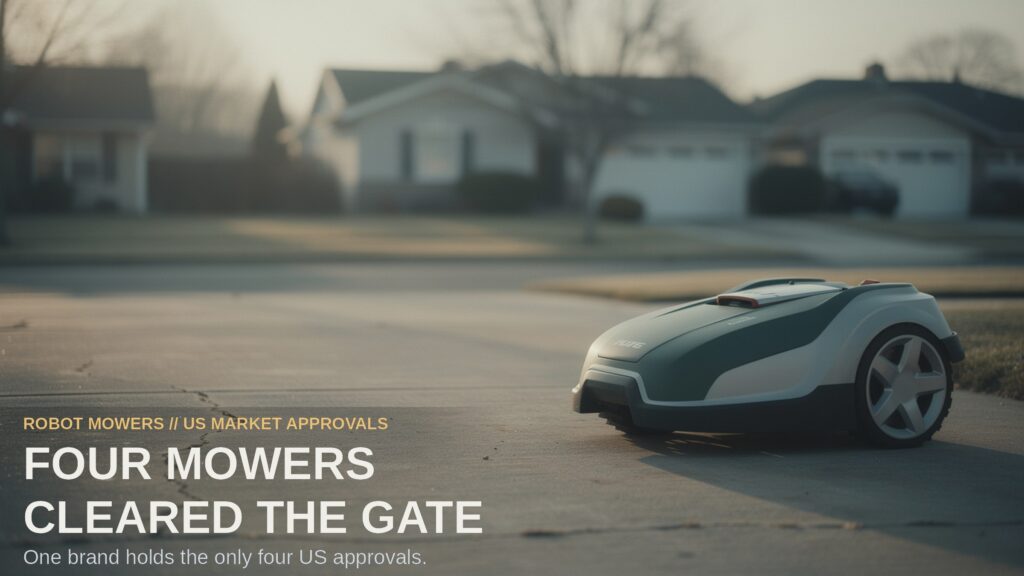
I read the table three times. It lists seven robot approvals, and a single entry covers the yard: Husqvarna’s 305v iQ, 310v iQ, 420v iQ and 440v iQ, granted on 9 September for a 2027 launch in the US market [2][4]. The rest are floor cleaners and factory carts. Four of the seven arrived on or after 16 October, so the queue moves quickly, but it bypasses the mower aisle. The same page carries twenty drone approvals and twenty-three for routers against seven for robots, so the queue is not slow in general; it is slow for machines that drive themselves around a yard [2]. In the month the leader admitted it cannot hold price in Europe, its four platforms stood alone with approval in America.
By the numbers
- 334 million krona — Quarterly loss: the group operating result fell to a loss of 334 million krona from income of 141 million a year earlier, a -3.7 percent margin against 1.5 percent [1].
- 4 of 7 — Yard models approved: the FCC lists seven robot approvals, and Husqvarna’s four mowers are the only home garden gear among them [2].
- 65 percent — US content bar: a mower dodges the list if it counts as domestic: local parts above 65 percent of cost through 2028, and 75 percent from 2029 [3].
- $800 to $2,500 — What buyers pay: the mowers in Consumer Reports’ current ratings run from about $800 to more than $2,500, against $400 to $800 for its top battery walk-behind mowers [5].
What I’d watch:
The public record changes by notice, so the next entry is the signal. The agency also lets a maker apply for a whole class of devices, which is how four models landed in one entry [3]. An approval for a second brand would mean 2027 brings a real choice, rather than four takes on a single design.
- The next name on the register: a new brand appears there before it reaches a store [2].
- A premium on the four: a market with one approved supplier is the easiest place to hold a price [1].
- Stock of older models: everything approved before 28 July can still be imported and sold, which is where this season’s deals sit [3][5].
- Any move against old approvals: the agency can also halt the import of gear it already approved, using a process in its own rules, last used in June 2026 for older covered gear [2].
The market leader is hardly finished. The group still expects 3 billion krona of gross savings by the end of 2028, with about 935 million booked so far [1]. America is also where it already sells the most robot mowers to golf courses, with more than 500 of them on its platforms and 24 percent of group sales booked there in 2025 [4]. What I am watching is narrower: whether a rival ever joins a list that currently holds one name.
The catch
Consumer Reports tells readers the government “banned the sale” of robots built abroad, then adds that it skips mowers already owned or already approved [5]. The agency is narrower: new models cannot get approval, while older models keep flowing to stores [3]. If you own one today, none of this reaches you.
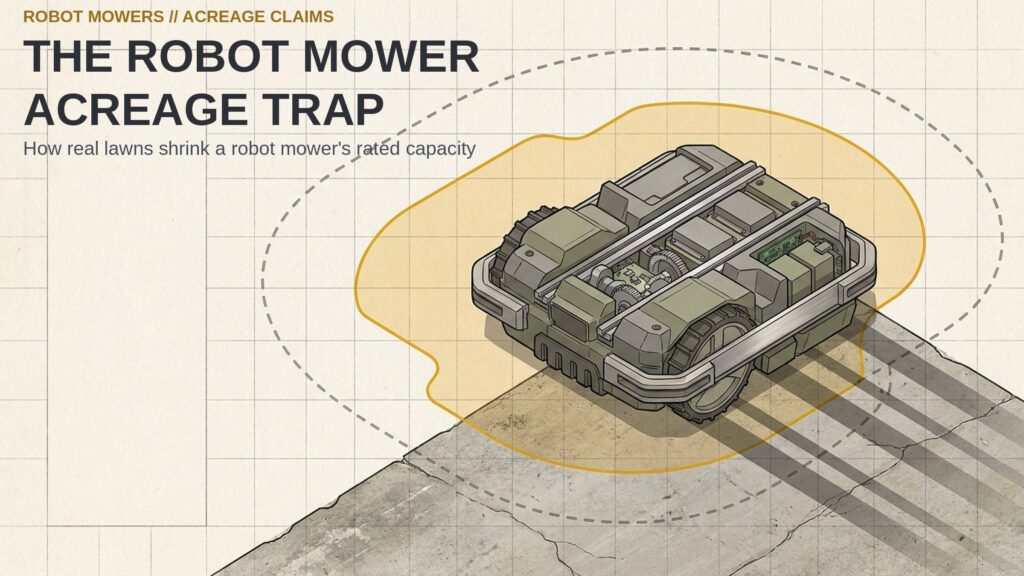
So the shortage sits in next year’s models, not in the aisle. I keep coming back to what the list leaves out: it records approvals, not applications, so nobody outside the agency knows how many rivals asked and were turned down. No source in this run publishes a rival price either, so the claim that the price war will not arrive on schedule is a judgment about a queue, not a forecast. The rated acreage on a spec sheet is already a best case, which makes the gap between rated and usable area the other place a buyer’s math goes wrong.
At a glance
The shift: New robot mowers built abroad need their own US approval, and the public register holds one home yard brand. The number: Seven approvals granted, four of them since 16 October, and only Husqvarna’s four mowers. The risk: Waiting for a cheaper 2027 model is a bet on a queue you cannot see.
Related reading
- Snow Robot Stops at 6,000 ft² — more on Yard Robots & Automation
- Your 1-Acre Mower’s 0.4-Acre Trap — more on Yard Robots & Automation
Sources
[1] Husqvarna Group, “Interim report January – September 2026”, 2026-10-21 — https://www.husqvarnagroup.com/en/press/interim-report-january-september-2026-2490517 [2] Federal Communications Commission, “List of Equipment and Services Covered By Section 2 of The Secure Networks Act” (Covered List and Conditional Approvals, updated 2026-10-23) — https://www.fcc.gov/supplychain/coveredlist [3] Federal Communications Commission, “FAQs on Recent Updates to FCC Covered List Regarding Foreign-Produced Advanced Robotic Devices and Power Inverters” (updated 2026-10-27) — https://www.fcc.gov/covered-list-faqs-robots-inverters [4] Husqvarna Group, “Husqvarna Group first to receive FCC Conditional approval for foreign-manufactured advanced robotic lawn mowers in the U.S.”, 2026-09-09 — https://www.husqvarnagroup.com/en/press/husqvarna-group-first-receive-fcc-conditional-approval-foreign-manufactured-advanced-robotic [5] Consumer Reports, “Best Robotic Lawn Mowers of 2026, Tested and Reviewed” — https://www.consumerreports.org/home-garden/lawn-mowers/best-robotic-lawn-mowers-a2310984432