| Region | Mowing season | Weekly visit | Annual total |
|---|---|---|---|
| Northeast | ~24 weeks | $49–$77 | $1,176–$1,848 |
| Midwest | ~26 weeks | $48–$70 | $1,248–$1,820 |
| West / Northwest | ~34 weeks | $45–$68 | $1,530–$2,312 |
| Southeast | ~45 weeks | $46–$72 | $2,070–$3,240 |
| Southwest | ~46 weeks | $42–$64 | $1,932–$2,944 |
These published quotes cover a standard quarter-acre lawn, drawn from service bookings made between September 2025 and September 2026 [1]. Mowing runs $45 to $75 a visit across these regions, and most homes pay $60 [1]. Anyone pricing a robot against that bill is weighing a one-time buy against a seasonal service, which makes the machine look like a steal in Georgia and a hard sell in Maine.
The big picture:
Mowing is sold by the visit and budgeted by the year, which makes standard payback claims wrong.
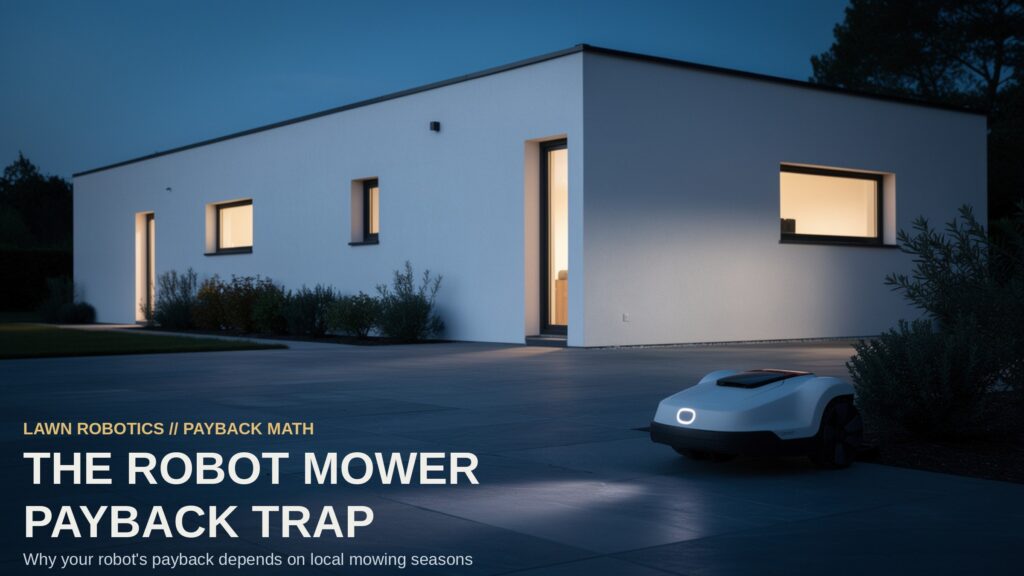
My read is that the math in those brand write-ups works fine, but the calendar they use is wrong. A one-year payback built on twelve months of constant mowing stretches close to two and a half years in the Northeast. That distance is the whole gap between buying the machine and leaving it on the shelf.
The monthly average makes this error harder to spot. Booking sites post a per-month lawn care figure that folds in feeding, leaf removal, and bed weeding [1]. Spreading that big sum over a full year gives a number much larger than a northern mowing bill, but a robot only cuts the grass.
The base pay explains why the visit price stays firm. The federal labor survey puts median pay for yard and grounds workers at $18.82 an hour in its 2025 data [2]. At that rate, a $60 visit covers about 3.2 hours of a worker’s time before adding fuel, gear, or the drive between jobs.
By the numbers
- 2.8× — One mower, two seasons: The quarter-acre machine’s payback runs 2.38 years against the lowest Northeast bill and 0.86 years against the highest Southeast one, a spread set only by how many weeks the grass grows [1].
- $451.68 — A season of your own mowing: That is 24 weeks at the source’s own “1+ hour per mow” estimate, paid at the median worker wage [1][2]; the same sum over a 45-week season gives $846.90.
- 6.2 — Seasons of northern labor: The quarter-acre list price equals 6.2 Northeast seasons of doing the work yourself at that wage, next to 3.3 Southeast seasons [1][2].
- 3.2 hours — What one visit buys: Dividing a $60 visit by the median hourly wage shows the time covered at the base line, while a $75 visit covers 4.0 hours [1][2].
What I’d watch:
The quotes that hold up arrive with a visit count attached, and that count is the first detail worth reading.
- The season line: Yard crews who quote a flat rate usually know their local season to the week, so the annual bill flows right from it.
- The quarter-acre scope: Published per-visit prices apply to a quarter-acre lawn [1], while the machines in this class — the ones the yard robots hub sorts by rated area — start at a quarter acre and climb. On a bigger lot, the service bill grows with the visit price while the hardware price barely moves.
- The sale window: Kress offered its quarter-acre KR161 at $1,499.99 against a $2,799.98 list price, in a sale dated to 31 December 2026 [3]. A discount like that halves every payback number here, so the price in any comparison is a dated input rather than a fixed trait.
The catch:
The data behind these figures belongs to a single booking site built to sell yard visits [1]. A local crew who mows four lawns on one street may bill quite differently, and no broad survey of private contract prices is checked here.
These totals also cover mowing only. Feeding, aerating, and leaf cleanup sit outside them, and a robot does not do that heavy work. The full-service monthly average that payback claims quote makes the savings look much bigger than the pure mowing line does [1]. I find it hard to square a test that subtracts a full-service bill from a machine that only cuts grass.
There is also a hardware cost the service contract avoids: blade sets, and in time a new battery. I could not find a clear battery price or cycle count for either machine, so that cost is left out of the math rather than guessed. A true lifetime cost model needs those upkeep lines.
Scope is the final limit. The one-acre machines in this class are being priced against a bill for a quarter of their rated area, so the northern payback figures are the cautious end of the range rather than a national number [1][4]. On a lot that is sloped, gated or cut into zones, the machine may not cover the area at all.
At a glance
The shift: Payback claims now rest on the exact weeks a region’s grass grows, not on a twelve-month contract. The number: 2.8× separates the shortest and longest U.S. mowing seasons. The risk: Published visit prices assume a quarter-acre lot, so a larger yard moves the answer more than the machine does.
Related reading
- Your 1-Acre Mower’s 0.4-Acre Trap — more on Yard Robots & Automation
- Emporia Vue: How to Cut Energy Bills — more on Smart Home & Security
- Your Class 4 Roof: Ten Times Riskier — more on Energy & Efficiency
Sources
[1] Lawn Love, “How Much Does Lawn Mowing Cost in 2026?” — guide dated 26 October 2026, data September 2025 to September 2026 — https://lawnlove.com/blog/lawn-mowing-cost/ [2] O*NET OnLine, Landscaping and Groundskeeping Workers (37-3011.00), 2025 wage data — https://www.onetonline.org/link/summary/37-3011.00 [3] Kress, robotic mowers range page and dealer list prices, read 31 October 2026 — https://www.kress.com/en-us/robotic-mowers [4] Husqvarna, Automower 420 iQ product page, price and rated capacity, read 31 October 2026 — https://www.husqvarna.com/us/robotic-lawn-mowers/automower-420-iq/