At a glance
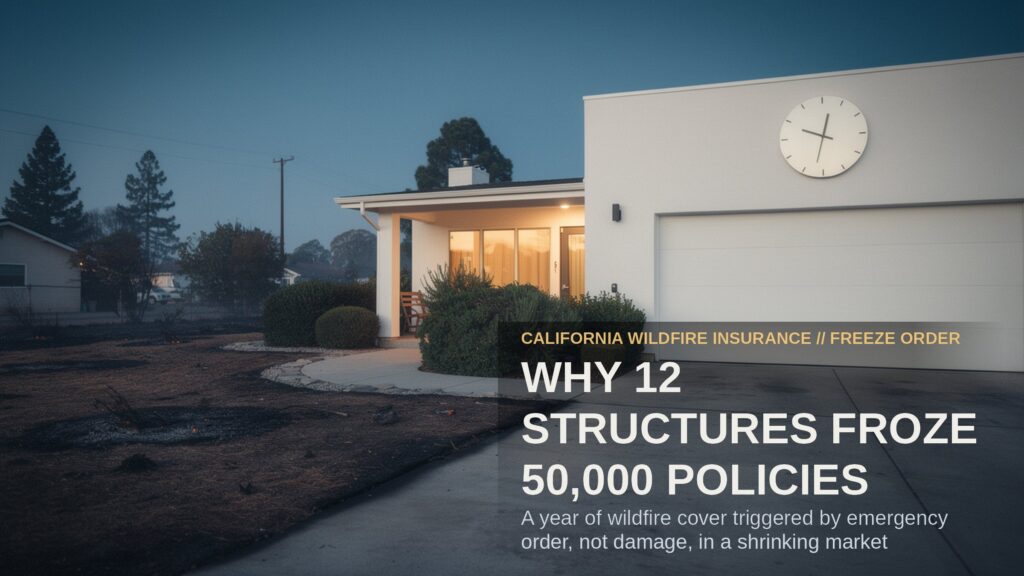
- The shift: California now hands out a year of insurance protection by fire perimeter, not by damage.
- The number: 50,000 policies protected by a fire that destroyed 12 structures.
- The risk: the year starts at the emergency declaration, so 26 days were gone before the order printed.
The clock starts before the notice
The dates tell the story better than the order does. The Dove Fire started on 26 July near Highway 108 and Stockton Street. The state fire agency (CAL FIRE) lists the cause as arson, and its officers arrested a 30-year-old Sonora resident the same day [4]. Crews had the fire contained on 1 August [2].
The governor’s emergency order for Tuolumne County was signed on 15 October, eighty-one days after ignition [2]. The commissioner’s order came on 10 November, another twenty-six days later [1]. I read the sequence three times before the middle step made sense.
It was a cleanup order, written to clear hazardous debris from a fire that had been out for ten weeks [2]. Under state law, though, cleanup is enough. That order starts the clock, so the twelve months run to 15 October 2027 [1]. Nobody in the three counties got a full year. They got a year minus the gap between the debris order and the notice.
The map does the rest of the work. Cover follows the burn scar: the postal code zones next to the perimeter, in Tuolumne, Stanislaus and Calaveras counties, whether or not a household lost anything [1]. A law that took effect on 1 January widened the net. Commercial policies under $25,000 a year now qualify, along with homeowners groups, apartment blocks, student housing and senior living [1]. The map is drawn from a burn scar, and everything after it is a count in an office.
By the numbers
- 81 days: From ignition to the declaration that started the protection clock [2].
- 4,167 policyholders: The population protected for each of the 12 destroyed structures [1].
- 195,929 new policies: The state plan’s fiscal 2026 intake, a 27% drop in its average month [3].
The market behind the year
A freeze buys time, and it helps to know what market that time is spent in. The California FAIR Plan, the state-created insurer of last resort, closed its books on 30 September [3]. It stood behind $773 billion of exposure, up 252% since 2022, spread across 698,307 live policies [3]. Premiums booked for the year came to $2.04 billion [3]. That figure is what the plan billed its members for cover, not what it paid out in claims.
The intake is the part that moved the other way. New business totalled 195,929 policies, an average of 16,327 a month, which is 27% below the prior year’s average month [3].
For a household inside a freeze, that mix matters at renewal: the year buys time to be declined again, not a lower price. A 29.1% average increase also took effect in the same month for homes that had nowhere else to go; the exit math behind that increase covers what it costs to leave.
The department reads the same market more warmly. Its release notes that twelve insurance groups, among them seven of the state’s largest home carriers, are staying and growing in fire-affected areas [1]. My reading is that both statements can be true at once. A carrier can grow in the parts of a county it likes while the addresses it declines keep feeding the plan.
The catch
The department never says how many of those 50,000 policyholders are FAIR Plan customers. Neither document links the two counts, so setting 50,000 beside 698,307 gives a share of about 7% that is worth an order of magnitude at most. I want the March quarter’s intake number, because one soft year is a data point and two is a direction.
The 4,167 comparison deserves the same caution. It divides protected policyholders by destroyed structures, and it is not a chance that any home was hit. I could be wrong about the slow clock mattering much. Most households will never test the cover, and the ones who do will find that a year is enough only if a carrier will write them at all.
What the record does support is narrower, and more useful. A small arson fire bought a freeze across three counties. A far larger fire next door did the same for its own county. The Gann Fire burned 10,339 acres and damaged or destroyed more than 50 structures, and it drew a Calaveras County declaration on 6 August [2]. Both clocks started with a signature, not with an acre count. That is the piece a homeowner can use without waiting for a notice, because it says which event to date and which letter to keep.
Related reading
- Your Nonrenewal Isn’t Final: Count 120 Days — more on Home Cost Decisions
- Energy & Efficiency — more on Energy & Efficiency
Sources
- [1] California Department of Insurance, “Commissioner Lara protects 50,000 Californians across three counties from non-renewals following wildfire emergency,” 2026-11-10 — https://www.insurance.ca.gov/0400-news/0100-press-releases/2026/release041-2026.cfm
- [2] Cal OES News (Office of the Governor), “Governor Newsom activates statewide response amid dangerous fire weather, signs actions to speed Tropical Storm Rachel recovery and wildfire cleanup,” 2026-10-15 — https://www.news.caloes.ca.gov/governor-newsom-activates-statewide-response-amid-dangerous-fire-weather-signs-actions-to-speed-tropical-storm-rachel-recovery-and-wildfire-cleanup
- [3] California FAIR Plan Association, “Key Statistics & Data” (statistics through September 2026, Fiscal Year End 2026) — https://www.cfpnet.com/key-statistics-data/
- [4] CAL FIRE, “Dove Fire” incident record, Tuolumne-Calaveras Unit — https://www.fire.ca.gov/incidents/2026/7/26/dove-fire