At a glance
- The shift: The mesh size the code and the discount list accept still lets embers through.
- The number: 71% open area for a 1/16-inch screen, against 75% at 1/8 inch [2].
- The risk: Finer mesh cuts airflow, so a fully screened attic can go under-ventilated.
The screen was a rodent guard
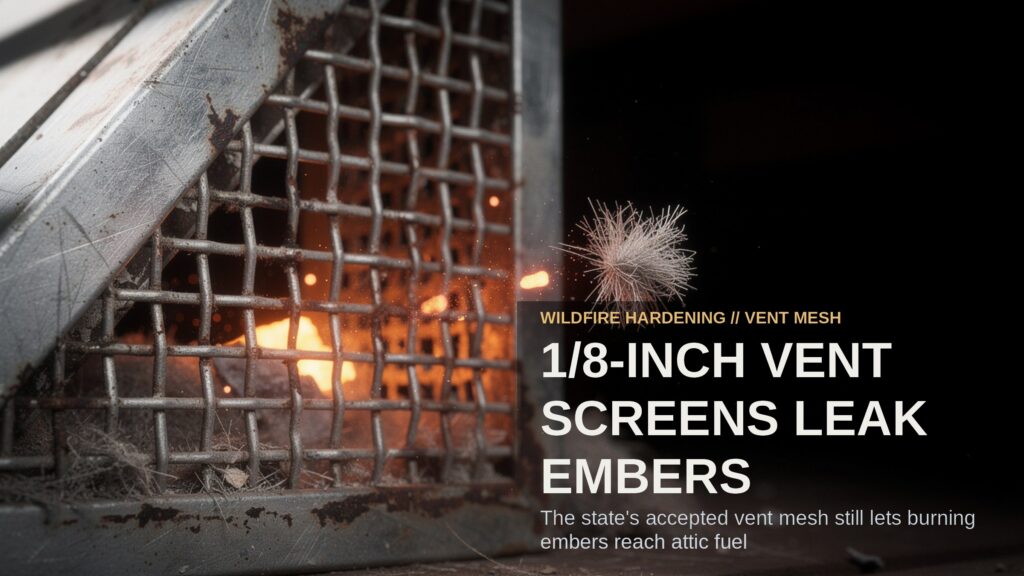
The mesh in a vent was never a fire device. It kept rodents and nesting birds out of the attic, and a quarter-inch opening did that job. The code then moved to 1/8 inch for ember resistance, and the retrofit guidance now calls the quarter-inch screen ineffective [2].
That history explains why the number moved one step and stopped. A mesh size is the one thing an inspector, a contractor, and a homeowner can all check from the ground, so the prescriptive path in the code is a mesh size. The performance path measures the whole vent instead: no flaming ignition during the ember test, no flaming ignition during the flame test’s integrity portion, and an unexposed face that stays under 662°F (350°C) [4]. That path needs a listed product, a test report, and a model number.
I read the two paths side by side and keep coming back to how differently they treat the same opening. The Insurance Institute for Business & Home Safety calls wind-blown embers the principal cause of building ignitions during wildfires, and vents one of the most vulnerable points in a structure [5]. The discount list reduces all of it to a mesh range [1]. The screens differ by a few points of open area — 81% for the quarter-inch, 75% for the 1/8-inch [2] — and nobody in that chain is lying. Each document answers a narrower question than the one the house asks.
By the numbers
- $40 a vent: The council’s estimate for a listed assembly where flames can reach the opening [2].
- 662°F: The ceiling the flame test puts on the unexposed face of a vent [4].
- 144 square inches: The largest single vent opening the code allows, which a finer screen still has to feed with air [4].
Where the money goes
Exposure is not evenly spread across a house. The gable-end vent, set in the triangular wall under the roof peak, faces the wind head-on, and Fire Safe Marin advises against it or wants a listed assembly where it cannot be avoided [2]. Open-eave soffit inlets under the roof edge sit where burning material collects, and the guidance prefers a soffited eave for that reason [2]. Ridge and off-ridge vents, along and near the roof’s top edge, take less, though the same guidance warns against the unresistant versions of both [2]. Foundation and crawlspace openings are still openings into the building’s underside.
The council’s own rule for spending is blunt. Where flame impingement is plausible, a listed assembly is a good investment, and where only embers are plausible, mesh alone is adequate [2]. My reading is that this ranks the job better than any “ember-resistant vents” line item does, because it puts the money on the two faces that can see fire and leaves the rest as screening.
The airflow arithmetic is where a cheap retrofit goes wrong. Backing an existing quarter-inch screen with 1/16-inch mesh takes that opening from 81% open to 71% [2], and a vent sized at the code minimum has no spare capacity for a tenth of its face. Debris no longer falls through, so the finer mesh needs cleaning more often [2]. Neither cost appears on a discount form. Block-level hardening is somebody else’s bill — the state’s own estimate covers every house on the street, not the vent on yours.
What the study does not say
The 2009 finding is narrower than “mesh does not work.” It says embers small enough to pass a 1/8-inch screen still carry ignition energy, and that energy needs fine fuel packed close behind the opening before it becomes a fire. Cardboard, dried leaves, and a bird’s nest all do that job. An attic with nothing combustible against the vent is a different risk from one used for storage, and the council’s advice treats the interior as part of the assembly. What I find telling is that the cheapest fix in the chain is not a product: clearing what sits behind the vent removes the fuel that passing embers need.
The honest limit on the finer mesh is maintenance and airflow, not protection. A screen that clogs is worse than a clean one with wider openings, and a vent swap that ignores the attic’s ventilation arithmetic trades a fire risk for a moisture one. The flame test’s temperature ceiling is a limit on a test specimen, not a promise about a house. It says nothing about the radiant heat that arrives before any ember does.
Related reading
- California FAIR Plan Premiums Jump 29.1% Oct 15 — more on Energy & Efficiency
- California Legalizes Plug-In Home Solar Panels — more on Energy & Efficiency
- Cheap Gas, $20,000 Pipe — more on Energy & Efficiency
Sources
- [1] California Department of Insurance, “Safer from Wildfires” — https://www.insurance.ca.gov/01-consumers/200-wrr/Safer-from-Wildfires.cfm
- [2] Fire Safe Marin, “Fire-Resistant Vents” — https://firesafemarin.org/harden-your-home/fire-resistant-vents
- [3] Lake County Fire Safe Council, “Vents” — https://firesafelake.org/vents
- [4] Vulcan Vents, “Soffit Vent Code Compliance” — https://vulcanvents.com/codes-and-compliance
- [5] Insurance Institute for Business & Home Safety, “Ember Entry: Vents” — https://ibhs.org/wildfire/ember-entry-vents