The big picture:
An alarm is a measuring instrument, yet most homes treat it like a fixture. It carries a standard number — Underwriters Laboratories (UL) 2034 for CO, UL 217 for smoke — and the sensor inside it is a part the standard treats as limited-life [5]. Underwriters Laboratories began requiring an end-of-life signal in 2009 for one reason. The sensor wears out while the plastic still looks new.
The makers do not agree on how long it lasts, which is a tell of its own. Kidde puts its alarms at seven to ten years. First Alert says five to seven, adding that an alarm at the end of that window should be replaced [5][9]. Kidde is blunt about the result on its own support page. Once an alarm reaches the end of its life, it cannot sense CO at all.
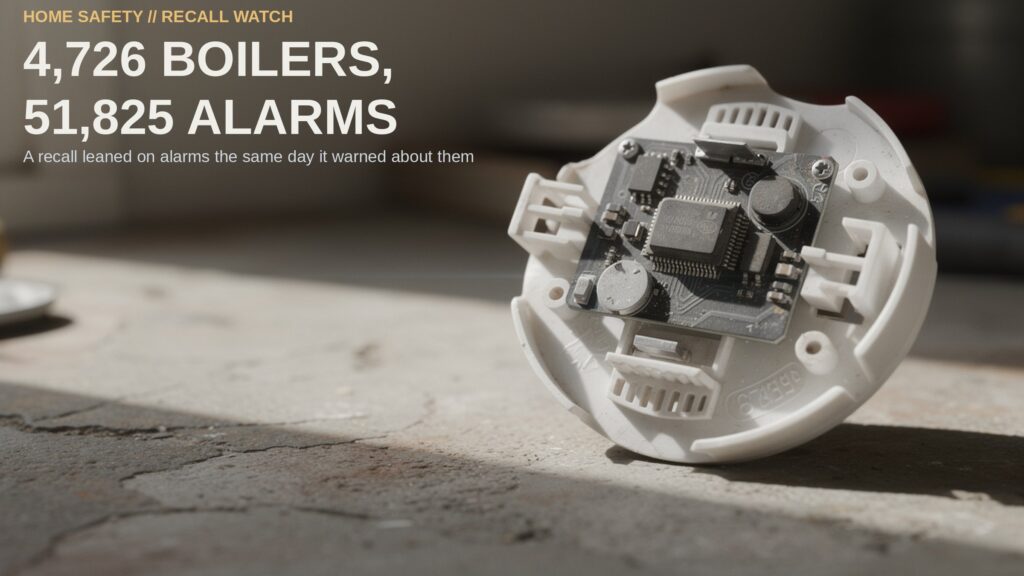
I read both releases twice before the timing landed. The regulator needed an alarm to stand in for a boiler it could not fix on the spot, while warning that one batch of the alarms people bought for that job might stay silent [2][3]. That is the same gap an imager leaves when it reads a wall’s skin instead of the cavity behind it — what a cheap imager can and cannot prove.
By the numbers
- 34 — Cracked condensate dishes: the number of times that dish had broken by 2026-10-16, with one reported injury in Canada and one reported incident in the United States [2].
- 7 — Reports of silence: the agency’s count of reports that those alarms failed to alert in the presence of smoke or fire [3].
- $11 to $107 — Sold price band: what those alarm models fetched on Amazon and eBay between November 2023 and October 2026 [3].
- 36.4% to 50% — Homes with a CO detector: the spread CPSC carried in a lab report published in March 2014, drawn from surveys taken in 2011 and 2009 [7].
What I’d watch:
The boiler side has a clock on it. The affected units went into homes from May 2021 to August 2025, the fix is an upgrade kit fitted by a certified technician, and heating season has already started across most of the country [1][2]. One of the reported injuries went to a technician servicing a unit, according to the trade press [8].
- Where the repair queue lands: a free kit still has to be booked. Until it is, the notice says the boiler that keeps running needs a working alarm beside it.
- Whether the flagged models keep selling: the regulator says not to sell or give the units away, and both were sold on large open marketplaces [3][4].
- What the box says: the agency line is to buy only units that meet UL 2034 and UL 217, which is printed on the package rather than proved by the price [3].
- What the second alert leaves out: the other same-day notice publishes no unit count, so its reach is still unknown [4].
What I am watching next is how owners test the alarms they already own. The check most people do — pressing the test button once a month — verifies the electronics and the sounder [6]. It never puts CO in front of the sensor.
The catch:
The documented fault in both warnings is smoke and fire, not CO. CPSC writes that the units “fail to alarm in the presence of hazardous smoke and fire.” Neither warning says the carbon monoxide side was tested and failed [3][4]. That gap matters, because the easy read is that CO sensing is broken across a whole category of imports.
The scale of the problem is softer than it looks. The estimate that 36.4 to 50 percent of homes had a CO alarm rests on surveys from 2011 and 2009 inside a lab report published in March 2014 [7]. I could be wrong, but the honest read is a slow measurement gap rather than a fresh collapse.
A certified alarm is no absolute guarantee either. Chamber tests by the agency found units firing outside the required time windows in some cases. That is a gap a standard tries to limit rather than remove [7]. The recall and the warnings describe the tails, and the tails are where the deaths sit.
At a glance
The shift: A safety agency leaned on home alarms to cover a boiler it could not fix that day, while warning that 51,825 of those alarms may never sound. The number: 4,726 boilers recalled on 2026-10-29, with 34 cracked dishes known by 2026-10-16. The risk: The monthly test button checks the siren, not the sensor, and the sensor is the part with an expiry.
Sources
[1] U.S. Consumer Product Safety Commission, “NTI and HTP Brand Gas Boilers Recalled Due to Risk of Serious Injury or Death from Fire, Carbon Monoxide (CO) Poisoning and Impact Hazards,” recall dated 2026-10-29 — https://www.cpsc.gov/Recalls/2027/NTI-and-HTP-Brand-Gas-Boilers-Recalled-Due-to-Risk-of-Serious-Injury-or-Death-from-Fire-Carbon-Monoxide-CO-Poisoning-and-Impact-Hazards-Manufactured-by-Ariston-formerly-NTI-Boilers [2] Health Canada / CPSC joint recall, “Residential Gas Boilers recalled due to impact, carbon monoxide poisoning and fire hazards,” 2026-10-29 — https://recalls-rappels.canada.ca/en/alert-recall/residential-gas-boilers-recalled-due-impact-carbon-monoxide-poisoning-and-fire-hazards [3] U.S. Consumer Product Safety Commission, “CPSC Warns Consumers to Stop Using Yfwsrecinoe Smoke and Carbon Monoxide Detectors Immediately,” warning 27-052, 2026-10-29 — https://www.cpsc.gov/Warnings/2027/CPSC-Warns-Consumers-to-Stop-Using-Yfwsrecinoe-Smoke-and-Carbon-Monoxide-Detectors-Immediately-Due-to-Risk-of-Serious-Injury-or-Death-from-Fire-Hazard [4] U.S. Consumer Product Safety Commission, “CPSC Warns Consumers to Stop Using GuardianSense/KLTseanife Combination Smoke and Carbon Monoxide Detectors Immediately,” warning 27-057, 2026-10-29 — https://www.cpsc.gov/Warnings/2027/CPSC-Warns-Consumers-to-Stop-Using-GuardianSense-KLTseanife-Combination-Smoke-and-Carbon-Monoxide-Detectors-Immediately-Due-to-Risk-of-Serious-Injury-or-Death-from-Fire-Hazard [5] Kidde, “When Should I Replace My Carbon Monoxide Alarm?” — https://www.kidde.com/support/carbon-monoxide-alarms/replacement [6] First Alert, “How Often to Test CO Detectors and How to Test Them” — https://www.firstalertstore.com/store/product-support/how-often-to-test-carbon-monoxide-detectors.htm [7] U.S. Consumer Product Safety Commission, “Carbon Monoxide Alarm Conformance Testing to UL 2034: Phase I FY 2012 Test Results,” March 2014 — https://www.cpsc.gov/s3fs-public/pdfs/COAlarmConformanceReportPhaseI.pdf [8] HPAC Magazine, “Recall Alert: Condensate dish on NTI boiler,” 2026-10-29 — https://www.hpacmag.com/hydronics/recall-alert-condensate-dish-on-nti-boiler/1004149570 [9] First Alert, “7 Things to Know About Carbon Monoxide Alarms” — https://www.firstalert.com/blogs/safety-corner/7-things-to-know-about-carbon-monoxide-alarms