The big picture:
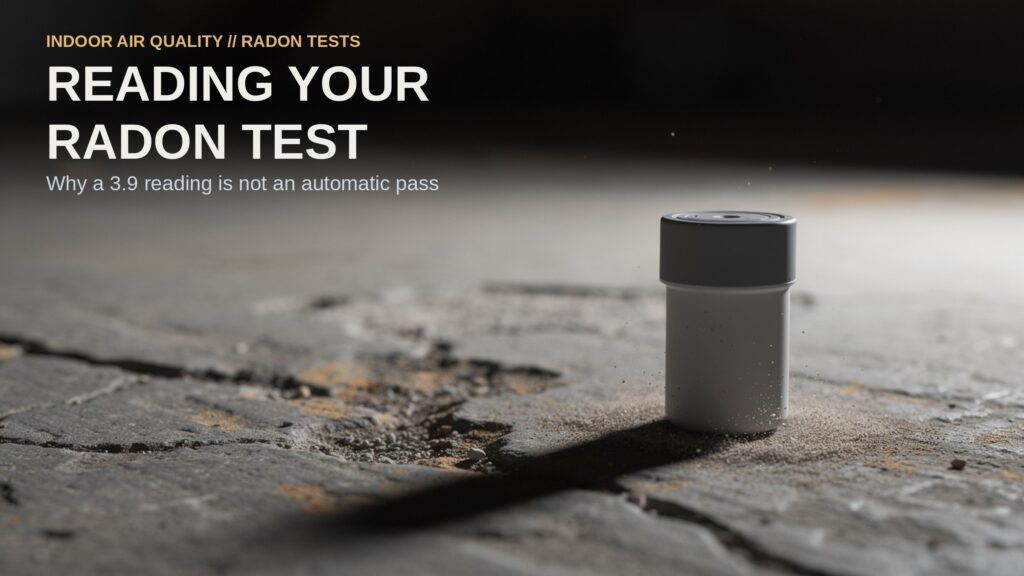
My read starts with the measurement itself. Radon is soil gas that seeps into the lowest part of a house, and the indoor level is a tug of war between how much gas gets in and how much fresh air thins it out.
Fresh air moves the number easily. The drop dies the moment you close the doors: New York’s fix guide notes that once windows and vents are shut, radon levels mostly return to past marks within about 12 hours [4]. A test run with a cracked window is not a low reading of your house. It is a reading of a different space, and it will not happen again next winter.
This is the same lesson as an imager that needs a 15-degree spread. The tool is not the problem, the setup is. The published guidance agrees on the shape of the test but differs on the exact clock: New York’s consumer page needs doors and windows closed 24 hours before and during the test [3], while the Lung Association’s kit steps start a closed house at least 12 hours early [7]. Pick the stricter clock and every rule is met.
By the numbers
- 2,900 — Non-smoker deaths: The Environmental Protection Agency (EPA) says radon causes roughly 21,000 lung-cancer deaths a year, and about 2,900 of those are people who never smoked [1].
- 1.3 pCi/L — Risk under the line: At a third of the action mark, a never-smoker faces a lifetime lung-cancer risk of about 2 in 1,000, against 20 in 1,000 for a smoker [1].
- Two to seven days — Short-term sample: A standard short test runs for two to seven days, and the device must sit in the lowest space the family uses [7].
- Less than $1,000 — Quote floor: Minnesota’s health office warns that fix rates under $1,000 are often too good to be true, and the cheap jobs behind them usually bring poor work [5].
What I’d watch:
The choice made in a kitchen is usually between a mail-in kit and a digital screen, but the test rules settle the debate before the gear does. What I keep circling is how little the brand changes the answer. A passive test sent to a lab returns a time average, and that is what the action line was written to match.
- What a lab offers: The $12.25 state kit collects gas on its own and comes back fully checked [3], so the number covers the whole time window rather than one point on a counter.
- The clock in the steps: State rules require sealing the house for 24 hours before and during the test [3], which also meets the shorter 12-hour start listed in published kit guides [7].
- Where the device sits: Testing means placing the unit in the lowest floor regularly used, kept away from drafts and bumps [7]. A basement you never enter is not the floor the family breathes.
- The install clock: After a system goes in, the retest happens within 30 days but no sooner than 24 hours with the fan running [4], then every two years, or every five years without a system [3].
The catch:
The honest limit is that one short test captures a single season. Both the state guide and the Lung Association treat a short sample as a sign of whether to test again, not as a final word on the level the house holds all year [7]. A long test takes at least three months to finish. Most people will not wait that long.
I also cannot price the fix for you, and neither reference page offers a firm number. The health offices give a floor below which a quote should act as a warning [5], but no set dollar range for a proper install. Three bids remains the only safe path, since a single average cost figure is a guess wearing a number.
The last thing worth sitting with is what a sloppy test buys. A reading taken with the house open is bold and wrong, and it will happen again every time someone reruns the test the same way.
At a glance
The shift: A radon number is wrongly read as a final house verdict instead of a short test result. The number: 4 pCi/L is the fix line, and 2 to 4 means consider fixing. The risk: An open-air test reads low, but levels return within 12 hours of closing up.
Sources
[1] U.S. Environmental Protection Agency, “Health Risk of Radon” — https://www.epa.gov/radon/health-risk-radon [2] U.S. Environmental Protection Agency, “Radon Publications” — https://www.epa.gov/radon/radon-publications [3] New York State Department of Health, Radon Program — https://www.health.ny.gov/environmental/radon/ [4] New York State Department of Health, “Radon Mitigation” — https://www.health.ny.gov/environmental/radon/mitigation.htm [5] Minnesota Department of Health, “Radon Mitigation” — https://www.health.state.mn.us/communities/environment/air/radon/mitigation.html [6] Minnesota Department of Health, Radon Program — https://www.health.state.mn.us/communities/environment/air/radon/index.html [7] American Lung Association, “Radon” — https://www.lung.org/clean-air/indoor-air/indoor-air-pollutants/radon