At a glance
- The shift: Both cases turned on a claim about the building, not a license or a contract term.
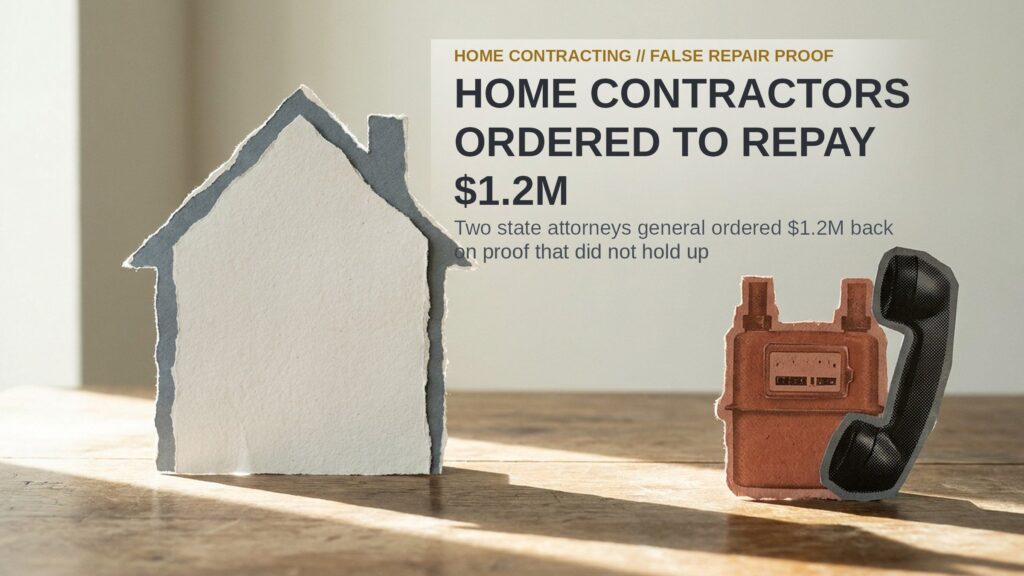
- The number: $1.2 million in restitution, our sum of Pennsylvania’s $700,000 and Minnesota’s $518,000.
- The risk: The finding that unlocks a payment is the document homeowners check least.
The half nobody checks
Pennsylvania’s case is the older one. The state sued the Gillece plumbing group over sewer work it says homeowners did not need. A county court ruled against the company in August 2023. The settlement order that set the money was filed on 21 October 2026, a little over three years later [1]. Minnesota moved faster. The state sued Ryan David Pietron and Affordable Home Remodeling in October 2025 and won a judgment on 5 November 2026, thirteen months on [2].
Both files split in two. One half is terms: a license number, a written scope, a schedule of progress payments, the lien waiver signed at each draw. The other half is findings: the pipe is cracked, the furnace has a bad heat exchanger (the part that keeps exhaust out of the air you breathe), the windows were ordered, the material shipped. Every guide a state puts out is about the first half. So is the lien clock that runs on money already paid.
The second half is what moves the money, and I keep coming back to how little of it anyone audits. A claim about a bad sewer pipe turns “your house needs work” into “pay for the dig today.” A progress report unlocks the next draw. Pennsylvania says the pipe defects were not there. It says the leak and heat-exchanger calls were later knocked down by other parties, including the consumers’ natural gas utility companies [1]. Minnesota says Pietron sent fake progress reports and, in one case, forged an invoice from a real supplier for an order that never existed [2].
By the numbers
- $700,000 back to homeowners: Pennsylvania’s order covers sewer lines the state says had no defect in them [1].
- $518,000 back to homeowners: Minnesota’s judgment covers dozens of families who paid a builder with no license [2].
The utility had the answer
The detail I keep circling is who proved the Pennsylvania diagnosis wrong. It was not a home inspector, and it was not the state. It was the gas utility. A leak is a physical fact a utility will test at no charge, and a delivery is a fact a supplier will confirm. The people who signed had made neither call [1].
Minnesota is the same test with a different number to dial. The forged invoice said an order had been placed with a real supplier, so the supplier’s own record could contradict it [2]. The attorney general’s release closes with the state’s license look-up and with the Contractor Recovery Fund, a state pool that pays court judgments against licensed contractors who cannot pay, up to $75,000 of a judgment [2]. Read in that order, a license is not a quality mark. It is the ticket into the fund, and Pietron’s first lie was that he held one.
The third Pennsylvania action filed this month, against a contractor the state says worked under several fake names, is still a complaint. It has claims, not findings [3]. What the state has to rebuild is what happened at the house.
What the orders leave open
The Pennsylvania settlement is not an admission of a violation, and the state says so itself [1]. The sewer and leak claims are claims. Minnesota’s file is a judgment, and Pietron has also pleaded guilty to felony theft in a separate case [2]. Two kinds of document, not one verdict on the trade.
I could be wrong about how much anyone can check at six in the evening, with water running and one van in the driveway. A second opinion takes days. The state’s own remedy took thirteen months in the faster case and more than three years in the slower one. What both files show is narrower, and hard to argue with: the claim about the house could have been checked both times, by a utility and by a supplier, before any money moved.
Related reading
- Retainage Trap: 5 Percent, Not 15 — what an owner may withhold until the work is proven
- Fewer Liens, 46% More Failures: Your Bid — what a payment record says about the contractor
- Tools & Equipment — more on Tools & Equipment
Sources
- [1] Pennsylvania Office of Attorney General, “AG Sunday Obtains Settlement Requiring Home Improvement Group to Pay Consumer Restitution and Undergo Robust Technician Certification Programs” (2026-10-22) — https://www.attorneygeneral.gov/taking-action/ag-sunday-obtains-settlement-requiring-home-improvement-group-to-pay-consumer-restitution-and-undergo-robust-technician-certification-programs
- [2] Minnesota Attorney General, “Attorney General Ellison bans fraudulent contractor from Minnesota construction industry for life, wins $1.1 million judgment” (2026-11-05) — https://www.ag.state.mn.us/Office/Communications/2026/11/05_Affordable-Home-Remodeling.asp
- [3] Pennsylvania Office of Attorney General, “Attorney General Sunday Sues New Jersey-Based Home Improvement Contractor Over Alleged Consumer Protection Violations” (2026-11-06) — https://www.attorneygeneral.gov/taking-action/attorney-general-sunday-sues-new-jersey-based-home-improvement-contractor-over-alleged-consumer-protection-violations