At a glance
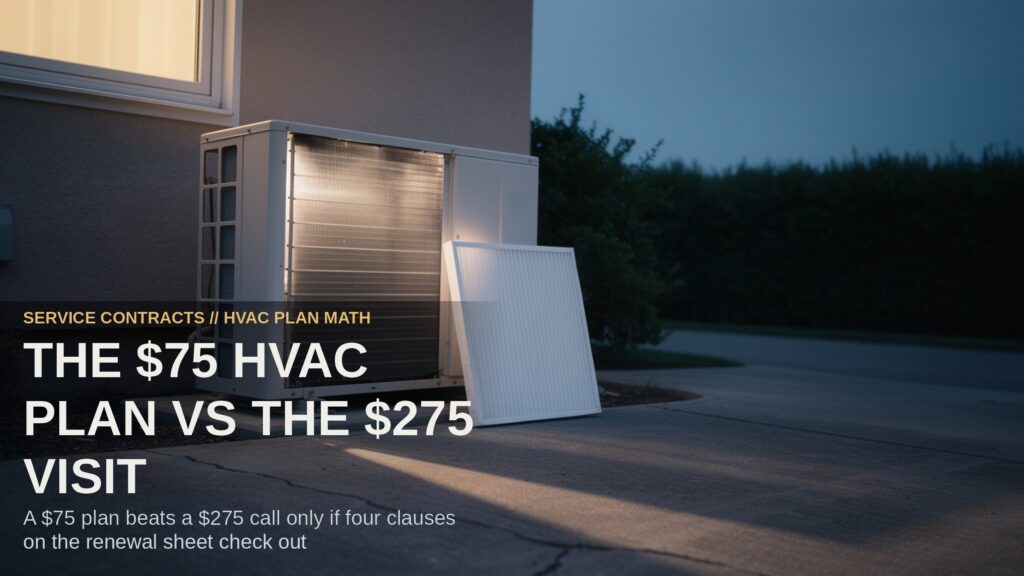
This piece prices the HVAC maintenance plan for homeowners: what the agreement costs, what a one-off visit costs, and the four clauses that decide whether enrollment pays. The finding is that the plan is prepaid labor, and the arithmetic is checkable before you sign.
What you are prepaying
Maintenance pricing has moved in one direction for years, and the climb is labor. A single tune-up visit now carries a flat fee between $75 and $200, depending on the contractor [1]. The national average for a one-off call sits at $275, and most services land between $150 and $350 [2]. Labor drives nearly all of that bill, because hourly service rates run $75 to $150 and the technician’s own median wage was $29.33 an hour in 2025 [3]. The visit itself is mostly inspection and cleaning on a schedule the contractor already knows: filter swaps, coil cleaning, drain-line work, refrigerant checks [2].
An agreement restructures that same visit as a subscription. Contractors report that people on the plan get priority scheduling, reduced fees and repair discounts, and some will call you to book, so the checkup never slips your mind [1]. Cost guides put the average annual agreement at $75–$150, with a two-visit plan running $150–$300 [1]. Pricing databases reach the same conclusion from the other side: signing up costs more upfront but usually saves money over time, especially on an older system [2]. My reading, held loosely, is that the queue matters as much as the work — half of what you buy is being near the front of the line when the unit fails in July.
By the numbers
- $275: the national average for a one-off HVAC maintenance call [2].
- $150: the top of the typical annual agreement range [1].
- $29.33 an hour: the technician’s 2025 median wage [3].
Four clauses decide the math
Four things on the renewal sheet decide whether the plan is worth signing, and each one is checkable before you commit.
- Count the visits. A two-visit agreement costs $150 to $300 [1], so it earns its fee only where your climate genuinely runs both heat and cooling hard.
- Price the repair discount. Even a small percentage off parts adds up — a coil cleaning alone runs up to $350 [2] — and this is where the contractor’s margin hides.
- Require a written record. The plan should issue a service record after each visit, because warranty and home-warranty claims need proof of regular maintenance before they pay out [1].
- Run the counter-math. Filters and a can of coil cleaner cost about a tenth of a plan, so the agreement earns its fee only if you will not do that work yourself.
What I would do before any renewal is ask for last year’s invoice total and compare it to the fee — the answer is usually on one page.
The catch
What I find hard to argue with is that the plan’s value depends on a behavior, not a price. Enrollment mainly changes whether the maintenance happens at all, and no agreement can change what happens after the technician leaves. Skip the filter changes, let the outdoor unit collect leaves, and the plan saves nothing. Our piece on the 11-degree delta-T that killed a $7,500 compressor quote shows a $180 valve adjustment fixing the problem the agreement was supposed to prevent. So the honest rule is simple. If you book service on time and do the cheap tasks yourself, buy the leanest plan that still issues a written record. If you do not, the fee is the cheapest way to make the maintenance happen — the compressor does not care who remembered.
Related reading
- Tools & Equipment — more on Tools & Equipment
- Insurance Bill Beats Property Tax 14% — more on Energy & Efficiency
- 3 Days to Kill Your Deposit — more on Tools & Equipment
Sources
- [1] This Old House, “How Much Does HVAC Maintenance Cost?” — https://www.thisoldhouse.com/heating-cooling/reviews/hvac-maintenance-cost
- [2] Fixr, “How Much Does HVAC Maintenance Cost?” (updated January 30, 2026) — https://www.fixr.com/costs/hvac-maintenance
- [3] O*NET OnLine, “49-9021.00 Heating and Air Conditioning Mechanics and Installers,” median wages (2025) — https://www.onetonline.org/link/summary/49-9021.00