At a glance
- The shift: “Bonded” is a licence condition with a fixed ceiling, not coverage that scales.
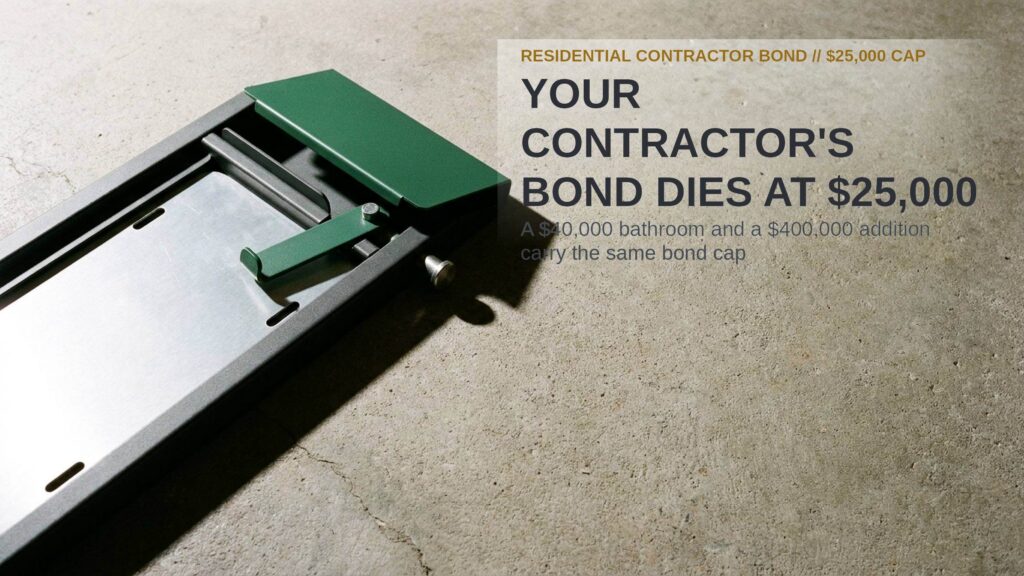
- The number: $25,000, flat, whatever the job costs [1].
- The risk: The claim clock starts at completion, not at discovery.
What sits behind the licence
The bond is filed before the licence issues and renewed with it, and it stays in place while the work runs. Nothing reaches the surety on your say-so: in Oregon the board pays a claimant only after a court judgment or a final order from the state labour bureau [7]. The surety also waits for the board to confirm the claim is ready, and by then the clock has usually been running for months. I read the Oregon statute twice before I accepted that sequence, because it means the bond is not a first line of defence. It is the last step in a process that starts somewhere else.
California is the most generous of these four states on paper. A homeowner improving their own home is named first among the people the bond protects [2]. The bond itself is written in favour of the state, not the customer. Claims from everyone else share a $7,500 cap, and anything above it is reserved for the homeowner claims [1]. That narrows the queue without enlarging the pot. The most a California homeowner can draw is still the face value.
Washington makes the bond answer for wages, benefits and state taxes, and for material suppliers [3]. It also covers any sum a court awards over a broken contract, “including improper work”. That clause is the one a homeowner uses, and it pays a contract claim, not damage to the house.
Oregon sets both side by side for a residential general contractor: a $25,000 bond and liability insurance of at least $500,000 [5]. The bond is 5 percent of the insurance beside it, so the state plainly does not expect it to make you whole.
Arizona prices the bond to the licence class instead. A general residential contractor posts between $5,000 and $15,000, and a residential specialty contractor in one trade posts between $1,000 and $7,500 [4]. On a kitchen worth more than the house’s annual tax bill, the bond may be the smallest number in the file.
By the numbers
- $30,000 Washington bond: A general contractor’s bond, with $15,000 for a specialty contractor [3].
- Two years to sue: A Washington homeowner’s window, counted from completion or abandonment [3].
- 14 months in Oregon: The outer limit for a complaint, counted from the licence or bond ending [7].
When the pot runs out
The boards’ reaction is the tell. Oregon suspends the licence until the money owed is paid, and may demand a replacement bond of up to five times the ordinary amount [6]. California doubles the bond when an applicant was cited for unlicensed contracting that hurt the public [1]. Arizona offers a different answer: an extra $200,000 bond for claimants’ actual damages, or a place in the state recovery fund [4]. I keep coming back to that spread, because the $200,000 is an alternative to a $5,000 bond, not an upgrade to it. The state is saying the standard bond is not the remedy for a real loss.
The bond is not the only remedy either. A mechanics lien is the neighbour, and the lien clock runs from completion too. Two instruments, two deadlines, and neither one watches the calendar for you.
The catch
The bond is not worthless. It is a cheap, quick claim for a small loss with records behind it, and California reserves the money above $7,500 for homeowners [1]. But a bond capped at a fraction of the contract is a partial remedy, and the schedules show the design: the amount tracks the licence class or the contractor’s volume, while your exposure tracks the job. My read is that the bond line belongs beside the licence number. Both are worth checking, and neither is reassurance.
Related reading
- Hidden Lien Clock Behind Your Remodel Payments — more on Tools & Equipment
- Retainage Trap: 5 Percent, Not 15 — more on Tools & Equipment
- Tools & Equipment — more on Tools & Equipment
Sources
- [1] California Legislative Information, “California Business & Professions Code § 7071.6 — contractor’s bond” — https://california.public.law/codes/ca_bus_and_prof_code_section_7071.6
- [2] California Legislative Information, “California Business & Professions Code § 7071.5 — beneficiaries of the contractor’s bond” — https://california.public.law/codes/ca_bus_and_prof_code_section_7071.5
- [3] Washington State Legislature, “RCW 18.27.040 — Bond or other security required; actions against” — https://app.leg.wa.gov/rcw/default.aspx?cite=18.27.040
- [4] Arizona State Legislature, “A.R.S. § 32-1152 — Bonds” — https://azleg.gov/ars/32/01152.htm
- [5] OregonLaws, “ORS 701.081 — Residential contractors; bond; insurance” — https://oregon.public.law/statutes/ors_701.081
- [6] OregonLaws, “ORS 701.068 — Bonding requirements; action against surety” — https://oregon.public.law/statutes/ors_701.068
- [7] OregonLaws, “ORS 701.150 — Determination of amount to be paid from bond” — https://oregon.public.law/statutes/ors_701.150