The big picture:
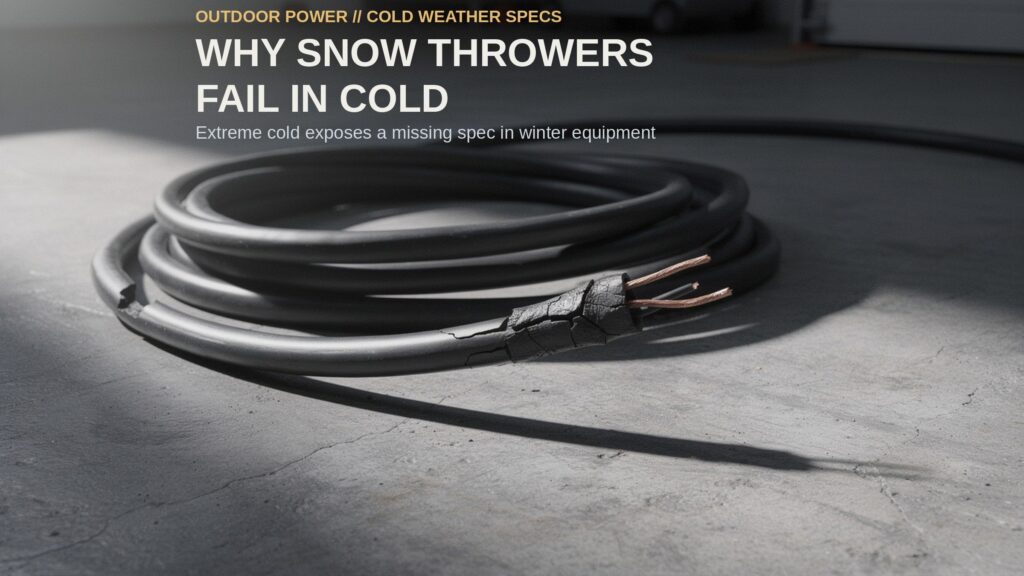
The battery pack is where this industry has an answer. A cold-start function, a stated -4°F operating point (about -20°C) and a charger that reaches 80% in under ten minutes are the words of a solved problem [1]. The cord on a 15-amp thrower has no such words, and the recall never says what temperature breaks it [2]. I keep coming back to that gap, because it tells a buyer which half of the machine the market has actually built for winter.
Cold does real damage inside a cell. A Department of Energy merit review from Argonne National Lab reports that discharge capacity falls by as much as 65% between room temperature and -40°C [3]. That work used vehicle cells, not a cordless tool pack in a driveway, but the direction is not in doubt. The review describes lost run time, while the recall describes a cracked cord jacket and the shock risk that follows it.
By the numbers
- 37,667 — Units recalled: Benchmark model YF6022, a 22-inch, 15-amp electric thrower sold in Canada from November 2020 to May 2026 through one chain [2].
- 19 — Cord failures reported: as of 2026-10-05, with no injuries logged, across those 37,667 units [2].
- -4°F (-20°C) — Rated cold point: STIHL’s first snow thrower, paired with a new pro pack whose cold-start function carries the rating [1].
- Up to 65% — Capacity lost to cold: lab cells measured from 25°C to -40°C, in a Department of Energy battery review [3].
What I’d watch:
The open question is whether -4°F stays one company’s talking point or becomes a line every maker prints. No one in this category competes on an operating temperature today. The sheets sell volts, amp-hours and a count of car driveways cleared, and none of those numbers moves when the mercury drops [1]. I am watching for the first rival to answer with a figure of its own, since that is the moment cold turns into a spec.
- The platform split: the rated machine runs on STIHL’s pro battery line, which fits more than 60 existing tools, while its homeowner tools use a separate system [1]. A buyer who wants the rating is buying into the pro line.
- The pack numbers: the same pack claims up to 60% more peak power and 20% longer run time than the model it replaces, plus 3,000 charge cycles [1]. Those decide what a spare costs in year three.
- The remedy: Health Canada tells owners to stop using the thrower and contact the retailer to destroy it for a refund [2].
- The cord: the notice names a 22-inch, 15-amp machine and a cord that breaks in extreme cold, and gives no degree value [2].
The clearing width on the box deserves the same doubt that the snow robot piece on this site applies to rated area. The remedy itself is harsher than a repair kit, because owners are told to destroy the thrower rather than fix it [2]. Canada’s product safety law bars a recalled item from being redistributed, sold or even given away, and the notice is posted to an international recall portal [2]. A machine sold across five and a half years of winters does not get a new cord; it gets scrapped.
The catch
Both records are thin in the same spot. STIHL’s -4°F is a maker’s claim tied to a tool-and-pack pair, and the release names no test method behind it [1]. The recall says “extreme cold weather” and stops, so any degree value quoted for that cord was invented [2]. The 65% drop comes from vehicle cells run to -40°C, colder than most driveways get and a different battery from the one on the shelf [3].
I could be wrong about where this lands, but the rate argues for calm. Nineteen cord reports against 37,667 units is a small share, and a report is not a failure count. What the week does settle is narrower: the part of an electric snow machine built for cold is the part with a spec, and the part without one is the part that reached a safety agency.
At a glance
The shift: Snow gear now prints a cold rating; corded machines are recalled for cords that fail in it. The number: 37,667 throwers pulled in Canada, five days after a rival’s -4°F rating. The risk: The rating covers a tool-and-pack pair with no stated test.
Related reading
- Your $550 Battery Spare Is Wrong — more on Outdoor Power & Snow Equipment
- Your Mat Costs 50 Blower Charges — more on Outdoor Power & Snow Equipment
- Outdoor Power & Snow Equipment — more on Outdoor Power & Snow Equipment
Sources
[1] STIHL, “STIHL Powers Into Its Next Century with New Battery Technology, New Mowers, and Its First-Ever Snow Thrower,” 2026-10-21 — https://www.stihlusa.com/en/support-events/about-stihl/press/equip-expo-2026
[2] Health Canada, “Benchmark-branded 22 inch, 15 amp electric snow thrower recalled due to electric shock hazard,” 2026-10-26 — https://recalls-rappels.canada.ca/en/alert-recall/benchmark-branded-22-inch-15-amp-electric-snow-thrower-recalled-due-electric-shock
[3] Argonne National Laboratory, “Fluorinated Solvent-Based Electrolytes for Low Temperature Li-Ion Batteries,” DOE Vehicle Technologies Office Annual Merit Review, Project ID BAT520, June 2021 — https://www.energy.gov/sites/default/files/2021-06/bat520_zhang_2021_p_5-13_307pm_LR_TM.pdf