The big picture:
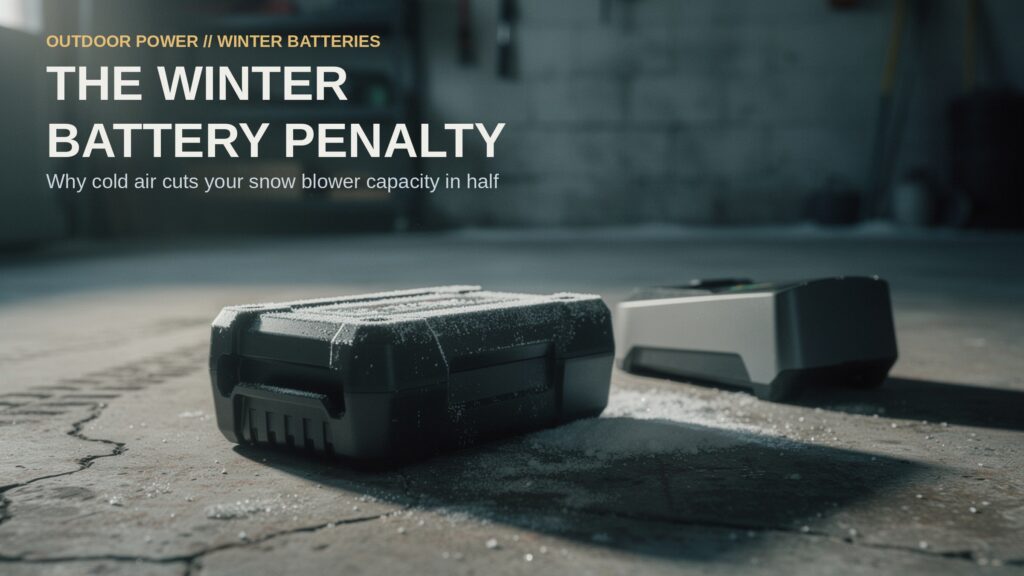
Makers rate packs at a warm 27°C because the numbers look best there, and the label never says how far the run time falls in winter air [1]. Heat beyond that level costs longevity. A pack run at 40°C loses 40 percent of its cycle life against one kept near room temperature [1].
Cold adds a second effect that a fuel gauge cannot show. The extra internal resistance drops voltage when the motor pulls hard, so the tool shuts off early before the charge is gone [1]. Electric vehicles (EVs) show the same thing on a larger scale. Cold cuts their fuel economy about 39 percent in mixed driving and their range by 41 percent [4]. About two-thirds of that extra energy goes to heating the cabin [4].
What I keep circling is that the fix here is heat, not capacity. Some advanced chargers refuse to charge a lithium pack below freezing [3], which is the cell setting the limit rather than the motor.
By the numbers
- 27°C — the rating temperature: every run-time figure on the box is measured at 80°F, and the label never says how far the number moves in colder air [1].
- 0.02C — the charge rate at -30°C: the rate research allows at that temperature is so low that one charge would stretch past 50 hours, a wait the source calls impractical [3].
- 12 to 15 years — pack life in a mild climate: modeling from the National Laboratory of the Rockies puts the same packs at 8 to 12 years in an extreme climate, which covers heat as well as cold [5].
- 40 percent — the cycle-life cost of heat: a pack run at 40°C instead of room temperature loses 40 percent of its cycle life, so where it is stored matters too [1].
What I’d watch:
The garage is the failure point, not the driveway. A pack left in an unheated shed or an attached garage sits at air temperature, and a January cold snap holds it below freezing for weeks [3]. Charging it there is the expensive move. Below 0°C a consumer lithium-ion pack cannot take a charge without plating metallic lithium onto the anode [3]. The pack looks like it is charging normally the whole time.
- The charge window: the best range is 10°C to 30°C, so a pack that comes in from the cold needs an hour indoors first [3].
- The pack in the machine: a warm pack carried out to a cold blower gives back some of what the label promised, then cools toward the air temperature while the machine sits between passes [1].
- The spare: rotating two packs through an indoor charge beats running one down and topping it up in a cold garage, and it keeps the spare away from the temperature that shortens its life [1].
What I am watching next is whether winter equipment brands start printing a cold-capacity number beside the run time. The rest of the desk’s coverage of these machines sits under outdoor power and snow equipment.
The catch
The half-capacity figure is a lab discharge at one rate on one chemistry, and the source says the momentary capacity decrease differs by chemistry [1]. A reader whose storms run warmer than -18°C loses less, though the source gives no figure for a specific temperature. The arithmetic here is about the pack, not a guarantee for one specific driveway.
The climate band is extreme climates, which includes heat, and it is predictive modeling rather than a warranty term [5]. A bigger pack does buy more cold run time, and that is not wrong. It just buys that time at the pack’s cold efficiency instead of its label rating, a poor trade if an hour indoors solves the same problem.
My view is that the two things worth keeping apart are the temporary half and the permanent damage. A pack charged below freezing suffers permanent degradation, and nothing on the charger tells you it happened [3].
At a glance
- The shift: winter run time is a pack-temperature problem before it is a capacity problem.
- The number: a pack rated at 100 percent in mild air gives about 50 percent at -18°C (0°F).
- The risk: charging a frozen pack plates lithium on the anode, and the charger shows nothing wrong.
Sources
[1] Battery University, BU-502 — Discharging at High and Low Temperatures: the 27°C rating, the 50 percent at -18°C, the momentary decrease by chemistry, the cycle-life loss at 30°C and 40°C, and internal resistance rising when cold. https://batteryuniversity.com/article/bu-502-discharging-at-high-and-low-temperatures (retrieved 2026-10-31)
[2] EGO POWER+ — 24 in. Self-Propelled 2-Stage Snow Blower SNT2400, product page: “Powered by 2 (7.5ah) ARC Lithium Batteries (recommended)” on the 56-volt platform. https://www.egopowerplus.com/two-stage-snow-blower-snt2400 (retrieved 2026-10-31)
[3] Battery University, BU-410 — Charging at High and Low Temperatures: no charging of consumer lithium-ion below 0°C, lithium plating during a sub-freezing charge, the 0.02C rate and 50-hour charge at -30°C, the 10°C to 30°C window, and chargers that prevent charging below freezing. https://batteryuniversity.com/article/bu-410-charging-at-high-and-low-temperatures (retrieved 2026-10-31)
[4] U.S. Department of Energy and Environmental Protection Agency, FuelEconomy.gov — Cold Weather: fuel economy down roughly 39 percent and range down 41 percent for electric vehicles in mixed driving, with about two-thirds of the extra energy heating the cabin. https://www.fueleconomy.gov/feg/coldweather.shtml (retrieved 2026-10-31)
[5] U.S. Department of Energy, Alternative Fuels Data Center — Batteries: predictive modeling by the National Laboratory of the Rockies indicates 12 to 15 years in moderate climates and 8 to 12 years in extreme climates. https://afdc.energy.gov/fuels/electricity-benefits (retrieved 2026-10-31)