At a glance
A comparison of three sub-$240 phone thermal cameras — RISION’s Magic and Magic Pro, and Thermal Master’s P3 Lite — for homeowners scanning walls and breaker panels this winter. Every headline resolution is software; only the native detector separates them, and the middle unit wins.
Why the headline resolution is the decoy spec
The prices above sit inside a sale window that has a hard edge. RISION announced the discounts on November 19 and runs them through November 30 [5]. Today’s figures are therefore sale figures, and the rendered pages already show what comes after: $119.00 on the Magic page and $229.00 on the Magic Pro page, against the $109.00 and $199.00 the cart records charge [1]. After the window closes, those banners become the honest expectation.
I read the three spec sheets twice before I trusted the pattern, and it is the same on all of them. The Magic advertises 320×240 [1]. The Magic Pro advertises 512×384 [1]. The P3 Lite advertises 512×384 through its X³ infrared (IR) upscale [2]. None of those numbers is the detector. RISION’s own pages concede it: “native 160×120 resolution super-resolved to 320×240” [1]. Thermal Master’s spec table names a “VOx 256×192 @12μm” detector [2]. The headline is software; the detector is the purchase.
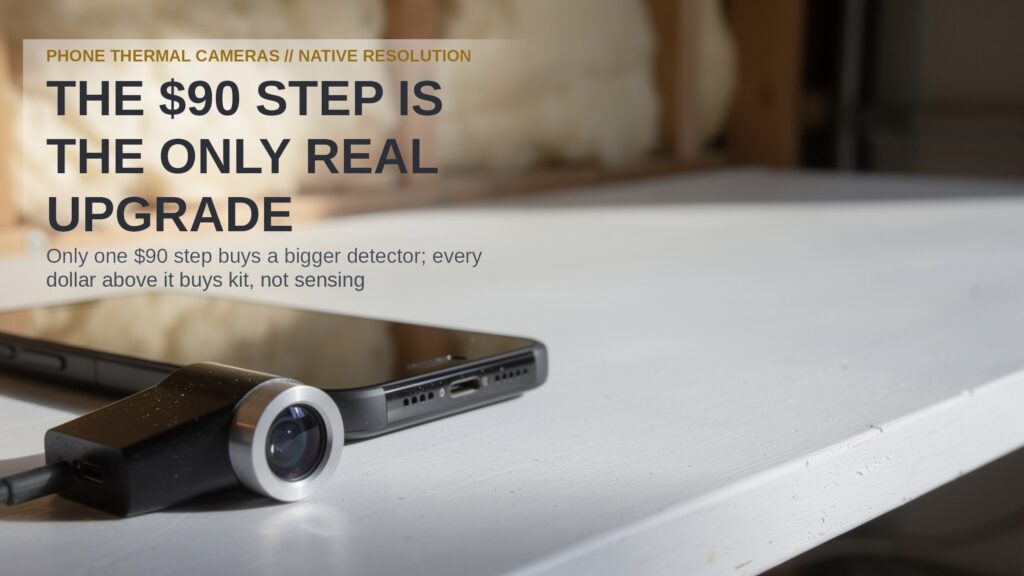
That makes the $90 step between the Magic and the Magic Pro the only hardware ladder in the set. A 160×120 detector holds 19,200 pixels [1]. A 256×192 detector holds 49,152 — 2.56 times the count [1]. On a wall bay between 16-inch-on-center studs, the bigger detector gives each tile about 2.6 vertical inches of wall against 3.6. Both makers rate the same 40 mK sensitivity floor, per their own pages [1], so the sharper image is a pixel count, not a better core.
Above that step, the money buys nothing a wall can see. The Magic Pro and the P3 Lite share the same 256×192 detector class [2]. Both claim ±2°C accuracy [3]. The differences are kit and timing. The P3 Lite’s macro lens is a separate $50.00 variant [2]. Its shells ship in December batches, per the maker’s own notice.
| Unit | Cart, 2026-11-22 | Claimed | Native | Fails at |
|---|---|---|---|---|
| RISION Magic (AF01) | $109.00 | 320×240 super-resolved | 160×120 | A bay boundary drawn in 120-tile steps [1] |
| RISION Magic Pro (AF02) | $199.00 | 512×384 super-resolved | 256×192 | Needs a Type-C phone port [1] |
| Thermal Master P3 Lite (P2 Max) | $239.00 | 512×384 X³ IR | 256×192 | December shipping; macro lens sold separately [2] |
By the numbers
- $5.68 per native pixel at the floor: the cart figure divided by 19,200 [1].
- $4.05 at the middle: the same arithmetic on 49,152 [1] — the best pixels-per-dollar in the set.
- $4.86 at the top [2] — the premium buys a brand name, not sensing.
- $289.00: the P3 Lite’s kit variant with the macro lens fitted [2].
Where each camera wins
The Magic Pro is the unit a first-time scanner should buy, and the case is arithmetic. It is the cheapest camera here with a 49,152-pixel detector [1]. It ships today [1]. It sits $40.00 under the top unit’s figure while doing the same sensing job [2]. One owner on the Magic Pro’s page puts the use case plainly: “Find the cold spots on your house. So simple to use, download app, plug it in, see the images.” [4]
The Magic wins on temperature span. Its 600-degree span [1] covers a cold baseboard and a hot breaker lug with room to spare. The catch is honest: 120 tiles across the detector can put a cold corner and the stud beside it in one tile. A reader who needs to know where a leak line runs will pay for the step after one frustrating scan.
The P3 Lite wins two narrow cases, and my reading, held loosely, is that neither applies to a wall. A reader on a pre-2018 Lightning iPhone gets a USB-C to Lightning adapter in its box [2], while both RISION units need a Type-C port. And a reader who wants the $50.00 macro lens for circuit-board work and can wait for December shipping has one option [2].
| The situation | The pick |
|---|---|
| First thermal camera, wants to find the cold bay this week | The RISION Magic Pro: 49,152 native pixels at the set’s best per-pixel figure, in stock now [1] |
| Once-a-season cold-wall check, budget as the constraint | The RISION Magic: full house-scan range at the class floor [1] |
| Lightning iPhone, or macro-lens electronics work, and no urgency | The Thermal Master P3 Lite: the adapter in the box, the macro variant, the December wait [2] |
The rest of this vertical’s instrument math, including the readings no specification sheet carries, sits in home diagnostic tools. This run’s neighboring coverage — why a cheap camera’s verdict is missing — is the reading side of the same aisle. For the money side, the true cost of ownership calculator takes a purchase figure and a service life and returns a yearly figure to hold against one contractor visit.
The catch
The sale deadline is the real cliff in this verdict. Once November 30 passes, the rendered banner figures — $119.00 and $229.00 — become the honest expectation [1], the step between the two RISION units widens, and the Magic Pro’s case weakens a grade. A buyer who wants these two at today’s figures should not shop the set in December.
What I find hard to square is that every number separating the three is one the makers rate and nobody has measured per unit. The sensitivity, the accuracy, the temperature spans — all manufacturer claims [3]. No independent measured review of these cameras was fetchable when the set was priced. The makers’ own guidance concedes the instrument’s limit: a thermal image shows surface patterns, not a confirmed diagnosis. This comparison can rank the detectors, because the detectors are printed. It cannot rank the images, because no hand has held the cameras.
What we did not test
This review is built from three maker spec pages, two cart records and one vendor announcement. The desk did not run, hold or measure any camera — no unit was handled, no wall was scanned, and every sensitivity, accuracy and range figure is a maker claim, labelled as such above. The RISION cart figures were read on the day this set was priced and are sale-window figures promised through the end of November; the rendered page banners differ and may revert. The P3 Lite’s December shipping notice is the maker’s own, and its macro lens is priced separately.
Sources
- [1] RISION — Magic and Magic Pro pages and cart records: “native 160×120 resolution super-resolved to 320×240”, “Native 256×192 sensor. QuadIR™ algorithm upscales resolution to 512×384”, “-4℉ to 1112℉ (-20°C to 600°C)”, “±2°C”, cart figures 10900 and 19900 cents, both available; rendered sale displays $119.00 / $229.00 against list figures $139.00 / $299.00. https://www.rision.com/products/rision-magic-smartphone-thermal-camera, https://www.rision.com/products/rision-magic-pro-smartphone-thermal-camera (+ .js cart records) (retrieved 2026-11-22)
- [2] Thermal Master — P3 Lite product page: “$239.00” og meta figure, variants at 23900 cents against compare-at 26900, macro lens variant at 5000 cents, kit variant at 28900 cents, “VOx 256×192 @12μm”, “-4°F~1112°F (-20°C~600°C)”, “±2°C or ±2% of the reading”, shipping notice “UK: Ships from mid-Dec / (Silver): Ships from early Dec”. https://thermalmaster.com/products/p3-lite-thermal-camera-for-iphone-and-android (retrieved 2026-11-22)
- [3] Both makers’ specification blocks — NETD “≤40mK” (RISION Magic/Pro pages; P3 Lite spec table), accuracy “±2°C or ±2% of the reading” (all three). (retrieved 2026-11-22)
- [4] RISION — Magic Pro verified buyer review: “Find the cold spots on your house. So simple to use, download app, plug it in, see the images.” https://www.rision.com/products/rision-magic-pro-smartphone-thermal-camera (retrieved 2026-11-22)
- [5] PR Newswire — RISION Black Friday announcement, 2026-11-19: “Magic 24-g USB-C camera $109 (45% off $199 MSRP)”, sale window November 19–30. https://www.prnewswire.com/news-releases/rision-offers-up-to-45-off-thermal-cameras-for-black-friday-and-cyber-monday-302945429.html (retrieved 2026-11-22)