At a glance
This article is for homeowners weighing a cheap thermal camera this holiday season. It covers a $109 Black Friday price drop, a lab-built heat cloak that can fool infrared imaging, and why the camera’s own maker says its pictures are clues rather than verdicts.
The big picture: a cheap camera, a staged image
The month’s timeline runs in one direction. On 26 October, the Illinois team published its cloak in Nature Communications [1]. On 19 November, the brand Rision cut its whole thermal camera line for a sale running to 30 November [2]. And on 21 November, the maker’s own advice page still refused to call the image a diagnosis [3]. Cheap camera, staged physics, cautious maker — in that order.
The cloak is not a software trick. The team 3D-printed an aluminum lattice that carries heat well, then cast a rubbery material into the gaps that carries heat badly. Together they steer warmth around whatever sits inside, and the camera reads the surface “much as it would if no object were present” — from almost any angle [1]. Earlier cloaks were flat or worked from one direction only. This one works in three dimensions, in metal.
I read the team’s framing twice before taking it, because it is broader than the device. Shelly Zhang, the Illinois engineer who led the work, said the point is “hiding and protecting information that is carried by heat” [1]. An infrared picture is news about surfaces, not truth about structure. The cloak lives in a lab, built to hide equipment from sensors. Nobody is hiding your missing insulation. But this month it became formal fact: what a thermal camera draws can be staged on purpose, in metal, from any side.
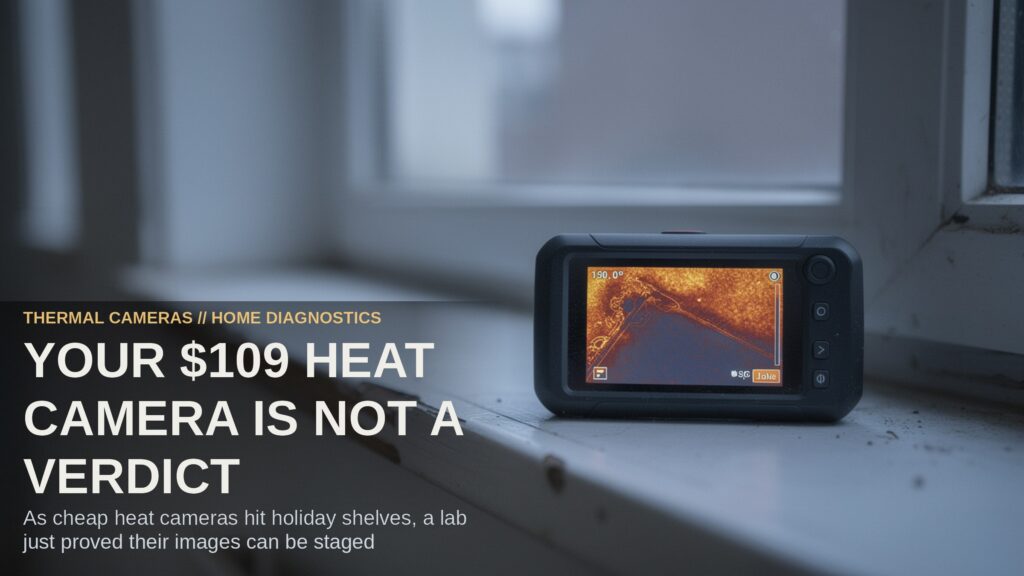
The sale makes that fact matter more. Rision’s release sells the cameras straight at winter fear, as gifts for spotting “areas to check for air leaks or gaps in insulation” around windows, doors and exterior walls [2]. Cheap cameras mean more of these pictures in more hands, held by people with no training in what moves a surface reading. Even the firm selling them says an odd cold area “may suggest where to investigate, but further checks may be needed,” and “a cold spot alone doesn’t prove that insulation is missing” [3].
The professionals hit the same wall. Buyer guidance posted this month restates what Britain’s new-home warranty body has long said: a thermal image is a “map of surface temperature,” useful only when indoor and outdoor air are far apart [4]. That guidance also documents a homeowner who sealed the attic leaks the scan flagged, then found the infrared image looked barely different afterwards [4]. The picture cannot even score its own repairs.
By the numbers
- Rision’s plug-in camera, 24 grams, reads from −4°F to 1,112°F; its sale price is 45% below list [2].
- The standalone handheld, with a built-in 2.8-inch screen, is $149 for the sale window [2].
- Ireland’s energy authority puts a home’s heat loss through the roof at up to 30% [3].
What I’d watch: the second tool
What I am watching is whether buyers follow the inspectors rather than the ads. The working method that the warranty body and the camera maker’s own guide converge on is simple: the camera nominates, a second tool convicts. A smoke pencil at the draft, a paper slip at the window, a pin meter where a stain shows — the touch confirms what the image only suggests [4]. The guides are also blunt about the conditions. A scan on a mild day tells you little, because the picture needs a real gap between inside and outside air [3]. And the roof, where the Irish energy authority says up to 30% of a home’s heat can escape, is beyond any casual scan of a bedroom [3].
The open question is whether the $109 price changes behaviour or just ownership. The guides already warn that sun-warmed walls and furniture against exterior walls repaint the surface picture — staging by accident, the same way the cloak does on purpose [3]. More cameras in untrained hands means more cold patches read as verdicts. The next signal worth having is whether inspection bodies update their guidance for a market where the tool costs about as much as a nice dinner.
The catch
I would take this week’s deal at its word and no further. $109 is a fair price for a clue generator, and that is all the image has ever been. What changed this month is not the price. It is that physics now shows the picture can be erased with a printed shell, while the maker’s own guide refuses to call it a diagnosis. A heat camera earns its keep the day it flags a cold bay you would never have guessed. It fails as an audit the day you let it skip the second tool. The trade-offs these tools force — scan first, verify second — are the standing subject of the home diagnostics tools hub.
Related reading
- Cheap Gas, $20,000 Pipe — more on Energy & Efficiency
- Your Heat Pump Cuts Everyone 13% — more on Energy & Efficiency
Sources
- [1] ScienceDaily (Univ. of Illinois News Bureau), “New 3D thermal invisibility cloak makes objects disappear from infrared cameras”, 2026-10-26 — https://www.sciencedaily.com/releases/2026/10/261025073051.htm
- [2] PR Newswire, “RISION Offers Up to 45% Off Thermal Cameras for Black Friday and Cyber Monday”, 2026-11-19 — https://www.prnewswire.com/news-releases/rision-offers-up-to-45-off-thermal-cameras-for-black-friday-and-cyber-monday-302945429.html
- [3] HIKMICRO, “Places Your Home Might Be Losing Heat”, first-party guide, read 2026-11-21 — https://www.hikmicrotech.com/en/explore/home-blog/Places-Your-Home-Might-Be-Losing-Heat
- [4] Intelligent Living via Yahoo Shopping, “Home inspections can miss costly heat leaks”, 2026-11-16 — https://shopping.yahoo.com/home-garden/home-improvement/articles/home-inspections-miss-costly-heat-123500302.html