At a glance
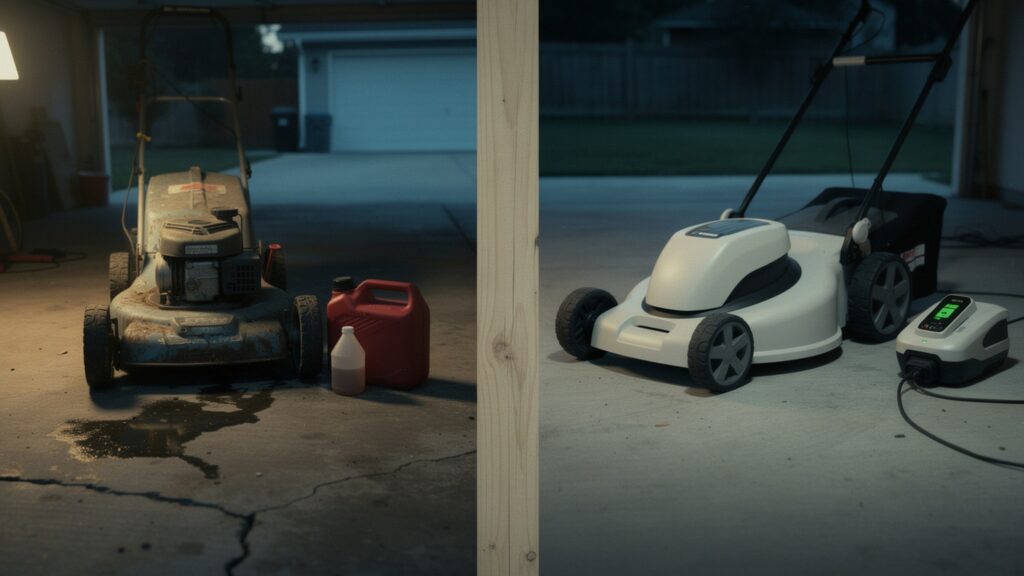
For homeowners choosing a gas or a battery mower, this piece compares the gas side’s printed upkeep — oil at 5 hours, then every 50 hours or yearly, plus fuel that decays in storage — with a cordless that finishes a quarter acre on one charge and carries none.
The schedule you inherited
The 50-hour rule is not advice. It is a condition the maker attaches to the engine. Briggs & Stratton wants the first oil change after the first 5 hours, then a change every 50 hours or once a year, whichever comes first [1]. A small suburban lot runs a mower 20 to 30 hours a season. The calendar triggers the work, not the hour meter. Every spring brings oil, a spark plug, an air filter, and an engine that must start or be diagnosed.
The fuel rule is the part owners skip until spring exposes it. Nichols Equipment, a Honda outdoor-power dealer, splits storage into windows. Gas in the tank for 30 to 90 days needs a stabilizer mixed into fresh fuel, then a 10-minute run to push the treated gas through the system [2]. Past 90 days, the whole fuel system must be emptied, tank included [2]. The same page is blunt about one thing: a stabilizer cannot fix fuel that has already gone stale [2]. I have watched enough neighbors curse a mower in April to believe this is the single most common failure in the class. The fuel aged on a clock nobody saw, and the carburetor kept score.
By the numbers
- Briggs & Stratton prints an oil change every 50 hours of use or yearly, whichever comes first, after a first change at 5 hours [1].
- Gas may sit in a stored mower for no more than 90 days before the entire fuel system must be drained [2].
- Consumer Reports measured the average battery walk-behind at 45 to 50 minutes of cut per charge [3].
What the cordless actually removes
Buyers price the wrong side of this comparison, and my reading, held loosely, is that the sticker gap hides it. The usual worry is what the cordless gives up: run time, peak torque, the freedom to refill and keep going. But the gas mower charges its price after the sale. It asks for oil on a 50-hour or yearly clock, a new filter and a plug [1]. It also asks for fuel rotated inside a 90-day window [2]. The battery mower asks for planning instead. Consumer Reports found two-thirds of the electric walk-behinds it rated could finish a quarter acre on one charge [3]. A 7.5 amp-hour pack holds 420 watt-hours of that work [5]. If your lawn fits inside one charge, the upkeep line goes away. No oil to change, no tank to drain. Nothing on the gas side’s list has an equivalent on the cordless side, and that absence — not the cut quality — is what you are paying for.
The running cost is easy to state. A charge or two a season draws from the wall, at a national grid intensity of 0.81 pounds of carbon dioxide per kilowatt-hour [4]. No jerry can, no mixed fuel, no oil bottle in the garage. The same trade runs through the rest of our outdoor power and snow equipment coverage, because every machine in this class carries either a service list or a charge cycle.
The catch
The upkeep tax is small in dollars, and honesty about that matters. A season’s oil, plug and filter run a few tens of dollars and one working hour. A battery mower often costs hundreds more at the till. The schedule alone does not close that gap in year one. What it changes is the character of owning the machine. The gas mower degrades when it is ignored, and it starts with the fuel first, per the 90-day rule [2]. The cordless wears through use and years of charge cycles, a slower and kinder clock [5]. Power still belongs to gas: Consumer Reports’ testers call it unbeatable there [3]. A cordless that bogs in tall, wet grass has not lost a service race. It has hit the limit it was bought around.
What I would tell a neighbor is the honest rule. If your lawn is a quarter acre or less and one charge finishes it, the cordless deletes a recurring chore, not just a price. If your lot takes several charges or your grass is heavy, the gas machine’s upkeep is the salary you pay for its torque — and the service list is the least of what you owe it.
Related reading
- Your 1-Acre Mower’s 0.4-Acre Trap — more on Yard Robots & Automation
- Your Mower’s 145-Minute Charge Trap — more on Outdoor Power & Snow Equipment
- Your Mower’s 2.4-Year Payback Trap — more on Yard Robots & Automation
Sources
- [1] Briggs & Stratton, “How to Change Small Engine Oil” (change the oil after the first 5 hours of use, then annually or every 50 hours of use, whichever comes first) — https://www.briggsandstratton.com/en-us/support/maintenance-how-to/how-to-change-oil
- [2] Nichols Equipment, “Storing Your Lawn Mower for More Than 30 Days” (30 to 90 days of storage requires fresh gasoline plus stabilizer and a 10-minute run; fuel may not remain in the mower past 90 days; stabilizers will not reconstitute stale fuel) — https://www.nicholsequipment.com/storing-your-lawn-mower-for-more-than-30-days
- [3] Consumer Reports, “Gas vs. Battery Lawn Mower: Which Is Better?” (average battery walk-behind run time 45 to 50 minutes per charge; two-thirds of electric walk-behinds rated can mow a quarter acre on one charge; gas unbeatable on power; electric largely maintenance-free) — https://www.consumerreports.org/home-garden/lawn-mowers/gas-vs-electric-lawn-mower-which-is-better-a1057954260
- [4] U.S. Energy Information Administration, “How much carbon dioxide is produced per kilowatthour of U.S. electricity generation?” (about 0.81 pounds of CO2 per kilowatt-hour, U.S. average) — https://www.eia.gov/tools/faqs/faq.php?id=74&t=11
- [5] EGO POWER+, “Learn More About EGO Batteries and How to Choose” (the 7.5 amp-hour pack holds 420 watt-hours) — https://www.egopowerplus.com/battery-info