At a glance
- The shift: A spare battery is a charge-time purchase, not a capacity one.
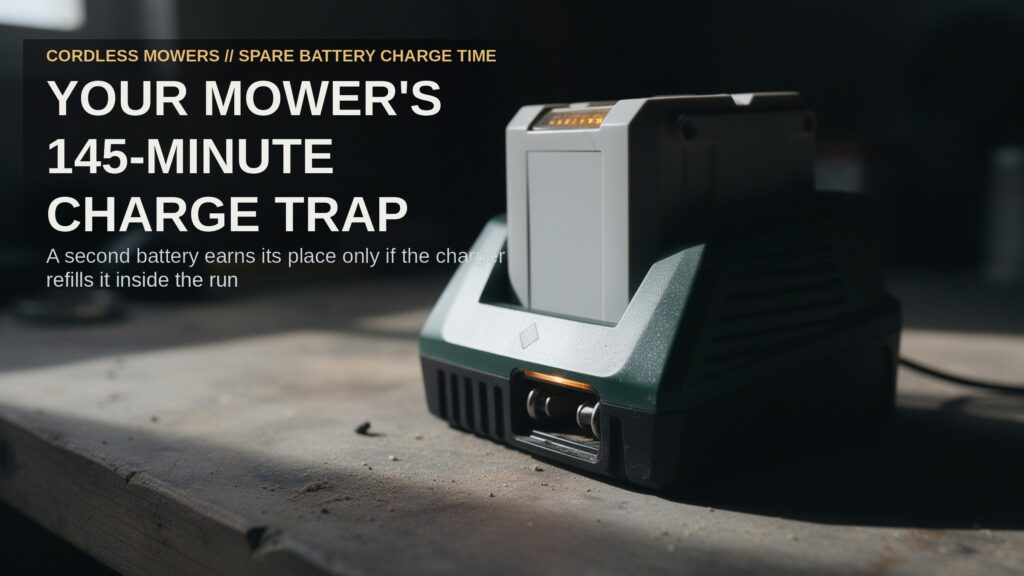
- The number: 145 minutes — the standard charger’s refill for a pack rated for one hour of cutting.
- The risk: The two-battery loop never closes, so the pack waits while the grass does.
The charger sets the pace
A pack stores energy, and a charger moves it, so the charger’s wattage sets the pace. My read is that the charger, not the pack, makes most of the difference. The pack holds 420 watt-hours, the total electrical energy it can deliver [6]. The 550-watt rapid charger could move that energy in about 46 minutes of loss-free charging, against the 60 minutes the maker publishes [5]. Battery University puts the share of electricity that actually reaches the cells near 99 percent, so the extra time sits in the charger’s own limit and the slow finish of a full charge [7]. The 320-watt unit in the same line needs 100 minutes for the same pack [6].
The yard size sets the other half of the math, and it is dull in the way good purchase math is dull. The deck is 1.75 feet wide, and at 2 miles per hour the mower sweeps 176 feet a minute [4]. That covers 308 square feet before overlap. Knock off 15 percent for the strip each pass cuts twice, and a quarter acre of 10,890 square feet takes about 42 minutes. The slowest drive speed, 0.9 miles per hour, needs 92 minutes for the same ground; the fastest, 3.1 miles per hour, about 27 [4].
Put both halves together and the share of time spent cutting becomes clear. The rated cutting time buys the same refill time on the rapid unit, so one spare pack can close the two-battery loop. Nearly two and a half hours of charging for the same rated cutting time leaves a machine that finishes its grass and then sits. The smaller number sets the useful output, and for most buyers that is the charger.
By the numbers
- 45 to 50 minutes: Consumer Reports’ measured average run time per charge for the battery walk-behind mowers it tested [1].
- 7.0 foot-pounds: the turning force this mower publishes; it is not what decides whether a yard gets finished [4].
- 70 minutes: the rapid charger’s refill for a 10 amp-hour pack, so refill times climb with pack size, not with mower width [5].
Where the two-battery loop closes
The people selling these machines treat the charger as an accessory and the pack as the upgrade. My read: that order is backwards for anyone cutting more than one charge of grass. A two-battery loop needs the refill to finish inside the run, and one spare pack closes that loop only on the rapid charger, not the standard one. The same clock runs across snow blowers, trimmers, and the rest of this desk’s outdoor power coverage, because each machine pairs a pack with a charger.
What I’d watch: whether stores start bundling the rapid charger with spare packs. The measured run-time band leaves less room than the box suggests. Consumer Reports’ testers found two-thirds of the electric walk-behind mowers they rated could clear a quarter acre on one charge [2]. That is the same quarter acre the deck math estimates on a two-mile-per-hour pass. Anyone whose yard runs past it has two real choices: a wider deck that finishes inside one charge, or a rapid charger that finishes the refill inside one run.
Against gas, the same testers say gas still leads on run time [2]. They also call electric mowers largely free of routine upkeep [3]. The trade, then, is a refill you wait for against upkeep you no longer do.
The “up to” gap
The maker’s run-time claim is an “up to” figure at a mowing load the company does not state, and a mulching pass through tall grass is not the load a spec sheet measures. Consumer Reports’ average run time is a figure across brands, not this mower’s own number. The real share of time spent cutting therefore sits below the tidy one-for-one even on the rapid charger, closer to 43 percent of the clock spent cutting [1].
The slow refill in the first paragraph belongs to the standard charger sold beside the pack, not to EGO’s chargers as a group [6]. Chargers between those two points fill at intermediate times, so the useful check is the refill time printed on your own charger, not the pack rating. What I keep circling is that none of this is a battery problem. The pack carries the same run rating either way; the deciding number sits on a different box. The choice before a spare pack goes in the cart is the charger refill time against the mower run time, and I keep that math in this desk’s outdoor power and snow equipment coverage.
Related reading
- Your 1-Acre Mower’s 0.4-Acre Trap — more on Yard Robots & Automation
- Your Half-Acre Mower’s $450 Gap — more on Yard Robots & Automation
- Your Mower’s 2.4-Year Payback Trap — more on Yard Robots & Automation
Sources
- Consumer Reports, “Gas vs. Battery Lawn Mower: Which Is Better?” (measured run time of 45 to 50 minutes per charge across the battery walk-behinds tested) — https://www.consumerreports.org/home-garden/lawn-mowers/gas-vs-electric-lawn-mower-which-is-better-a1057954260
- Consumer Reports, “Gas vs. Battery Lawn Mower: Which Is Better?” (two-thirds able to mow a quarter acre per charge; gas unbeatable on run time) — https://www.consumerreports.org/home-garden/lawn-mowers/gas-vs-electric-lawn-mower-which-is-better-a1057954260
- Consumer Reports, “Gas vs. Battery Lawn Mower: Which Is Better?” (electric mowers largely maintenance-free) — https://www.consumerreports.org/home-garden/lawn-mowers/gas-vs-electric-lawn-mower-which-is-better-a1057954260
- EGO POWER+, “POWER+ Mower 21-inch Select Cut System with Touch Drive, Self-Propelled Kit (7.5Ah Battery)” (an hour of run time on the 7.5Ah pack, 21-inch deck, 7.0 foot-pounds of torque, .9 to 3.1 miles an hour) — https://egopowerplus.com/21-inch-self-propelled-mower-select-cut-lm2135sp
- EGO POWER+, “POWER+ Rapid Charger” (7.5 amp-hour pack in 60 minutes, 10 amp-hour in 70; all charge times approximate) — https://egopowerplus.com/charger-rapid
- EGO POWER+, “Learn More About EGO Batteries and How to Choose” (7.5 amp-hour pack is 420 watt-hours; 60 minutes on the rapid charger, 100 on the 320-watt charger, 145 on the standard charger) — https://egopowerplus.com/battery-info
- Battery University, “BU-409: Charging Lithium-ion” (charge efficiency about 99 percent; 180 minutes to full saturation at 4.20 volts per cell) — https://batteryuniversity.com/article/bu-409-charging-lithium-ion