At a glance
- The shift: Outdoor power’s two biggest names moved factory work away from their own badges this quarter.
- The number: 42,860 trimmer-mower owners were offered a free repair kit.
- The risk: A machine’s importer, not its badge, decides whether that fix arrives.
The badge left the factory first
I read the recall dates against the earnings dates twice before I believed they fell in the same quarter. On 8 October, the safety commission announced the recall of the DR walk-behind trimmer mowers because they could catch fire. On 22 October, the same agency warned PowRyte pressure-washer owners to cut the cord and dispose of the units, because the seller had not answered its recall request [2]. Between those two notices, on 21 October, Husqvarna said it would move production of some of its battery handheld tools from Europe to Asia [4]. Stanley Black & Decker had already agreed on 4 September to sell Excel Industries, which builds the gas ride-on and zero-turn mowers sold as Hustler, to Bad Boy Mowers; Excel is expected to bring in about $300 million this fiscal year [3]. On 4 November, its third-quarter results made the pattern explicit.
A license splits two things a buyer has long treated as one: the name on the spec sheet and the company that owns the plant, the parts desk and the warranty. Its gas walk-behind mower line already runs under that deal, and the change took 2 percentage points out of Tools & Outdoor sales in the quarter [5]. The split is not new, and it is not a fault by itself. What changed this quarter is that the two biggest names in the category did it in public, at the same time, while the safety regulator was showing what the far end of the deal looks like.
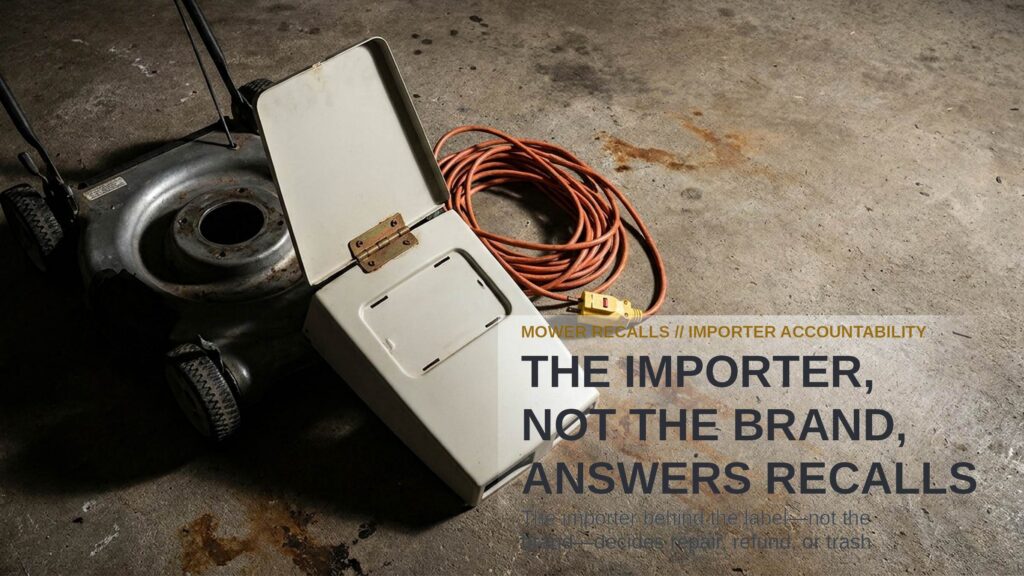
A recall has to be served on somebody who can be reached, and in practice that means the importer named on the box or a United States parent with money to lose. The PowRyte notice named a concrete defect: the pressure washers lack a built-in ground-fault circuit interrupter (GFCI) at the plug [2]. Powell Works, Inc. of China has not answered any request for a recall, so the notice offers no refund, no repair and no company contact [2]. DR’s mowers were imported by Generac Power Systems of Waukesha, Wisconsin, so the remedy arrived as a free repair kit with a phone number attached [1]. Same regulator, same month, same kind of danger, opposite endings.
By the numbers
- 19 fire reports: The incidents behind the recall of about 42,860 walk-behind trimmer mowers [1].
- 2% of Tools & Outdoor sales: What the gas walk-behind license took out of the quarter [5].
- $320 pressure washer: The top of the online price band for units owners were told to destroy [2].
Who answers in year three
I found the difference at the parts counter rather than in the press releases, because a licensed badge can keep its name and still lose the stock behind it. A licensed machine keeps its badge, its spec sheet and its price. The thing that quietly changes hands is who has to stock a spindle, a control cable or a battery contact plate five winters from now. Whether an orphaned machine is worth keeping comes down to the price of one spare part, and a spare battery pack is where that math most often goes wrong.
The money explains the timing. Its Tools & Outdoor margin rose to 17.0%, up 5.2 points, and about 4.3 of those points came from tariff refunds rather than from anything the business did [5]. Husqvarna reported organic sales down 5% and is halfway through a 3 billion kronor savings plan, with roughly 935 million kronor banked [4]. When a refund carries the margin and Europe buys less, a factory is a cost to hand off. The badge survives the handoff; the parts channel does not automatically follow.
Two things would settle the open question. The first is a label. Whether the next Cub Cadet walk-behind names Stanley Black & Decker or a license holder as the maker decides who a recall gets served on. The second is the pressure-washer file. The missing GFCI has now produced a refund, a recall and a warning in eight months. That pattern is a list of sellers, not one bad actor [6].
The catch
None of this tells me a licensed machine is built worse, and I will not turn it into that claim. DR is the counter-example to the argument: an importer with a phone number did exactly what the system is supposed to do. Agiiman, a seller in China, refunded every one of its 80 pressure washers in April [6]. The variable is not the country and not the license. It is whether anyone with money and a phone number still stands behind the label when the machine fails.
That part is knowable before you buy, which is the only lever a homeowner controls. The importer is printed on the carton and in the manual’s small print. The parts channel is one phone call away. On a corded machine, the GFCI sits in plain sight at the plug. None of this is on the product page, and all of it outlives the badge.
Related reading
- 37,667 Snow Throwers Failed Winter — more on Outdoor Power & Snow Equipment
Sources
- [1] U.S. Consumer Product Safety Commission, “DR Power Equipment Recalls Pilot and Premier Trimmer Mowers Due to Risk of Serious Injury or Death from Fire and Burn Hazards”, 8 October 2026 — https://www.cpsc.gov/Recalls/2027/DR-Power-Equipment-Recalls-Pilot-and-Premier-Trimmer-Mowers-Due-to-Risk-of-Serious-Injury-or-Death-from-Fire-and-Burn-Hazards
- [2] U.S. Consumer Product Safety Commission, “CPSC Warns Consumers to Stop Using PowRyte Pressure Washers Immediately Due to Serious Shock and Electrocution Hazards”, 22 October 2026 — https://www.cpsc.gov/Warnings/2027/CPSC-Warns-Consumers-to-Stop-Using-PowRyte-Pressure-Washers-Immediately-Due-to-Serious-Shock-and-Electrocution-Hazards-Risk-of-Serious-Injury-or-Death
- [3] Stanley Black & Decker, “Stanley Black & Decker Announces Agreement to Sell Excel Industries to Bad Boy Mowers”, 4 September 2026 — https://www.prnewswire.com/news-releases/stanley-black–decker-announces-agreement-to-sell-excel-industries-to-bad-boy-mowers-302870329.html
- [4] Husqvarna Group, “Interim report January – September 2026”, 21 October 2026 — https://www.husqvarnagroup.com/sites/husqvarna/files/pr/202610207143-1.pdf
- [5] Stanley Black & Decker, “Stanley Black & Decker Reports 3Q 2026 Results”, 4 November 2026 — https://www.prnewswire.com/news-releases/stanley-black–decker-reports-3q-2026-results-302928496.html
- [6] U.S. Consumer Product Safety Commission, “Agiiman Recalls Pressure Washers Due to Serious Risk of Injury or Death from Shock and Electrocution Hazards”, 16 April 2026 — https://www.cpsc.gov/Recalls/2026/Agiiman-Recalls-Pressure-Washers-Due-to-Serious-Risk-of-Injury-or-Death-from-Shock-and-Electrocution-Hazards