At a glance
A homeowner pricing a heat pump this winter faces one real question: how far above the federal efficiency floor a quote sits, and whether the ducts feeding it leak more energy than the upgrade saves. The $2,000 credit window runs through 2032.
Why the floor changed
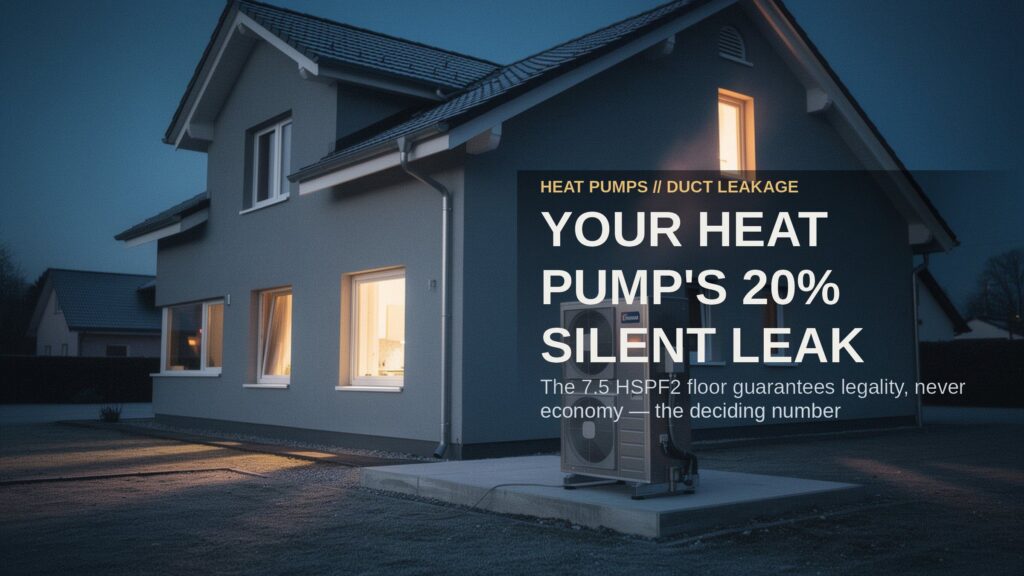
Federal standards rewritten in 2015 took effect on January 1, 2023, when the Code of Federal Regulations (CFR) raised the split-system floor to 14.3 SEER2 for cooling and 7.5 HSPF2 for heating [1]. No rulemaking since has moved it, so as of the 2026 edition the floor is the starting bid on every quote, not a selling point. What makes that rating worth arguing over is how much of the house it carries. Heating water and heating space together took 52 percent of the average household’s energy consumption in 2020, the two biggest uses the home has [4]. A machine that feeds those loads matters — but only inside a sealed system, and ducts installed in attics and crawlspaces leak on average, even in brand-new construction [5]. Beside the machine, Congress put one date. A qualifying unit earns a federal tax credit of up to $2,000, and installations can claim it to the close of 2032 [2]. My reading of the regulation is that the floor was written for the worst installer, not the best buyer — it guarantees legality, never economy.
By the numbers
- 7.5: The heating floor, in HSPF2 rating units, every split-system unit sold today must meet [1].
- 15–20%: The share of space-conditioning energy average duct leakage wastes, even in new construction [5].
- $2,000: The federal tax credit for a qualifying unit, through December 31, 2032 [2].
Where the money leaks
Run the floor math on a real house. Say a home needs about 40 million Btu (British thermal units — the heat in roughly one cord of dry wood) over a winter. At the 7.5 HSPF2 floor that costs about 1,563 kilowatt-hours (kWh) of electricity. At a 10 HSPF2 tier it costs about 1,172 kWh, so the better machine saves roughly 390 kWh a winter. At the measured 2025 residential price of 17.30¢ per kWh, that saving is about $68 [3]. Real money — but small. Now price the ducts. The same floor unit feeding a leaky run loses 234 to 313 kWh to the attic, which at that price is $41 to $54 a year spent on nothing [5]. I did this arithmetic twice before believing the direction of it: the hole in the duct run costs more than half of what the model upgrade saves, and the upgrade’s premium is what the quote actually itemizes. The conversation stops at the model number because that is the only line with a label on it. The fuel the house already burns sets the rest of that winter bill, as the winter-bill arithmetic shows.
The catch
The arithmetic cuts both ways. Duct sealing is invisible on a test label and hard to inspect from a supply grille, so a quote that leaves it out is not always a dodge — the work has to be found and paid for on its own. And the reward for chasing efficiency shrinks as you climb, because heating electricity falls as one over the rating: 7.5 to 10 cuts it 25 percent, and 10 to 12.5 only 15 percent more [1]. The defensible order follows from the numbers. Take the $2,000 credit on the machine while the window is open [2], then spend what remains on sealing the ducts the unit depends on, and treat anything above that as a comfort purchase. What I am watching in my own quotes this winter is whether the contractor prices the duct run at all — a floor-priced machine plus sealed ducts beats a premium machine feeding the attic.
Related reading
- Your $6.19 Oil Heat — more on Energy & Efficiency
- Energy & Efficiency — more on Energy & Efficiency
- Cheap Gas, $20,000 Pipe — more on Energy & Efficiency
Sources
- [1] eCFR, “10 CFR 430.32 — Energy and conservation standards for consumer products”, current as of 2026 — https://www.ecfr.gov/current/title-10/chapter-II/subchapter-D/part-430/subpart-C/section-430.32
- [2] ENERGY STAR, “Air-Source Heat Pumps”, 2026 — https://www.energystar.gov/products/air_source_heat_pumps
- [3] U.S. Energy Information Administration, “Electricity prices and factors affecting prices”, 2025 data — https://www.eia.gov/energyexplained/electricity/prices-and-factors-affecting-prices.php
- [4] U.S. Energy Information Administration, “Use of energy in homes”, 2020 data — https://www.eia.gov/energyexplained/use-of-energy/homes.php
- [5] InterNACHI, “HVAC inspection article” — https://nachi.org/hvac.htm