Your 8.48% Remodel: The Exits That Funded It Closed
At a glance
The resale market has frozen again, and the money priced against it for repairs runs high. This piece works out what that means for an owner who must replace a roof, a boiler or a compressor in 2027.
The funding loop runs backward
In November, 46% of builders cut prices, the highest share since the pandemic [1]. The average cut held at 6% for an eighth straight month [1]. New sellers are discounting into demand that is not clearing: pending contracts just logged a second record-low month, down 16.7% from a year earlier [3]. I read that pairing twice before accepting it — sellers cutting price while buyers still stay away — because it is the market’s own admission that the exit no longer clears.
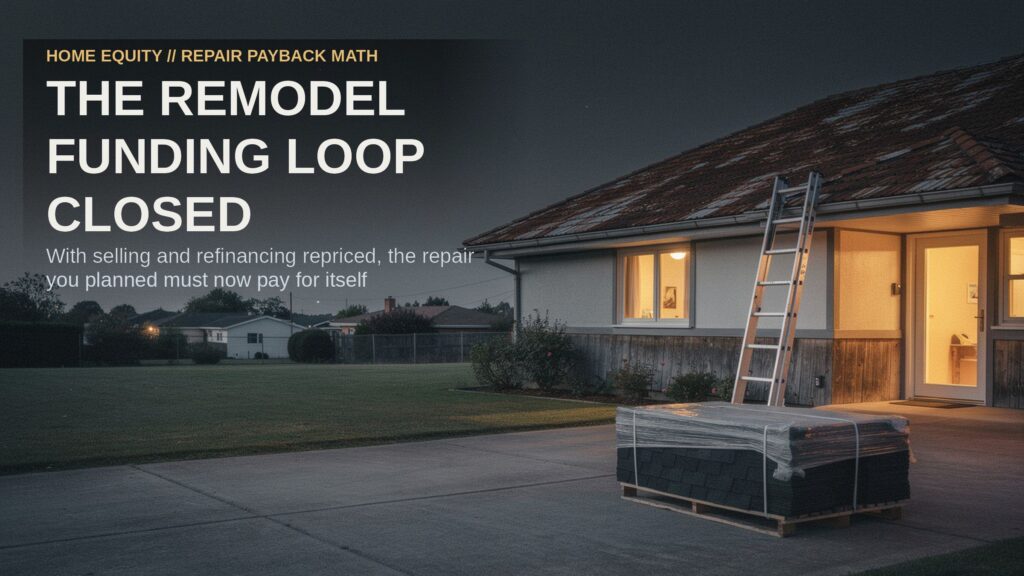
The old repair logic worked because a funding loop carried it. You fixed the kitchen because the sale price would return the money, or you refinanced into a lower rate and rolled the roof into the loan. Both halves of that loop have repriced. First-lien money sat at 7.35% in the Mortgage Bankers Association’s latest weekly survey, its highest in three weeks [4]. Purchase applications ran 18% below a year ago, and refinance volume was down 54% [4]. Second-lien money is worse: a credit line averages 7.47% [5]. A fixed home equity loan runs 8.48% to 8.77% depending on term [2]. The dollar you borrow to fix the house now costs more per year than the mortgage it sits behind. That relationship never held during the refinance era, and it changes which repairs make sense.
By the numbers
- 25 HMI: Builder confidence in new single-family sales, the lowest since April 2012 [1].
- 8.48% APR: The average Curinos price of a $500,000, 30-year fixed home equity loan at 60% loan-to-value [2].
- 16 traffic index: Prospective-buyer traffic, its lowest in 15 years outside the 2020 pandemic start [1].
The Housing Market Index (HMI) is the builders’ own monthly vote, so 25 means most of them see weak sales and see them getting weaker. The annual percentage rate (APR) is the price of the second loan, before fees. Traffic at 16 is the buyer half of the same vote, and it fell even as builders discounted.
What the lenders are holding, and what spring answers
The people closest to this read it as a staging problem, not a market call. Lenders kept second-lien rates wide through a week when first-lien rates bounced higher, and the 7.47% line average barely moved off last week’s 7.50% [5]. My read on that steadiness: the pricing is deliberate, not a temporary spread. What answers the open question next is the spring listing season. If contracts stay at record lows, the pre-sale repair logic dies quietly, and repair budgets shift to whatever pays an energy bill back inside the ownership window.
Where this bites hardest is the middle case: a house you neither need to sell nor can afford to walk away from, holding a roof or a compressor past its wear-out date. Run each repair against the house’s own payback first, as the renovate-or-move calculator does, and treat resale recovery as a bonus you no longer control.
The catch
The honest limit is that 8.48% is an average on a specific loan, not your quote. Curinos prices a $500,000, 30-year loan at 60% loan-to-value, so a smaller line at a shorter term prices differently [2]. Cash on hand changes the math entirely, because the compounding liability only exists when the repair is financed. And one leg of the funding loop could still reopen: first-lien money, which the Mortgage Bankers Association priced at 7.35% this week, is a survey number that moves [4]. An owner with a genuinely failing system still faces a timing bet, not a closed door. What I am watching is whether that survey rate breaks back under the second-lien spread, because that is the single number that would restore the old loop.
Related reading
- Borrow at 8% to remodel, or let your battery earn on the grid — more on Energy & Efficiency
- Remodel That Pays You Back Isn’t the One You Want — more on Energy & Efficiency
- Your Next Bedroom Costs $417,500 — more on Energy & Efficiency
Sources
- [1] National Association of Home Builders, “Builder Sentiment Continues to Fall on Affordability Concerns” — https://www.nahb.org/news-and-economics/press-releases/2026/11/builder-sentiment-continues-to-fall-on-affordability-concerns
- [2] Forbes Advisor (Curinos data), “Latest HELOC & Home Equity Loan Rates: November 19, 2026” — https://www.forbes.com/advisor/home-equity/current-home-equity-interest-rates-11-19-26/
- [3] Mortgage News Daily (NAR data), “Pending Home Sales Hit Another Record Low” — https://www.mortgagenewsdaily.com/news/11202026-pending-home-sales
- [4] Mortgage News Daily (MBA data), “Mortgage Applications Dip 2.3 Percent as Rates Bounced Back” — https://www.mortgagenewsdaily.com/news/11202026-mortgage-applications-mba
- [5] Bankrate, “Current HELOC Rates In November 2026” — https://www.bankrate.com/home-equity/heloc-rates/