At a glance
Husqvarna’s own maintenance pages put two consumption costs inside a robot mower’s sticker price: blades that wear out in weeks and a battery that dies in years. This piece prices both against the $2,599.99 machine, for any buyer running payback math before ordering.
The clocks nobody prices
The payback math that sells robot mowers is one division: machine price against the lawn crew’s annual bill. I have run that division with regional season lengths, and it holds as far as it goes. What it never includes is the wear schedule the maker prints in plain sight.
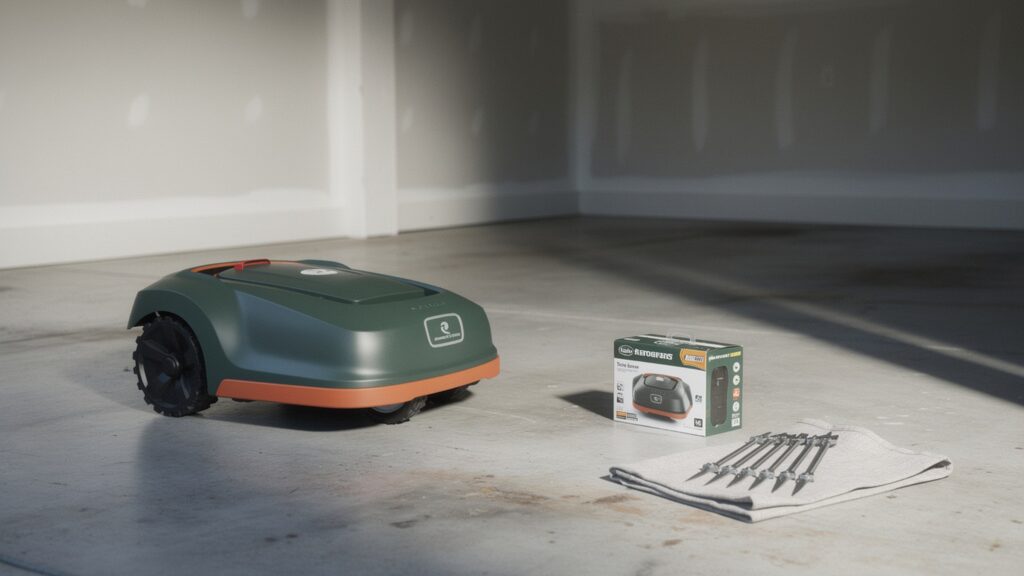
The blade clock is the fast one. Husqvarna’s guidance prints the whole sentence: “Husqvarna Long Life Safety Blades should be replaced every 6-8 weeks and Husqvarna Endurance Safety Blades every 3-4 months” [2]. Assume a 28-week mowing season and that works out to two or three blade changes a year on the Endurance schedule, up to four on Long Life. The Endurance six-pack lists at $26.99 [3]. The Classic pack lists at $64.99 [4].
The battery clock is the slow one, and it lands inside the years you own the machine anyway. Husqvarna’s support article puts it plainly: “The battery life of Automower® typically lasts between 2 and 5 years” [1]. A buyer who keeps the machine four years should expect to buy one battery, maybe two on daily duty. The kit for the 430X/440/450X generation lists at $313.36 at one mower-parts dealer — currently sold out there, which is itself a signal about demand [5].
By the numbers
- $313.36: One genuine battery kit for the 430X/440/450X generation, listed while marked sold out [5].
- 6-8 weeks: Husqvarna’s published replacement window for Long Life blades [2].
- $26.99: The Endurance blade six-pack’s list price, against $64.99 for Classic [4].
Where this bites
The people closest to these machines treat the battery as planned service, not a failure. Husqvarna’s support article tells owners to have a dealer swap the battery, and points at the app’s statistics screen — running distance, charging cycles — as the way to watch for the early sign: the mower “returning to the charging station too often” [1]. That is a wear signal you can read at home, years before the machine stops on the lawn. Before I trusted any second-hand robot mower, I would read those counters myself.
The blade side costs less but is easier to get wrong. Each change wants new screws, because Husqvarna says to swap them every time and never reuse them [2]. The Endurance pack’s pitch is “more than twice the lifetime compared to classic blades” [3], which is why the cheaper-looking pack wins on anything but the lightest duty.
The catch
I read that 2-to-5 band as the maker saying one thing clearly: nobody can quote your battery’s death year in advance. The band is a spread across duty cycles — a small lawn mowed twice weekly ages a battery far slower than a one-acre lot mowed daily — so one owner buys a battery in year four and another never does [1]. The blade windows are product-specific too: 6-8 weeks belongs to Long Life, 3-4 months to Endurance, and gravel or sand in the lawn shortens both [2]. Divide your own mower’s duty into those windows rather than quoting anyone’s four-year total.
My read of the two spec pages, held loosely: four years of ownership costs a quarter of the machine price again in blades and battery — more if the battery dies twice inside the window. A middle case with three or four blade packs a year lands near $330 of blades. Add one battery kit inside those four years and the upkeep total runs near $640 to $745 against a $2,599.99 machine. That is the line the shopping guides never print, and the year-four battery bill makes it too big to ignore.
Planning tools price the machine, not its life support — the same gap the payback article left open.
Related reading
- Your Half-Acre Mower’s $450 Gap — more on Yard Robots & Automation
- Mower’s 2 cm Dies Under Trees — more on Yard Robots & Automation
- Your Mower Needs 4 Approvals — more on Yard Robots & Automation
Sources
- [1] Husqvarna, “Automower® battery: signs of ageing and how to maximise lifespan” — https://www.husqvarna.com/ie/support/automower-battery-signs-of-ageing-and-how-to-maximise-lifespan-ka-01420
- [2] Husqvarna, “How Often Should My Automower® Run & When To Change The Blades?” — https://www.husqvarna.com/nz/learn-and-discover/how-often-should-my-automower-run-and-when-to-change-the-blades
- [3] Husqvarna, “Automower® Endurance Blades” — https://www.husqvarna.com/us/robotic-lawn-mower-blades/endurance-blades
- [4] Husqvarna, “Husqvarna Automower® Classic Blades” — https://www.husqvarna.com/us/robotic-lawn-mower-blades/classic-blades
- [5] Powered By Moyer, “Husqvarna 529606802 5.2Ah 18V Lithium Ion Battery Kit Automower 430X 440 450X” — https://poweredbymoyer.com/products/husqvarna-529606802-5-2ah-18v-lithium-ion-battery-kit-automower-430x-440-450x
- [6] Husqvarna, “Automower® 420 iQ” — https://www.husqvarna.com/us/robotic-lawn-mowers/automower-420-iq/