At a glance
- The shift: Colorado now makes a carrier hand over the score and the fixes behind a wildfire price.
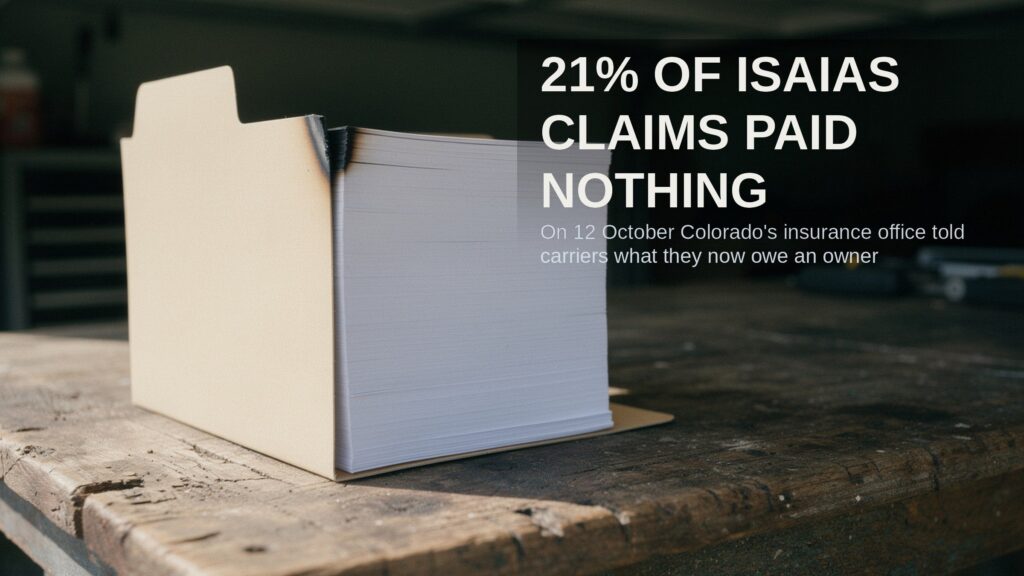
- The number: 14,402 of 68,071 Isaias claims closed with nothing paid.
- The risk: A credit nobody documented is a claim you cannot prove later.
Colorado timed the price
The rule is HB25-1182, in force since July and signed in May of last year [3]. The notices it requires began going out on 1 October [1]. The state wrote it because a score can set a price and a renewal, and until now the owner had no way to see the math. The score is the number a carrier assigns to a house to fix a price or a renewal term.
The clock is short and it runs both ways. A new applicant’s score must arrive about two weeks after a complete application. An appeal has to be acknowledged inside 10 days and decided in writing inside 30, and if the answer runs late the policy keeps covering the house for 10 days past its end date [1]. A state that times all of that has decided a score is a document, not a verdict. A deadline is the cheapest consumer protection there is, and the only kind a regulator can enforce without sending an adjuster to the house.
The notice itself is where the power sits. It must carry the property’s own score, a plain explanation of the math, the full range of scores, the features of the house behind that number, the effect of mitigation, and the right to appeal [1]. A carrier that uses a score to price, write or drop a policy must also post its mitigation discounts on its own site, or say there that it offers none [1]. A year ago a surcharge arrived as a number with no arithmetic attached. That is the part of this rule I would put above the 15%.
The carrier reply is the part that changes a decision. CSAA (an insurer) offers 15% off the wildfire share of a premium to a home that holds a Wildfire Prepared Home certificate, a certification for houses built or retrofitted against embers and flame, at the Enhanced or Essential level, subject to its own rules [1]. It also promises wildfire cover where the home reaches Enhanced and the owner holds a car policy with it [1]. State Farm will look at homes “even in high wildfire risk areas” when they carry the same certificate [1]. Put those two offers side by side and here is what I read: the 15% is the smaller half. What the certificate buys is a writer’s willingness to take the house at all.
By the numbers
- 15% off the wildfire share: CSAA’s filed discount for a home that holds the certificate [1].
- 10 days: The carrier’s limit to answer a score appeal before the state’s clock runs out [1].
- 14,402 Isaias claims: Closed with nothing paid, of 68,071 filed after the storm [2].
Florida’s gate has no clock
Florida’s own storm table reads like the other half of the story [2]. Of the claims in the table, 25,211 had closed with some payment and 14,402 with none, while 20,482 were still open and unpaid; a little over half of the book had closed at all [2]. Homes account for 55,471 of the count, so this is an owner’s story before it is anything else [2].
The table prints counts, not causes. The reasons come from a newsroom’s read of the same file [4]. Of the closures with no payment, 6,835 involved damage that landed under the deductible. Another 5,374 closed over paperwork: a duplicate, a wrong date of loss, an owner who never called back, a claim filed as an inquiry [4]. A closure is an event in a file, not a verdict on the damage. That last group is what I find hard to square with a market that is otherwise pricing risk house by house: those claims did not fail on an exclusion, they failed on a file.
The table offers no timetable and prints no average payout, so a closed claim tells you a file ended and nothing about what it held [2]. Colorado gives an owner 10 days for an acknowledgment and 30 for a written decision, with a regulator behind both [1]. The same proof logic runs through the back half of a roof claim, where a second check waits on the work being documented: Your Roof Claim’s Hidden Second Check: 12 Months to Collect.
What I’d watch: the 20,482 still open, and whether the share of them that ends with a payment looks like the 25,211 that already did.
What the proof does not settle
None of this proves a tidy record file changes an outcome. The storm data has no field for records, so the paperwork closures are a class, not a finding about photographs, and some of those claims had nothing to show. Colorado’s promise also belongs to one carrier at one certificate level, and the discount is written for an owner who “may be eligible,” subject to that company’s rules [1]. A discount is not a right, and a certificate is not a policy.
What I think holds up is narrower and more useful than either headline. A wildfire credit and a claim payment are both calls about proof, and the state has just made the first one legible, timed and open to challenge. That makes the appeal the cheapest practice run on offer. The receipts, dated photos and certificate that win a score review are the same papers that answer an adjuster after a storm. The work is half the purchase. The file is the other half, and it is the half the owner keeps.
Related reading
- Your 4.3% Cut Hides 751,000 Hikes — more on Home Cost Decisions
- Your Nonrenewal Isn’t Final — more on Home Cost Decisions
- Your 49% Discount Isn’t All Roof — more on Home Cost Decisions
Sources
- [1] Colorado Division of Insurance, “New Homeowners Insurance Protections and Transparency Rights Under HB25-1182 Take Effect This Fall,” 12 October 2026. https://content.govdelivery.com/accounts/CODORA/bulletins/42e8cde
- [2] Florida Office of Insurance Regulation, “Hurricane Isaias” storm claims data, as of 6 November 2026. https://floir.gov/home/hurricane-isaias
- [3] Colorado General Assembly, HB25-1182, “Risk Model Use in Property Insurance Policies,” signed 28 May 2025, effective 1 July 2026. https://leg.colorado.gov/bills/hb25-1182
- [4] Christine Sexton, “Hurricane Isaias claims keep climbing,” Florida Phoenix, 9 November 2026. https://floridaphoenix.com/2026/11/09/hurricane-isaias-claims-keep-climbing