At a glance
- The shift: a category cap sits inside the contents limit, so a bigger limit never moves it.
- The number: 0.75 percent — the jewelry cap’s share of the line.
- The risk: it binds on theft alone, so a fire pays in full.
The cap inside the limit
A homeowners form splits its property cover into the dwelling, other structures, and personal property; the third is what pays for belongings [1]. The contents figure is usually a percentage of the dwelling limit, not a count of what the house holds, and the percentage is a choice the form makes: the Texas Department of Insurance guide uses 20 percent in its example, which puts a $20,000 contents line on a $100,000 house [2]. Most carriers quote a higher share, and one explains the convention as 50 percent of the dwelling limit [3].
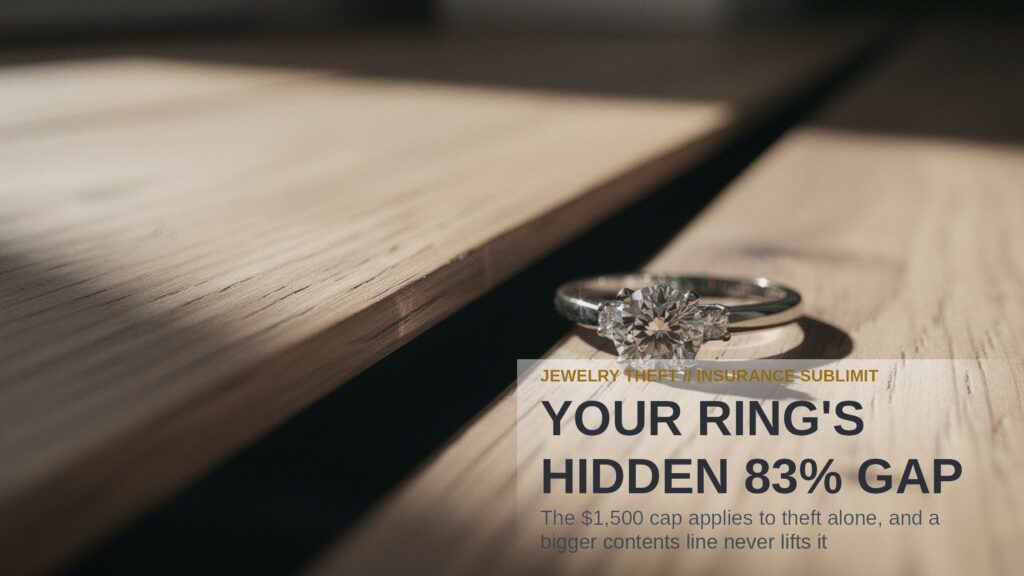
The second layer is a short table near the back of the form. Jewelry, watches, furs, and precious stones are capped at $1,500; firearms at $2,500; silverware and precious-metal ware at $2,500; money and coins at $200 [1]. The Texas guide’s warning sits beside its percentage, and it is blunt: policies “limit what they’ll pay for things like jewelry and art” [2].
What I find hard to square is the scope of those caps. They “apply only in the event of theft,” and for fire or wind the form sets no special limit at all [1]. A ring that burns is paid to the contents limit. A ring that is taken stops at $1,500. The item a reader worries about at renewal is often the one the cap describes.
By the numbers
- $2,500 for firearms: the theft limit on guns and related equipment, whatever the collection is worth [1].
- $200 in cash: the limit on currency and coins, a sum a wallet can pass without trying [1].
- $5,000 in jewelry, if endorsed: the ceiling a raised-limit rider buys above the form’s own cap [4].
Where the rider decides it
A scheduled rider lists the item, its description, and its appraised value, and it moves both numbers at once. It lifts the category cap, and it widens the perils, because a standard policy does not cover accidental loss at all: a ring lost in a lake is not a claim, whatever it cost [6]. The agency page that lists the form’s caps shows the other side in plain terms, with a rider that lifts jewelry and furs to $5,000 and money to $500 [4].
Paperwork is the part owners skip. Even where no special limit applies, proving the value and the existence of the property “requires documentation, including appraisals” [1]. The rider is that appraisal turned into a limit, so the appraisal is the work and the rider is the formality. I keep coming back to the appraisal, not the limit, as the figure worth bringing to renewal, because every insured item has to be named and valued before any carrier will write the line.
The dwelling side has its own ratio, and the two are easy to mix up: a limit below the rebuild cost cuts what a partial loss pays, as the coverage-gap arithmetic works through. That ratio is about the house. The special limit is about what sits inside it.
What the cap cannot fix
The special limits are not the main risk in the file, and the industry’s loss data says so. In 2023, 5.33 of every 100 insured houses had a claim, at an average of $20,062, and property damage including theft was 97.3 percent of claims [5]. The jewelry cap is small against that average, but most of the average is the house, so scheduling a ring does not buy protection against the fire that takes the roof.
The real limit here is the form. Texas writes its own policy, and it caps jewelry at $500; any carrier may file its own version of that table [1]. The two numbers a reader needs are already printed, one on the declarations page and one in the form’s back pages, which leaves a judgment rather than a discovery: whether the item is worth the appraisal it takes to schedule. I find it telling that nothing in the form answers that question, and no loss record can.
Related reading
- 21% of Isaias Claims Paid Nothing — more on Home Cost Decisions
- Your Adjuster Hides a 25% Gap — more on Home Cost Decisions
- Home Cost Decisions — more on Home Cost Decisions
Sources
- [1] Texas Real Estate Research Center at Texas A&M University, “What Does Homeowners Insurance Really Cover?” — https://trerc.tamu.edu/article/what-does-homeowners-insurance-really-cover-2372
- [2] Texas Department of Insurance, “Home insurance guide” — https://www.tdi.texas.gov/pubs/consumer/cb025.html
- [3] Progressive, “Personal property coverage” — https://www.progressive.com/answers/personal-property-coverage
- [4] Insurance Resources, “11 Special Homeowners Limitations” — https://insuranceresourcesllc.com/11-homeowners-limitations
- [5] Insurance Information Institute, “Facts + Statistics: Homeowners and renters insurance” — https://www.iii.org/fact-statistic/facts-statistics-homeowners-and-renters-insurance
- [6] Adjusters International, “Standard Homeowner’s Policies Limit Coverage on Your Valuables” — https://www.adjustersinternational.com/resources/news-and-events/homeowners-policies-limit-coverage-on-your-valuables