At a glance
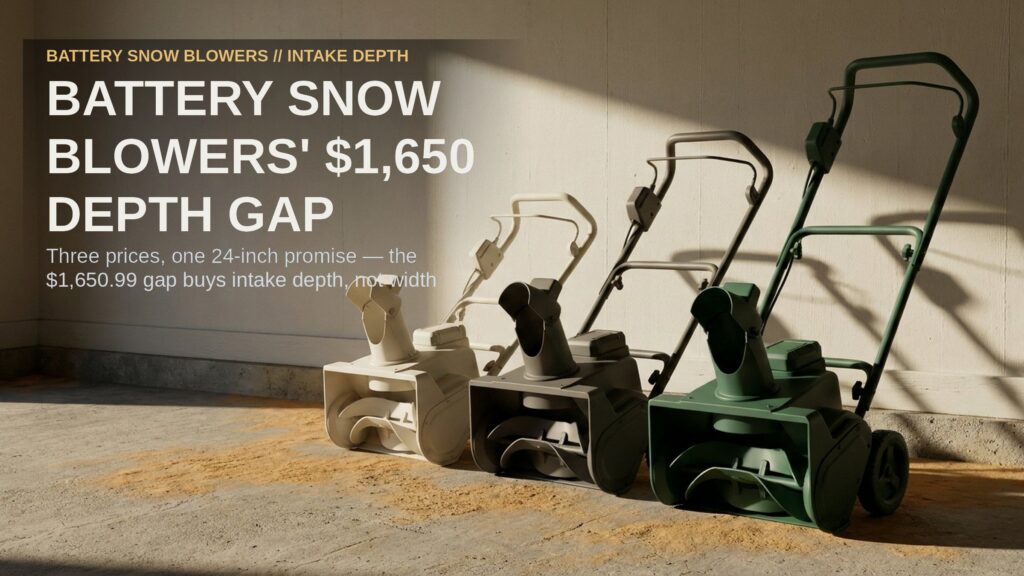
This comparison prices the three battery snow blowers a large-driveway buyer meets first and finds the deciding spec is intake depth, not width — with the mid-tier Toro delivering the class promise for $900 less than the flagship.
The big picture: width is the decoy spec
All prices here are the makers’ listed prices, and the widths are close. Ryobi cuts 21 inches [1]. The Toro and Greenworks machines both cut 24 — three inches more for $750 and $1,650 more respectively [2]. At $849.00 for the first machine and $2,499.99 for the third, the arithmetic runs the wrong way for the premium: $40.43 of price per inch of cut against $104.17. I did that division twice before accepting it, because it inverts the usual story that the top of a class buys scale.
The intake depths are not close, and that is where the money goes. Ryobi takes 11.5 inches per pass [1]. Greenworks takes 18 [3]. The Toro housing is the deepest of the three, at 20 [2]. That is the number a February storm meets. In a 10-inch fall the Ryobi takes one pass and a sweep for the remainder. In a 16-inch fall it needs two full passes where either two-stage takes one. Passes are the winter’s actual labor, and depth sets them.
Throw is the second gate. Ryobi rates 35 feet [1]. Both two-stage machines rate 50 [2]. A 21-inch path throwing 35 feet ends near the driveway edge on a wide lot, and the machine can only clear what it can throw within its own arc. The two-stage pair throws a whole strip farther.
| Unit | Price, 2026-11-22 | Width | Intake depth | Rated throw | Where it loses |
|---|---|---|---|---|---|
| Ryobi 40V HP 21″ kit (RY40HPSN02K2) | $849.00 | 21 in | 11.5 in | 35 ft | Two full passes in any storm over 11.5 inches, and the shorter arc [1] |
| Toro Power Max e24 60V (39925) | $1,599.00 | 24 in | 20 in | up to 50 ft | The maker’s page routes to retailers, so a dealer may price above $1,599.00 [2] |
| Greenworks 80V MAXIMUS kit (MSN240TN3) | $2,499.99 | 24 in | 18 in | up to 50 ft | 176.4 lbs to steer, and $900 more than the Toro for one inch less of intake [3] |
By the numbers
- $79.95 per inch of intake: the Toro’s price divided by its 20-inch intake [2].
- $138.89: the Greenworks figure on the same arithmetic — depth per dollar is nearly flat up to the Toro, then doubles on the flagship.
- $329.99: the price of one spare 80V pack on the maker’s own store [4] — the platform tax on an evening of February clearing.
What I’d watch: where each machine wins
What I am watching in this set is which driveways the two-stage premium actually pays on, and the answer is wherever snow arrives in bulk — plow windrows, end-of-driveway piles, anything deeper than a foot. The Toro’s 20-inch intake swallows a plow’s leavings in one pass [2]. So does the Greenworks’ 18 [3]. The Ryobi’s 11.5 requires the operator to break the pile first or take it twice [1]. The class’s own reference point is the EGO (the battery outdoor-tool brand) 56V two-stage, which Pro Tool Reviews priced at “$799.99 bare, $1299.99 kit” at review time and measured clearing the same driveways on 20 to 30 percent of its battery charge in light snow [5]. That is the two-stage pitch working as designed, and it is what the $849 single-stage is measured against — not a machine this desk handled.
The Ryobi wins on the axis nobody quotes: weight. It carries 59.4 pounds [1]. The Greenworks carries 176.4 [3] — a difference you feel every time the blower turns. A single-stage at that weight is a machine a person walks at a pace; a 176-pound two-stage is equipment the driveway pushes back on. Both two-stages are self-propelled, which converts mass into traction. The maker’s own copy for the Toro reads “Self-Propelled” [2]. Pro Tool Reviews lists the Greenworks as self-propelled with power steering [5]. The machine still has to be turned at the end of every pass.
The warranty ladder is quiet but real. Greenworks carries the battery 4 years and the tool 5 [3]. On a platform where the pack is the consumable that costs $329.99 [4], that fourth year is a line item, not a footnote. The battery configurations differ too: Ryobi runs two 8Ah 40V packs [1]. Toro runs one 10.0Ah with two empty slots [2]. Greenworks runs two 4.0Ah [3] — three answers to how much capacity rides in the box.
| The situation | The pick |
|---|---|
| A large drive with plow windrows and storms past 16 inches | The Toro Power Max e24: 20 inches of intake takes the windrow in one pass, and three battery ports extend the evening |
| A buyer who will pay for the longest battery warranty and dealer service | The Greenworks 80V MAXIMUS kit: 4 years on the pack, 5 on the tool, bought direct |
| A short drive, lighter storms, budget as the deciding constraint | The Ryobi 40V HP 21-inch kit: at $849.00 it is the class floor, if the 11.5-inch intake is enough for your storms |
The rest of this vertical’s equipment math, including the cold-weather limits no specification sheet carries, sits in outdoor power equipment. The buy-window angle is already covered on this front — the EGO kit discount that expires November 30 is the same aisle’s calendar risk. For the money side, the true cost of ownership calculator takes a purchase price and a service life and returns a yearly figure to hold against a plow contract.
The catch
Coverage claims are not measured on a shared yardstick, and the class’s own pages prove it. Toro speaks in car spaces — “clear up to 20 car spaces on one charge” [2]. Ryobi speaks in car spaces too — “Clears up to 25 Car Spaces Using Included (2) 40V 8Ah Batteries” [1]. The Greenworks publisher row speaks in inches of snowfall and feet of throw [5]. And the 24-car EGO claim Family Handyman retells is a publisher’s phrasing of the maker’s claim, not a shared measurement [6]. A car space is a shape, not a measurement. Nothing here can rank the three machines on a single coverage number, so the comparison above rests on intake depth and pass counts instead.
My reading, held loosely: most of the price argument rests on figures the makers rate and nobody measures per machine. Every throw distance and car-space count in this piece is a vendor rating under vendor conditions, except where a publisher is named. The pass arithmetic assumes straight full-width passes on a flat apron — the best case no driveway quite is. The Ryobi single-stage and the two-stage pair also sell different jobs; a buyer whose heaviest storm is six inches is overserved by all three, and the honest cheapest answer to that winter is the machine the box actually prices, not the class its aisle sits in.
What we did not test
One more thing the reader should hold: this desk did not run, push or measure any of these machines. The EGO figures belong to Pro Tool Reviews and Family Handyman, cited as the class reference rather than a current buy, because the EGO kit had no fetchable live price on the day this comparison was built. And the Toro page lists $1,599.00 but routes the buyer to retailers, so a dealer may price it differently on the day you shop.
Related reading
- $220 Off Your EGO Kit — more on Outdoor Power & Snow Equipment
- Your $550 Battery Spare Is Wrong — more on Outdoor Power & Snow Equipment
- Your Mower’s 145-Minute Charge Trap — more on Outdoor Power & Snow Equipment
Sources
- [1] Ryobi — 40V HP Brushless 21″ Single-Stage Auger-Propelled Snow Blower Kit RY40HPSN02K2: “$849.00”, “21” WIDTH & 11.5” DEPTH”, “Clearing Distance Up to 35′”, “Clears up to 25 Car Spaces Using Included (2) 40V 8Ah Batteries”, “Weight 59.4 lbs.”. https://www.ryobitools.com/products/46396054982 (retrieved 2026-11-22)
- [2] Toro — 60V MAX 24 in. Power Max e24 Two-Stage Snow Blower, 10.0Ah battery included, model 39925: “$1,599.00 USD”, “clear up to 20 car spaces”, “24-inch clearing width and 20-inch intake height”, “with a second and third battery slot, you can add another 4 to 20 car spaces”. https://www.toro.com/en/product/39925 (retrieved 2026-11-22)
- [3] Greenworks — 80V MAXIMUS 24″ Cordless Battery Two-Stage Snow Blower Kit MSN240TN3: “2,499.99”, “Cleaning width: 24” / Cleaning depth: 18””, “discharges up to 50 ft.”, “Product Weight 176.4lbs”, “Product Warranty 5-year”, “Battery Warranty 4-year”. https://www.greenworkstools.com/products/80v-24-cordless-battery-two-stage-snow-blower-kit-msn240tn3 (retrieved 2026-11-22)
- [4] Greenworks — 80V 5.0Ah Lithium-Ion battery (replacement pack): “329.99”. https://www.greenworkstools.com/products/80v-gen-2-2-5-ah-lithium-ion-battery (retrieved 2026-11-22)
- [5] Pro Tool Reviews — EGO 56V 2-Stage Snow Blower Review: “Price: $799.99 bare, $1299.99 kit”; “The same 6 driveways with powdery snow and low auger speed only used 20-30% of the battery!”; and the Greenworks roundup: “It can clear 18-inch snowfalls and fling snow up to 50-feet using its 200-degree articulating discharge chute.” and “This one is $2499.99 with two 5.0Ah batteries and a charger.” https://www.protoolreviews.com/ego-2-stage-snowblower and https://www.protoolreviews.com/best-greenworks-snow-blower-reviews (retrieved 2026-11-22)
- [6] Family Handyman — EGO snow blower review: “Ego says the 24-inch two-stage snow blower can clear up to a 24-car driveway with 8 inches of snow on a single charge when using both of the included batteries.” https://www.familyhandyman.com/article/ego-snow-blower-review (retrieved 2026-11-22)