At a glance
- The shift: Texas publishes why home policies end, area by area, in reason codes.
- The number: 289,218 reason lines across four notice months, the newest from July.
- The risk: six fixable flaws share one code, so the file cannot say which.
What one line absorbs
A state law passed in 2025 created that record. A carrier must now say in writing why it refused an application, ended a policy early, or declined to renew [1]. It must also send the state a quarterly report of those reasons, sorted by area [1]. The Texas Department of Insurance (TDI) put the updated reporting plan in force in February, for use from April [3]. Its lookup page now returns those numbers by postal code [1]. A Houston news station walked readers through the same lookup in October [4].
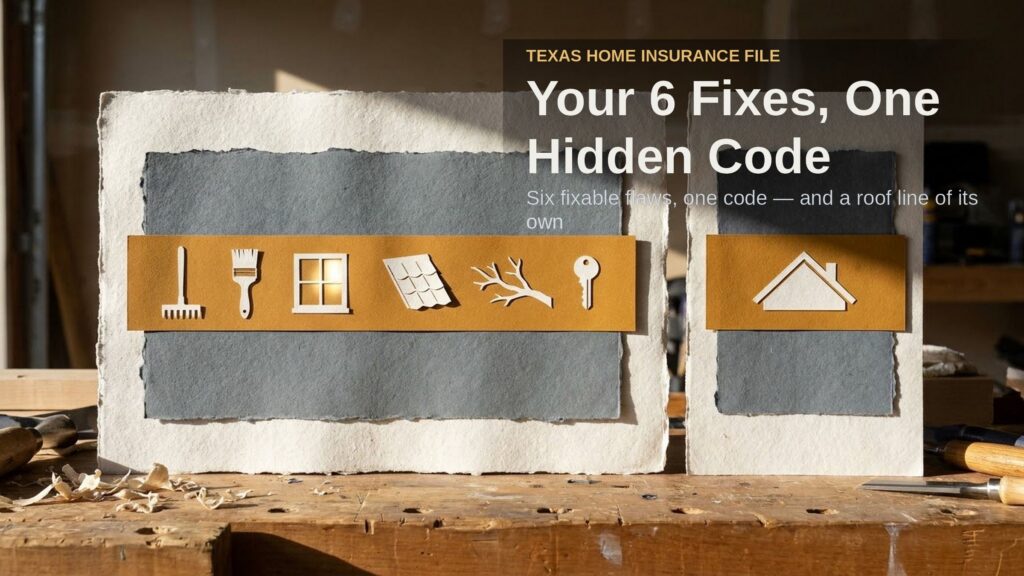
The list of reasons is where the story lives. One reason, “Condition of property,” covers “insufficient defensible space; maintenance, occupancy, or vacancy issues; roof condition; or tree overhang” [1]. Those are six separate jobs. You clear the strip beside the wall, you keep the house in repair, you keep living in it, you avoid leaving it empty, you replace the roof, you cut the tree back. The file records all six as one reason.
Then there is the split. A company that turns down a home because it does not insure certain kinds of roof must code that as “Other, Insurer’s Action” instead [1]. So the cause you cannot touch gets a box of its own, and the six you can touch share one. Credit cannot stand alone either; a carrier that blames credit must also name another reason [1].
I read the state’s reason list three times before I believed the split. Money you spend hardening the house is the only lever you hold at renewal, and the one code that would credit it cannot tell your hardened house from a neglected one two doors down. The state built openness that stops where your decision starts.
By the numbers
- 289,218 reason lines: The rows in the public home file, each a reason a carrier attached to a decision [2].
- Four notice months: April through July, with July the newest month the page carries [2].
- Six flaws, one code: Defensible space, repair, occupancy, vacancy, roof and tree overhang, counted from the state’s own wording [1].
Where this bites
The reporting is still growing, which shows how much weight the state puts on the reason itself. TDI has proposed extending it to business property from October, with the same area summaries [3]. One field on that form already asks whether a decision rested on “aerial imagery versus other types of third-party information” [3]. That is the photograph of your roof, scored by a model you never see.
What I am watching is whether the business-property form keeps the same coding split. If it does, a strip-mall owner and a homeowner will face the same blind spot: the file will say “condition of property” and neither will know which of six jobs the carrier meant.
Agents who handle these letters read them against the state’s list. The list is the only public statement of what a lawful reason looks like. The letter itself is meant to be a plain description rather than a code, which is the line the state’s rules draw [3].
The wider market runs the same way. In 2024 insurers ended more than two million home policies at renewal, about 61% more than the year before [5]. The West carried the highest rate at 25.1 per 1,000 policies, according to data from the National Association of Insurance Commissioners (NAIC) reported this month [5].
The catch
The file counts reasons, not homes. One policy can carry several reasons. The state says outright that the reasons report “isn’t the total number of declinations, nonrenewals, and cancellations” [1]. So those rows measure paperwork rather than families.
A second limit decides whether you can look up your own street. The public file gives reasons without the company that gave them, and its short letter codes have no published key that names them [2]. The words above come from the state’s own page for homeowners, not from the data rows.
My reading of both limits is that they push the same direction. The letter matters more than the lookup page because it is the only document that names one reason for one address, and the law gives you the right to have it in writing [1]. Keep it, and keep your own note of the fixes it lists. A refused renewal is a clock you can count as well as a decision.
Related reading
- Your 4.3% Cut Hides 751,000 Hikes — more on Home Cost Decisions
- Your 49% Discount Isn’t All Roof — more on Home Cost Decisions
- Your Flood Gap Has 44 Days — more on Home Cost Decisions
Sources
- [1] Texas Department of Insurance, “Reasons home and auto insurance policies are declined, not renewed, or canceled” — https://www.tdi.texas.gov/consumer/reasons-home-and-auto-insurance-policies-are-declined-canceled-not-renewed.html
- [2] Texas Open Data Portal, “89R HB 2067 – reasons for residential property declinations, cancellations, and nonrenewals” — https://data.texas.gov/dataset/89R-HB-2067-reasons-for-residential-property-decli/3efz-d6qn
- [3] Texas Secretary of State, Texas Register, “Proposed Rules: 28. Insurance” (28 TAC §5.9501), 22 May 2026 — https://www.sos.state.tx.us/texreg/archive/May222026/Proposed%20Rules/28.INSURANCE.html
- [4] Click2Houston, “Is your insurance company dropping coverage? Texas tool reveals why policies are canceled by ZIP code”, 28 October 2026 — https://www.click2houston.com/news/local/2026/10/28/is-your-insurance-company-dropping-coverage-texas-tool-reveals-why-policies-are-canceled-by-zip-code
- [5] Insurance Business, “COP31 opens with record heat looming and insurance gaps widening”, 9 November 2026 — https://www.insurancebusinessmag.com/us/news/catastrophe/cop31-opens-with-record-heat-looming-and-insurance-gaps-widening-596625.aspx