At a glance
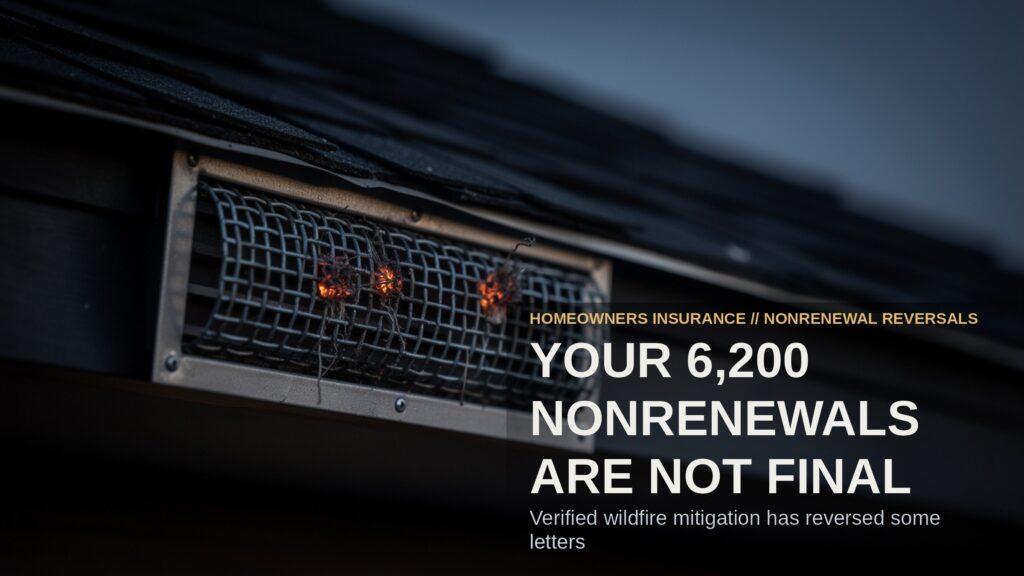
This article is for New Mexico homeowners facing a non-renewal notice. It covers the state’s record 6,200-plus refusals in 2025, the superintendent’s testimony that documented mitigation has reversed some of them, and the capped, used-value terms of the FAIR Plan fallback.
The record, and what answers it
The record went public in stages, and the order matters. Insurers dropped more than 6,200 policies during 2025, the highest annual count in state history [1]. On October 20, 2026, State Rep. Anita Gonzales put the number in front of an industry panel at an interim legislative committee hearing [1]. By November 18, the state’s guidance had been restated for agents and owners still inside their notice windows [2]. That is the timeline: a record year, a hearing, and a restatement — no new law in between.
Gonzales asked the panel a blunt question. If insurers pull out of whole communities, she wanted to know, “how are we able to then rebuild?” [1]. Her district has lived through the state’s largest fire, and her question was about survival, not paperwork.
The industry witness gave the carriers’ side. Julie Rochman, a former head of an insurance research group, told the panel that carriers “back away” when the risk already on their books maxes out what they can pay [1]. Rising reinsurance and building costs squeeze the same balance sheets [1]. Nothing in that account responds to a better cover letter.
What does respond is proof of real work, and I keep coming back to who said so. Alice Kane, the state’s insurance chief, told lawmakers in summer 2026 that some non-renewals were reversed after owners cut their fire risk [2]. She also said insurers will soon give discounts for verified work [2]. Her office points owners to Wildfire Prepared Home, a program run by the Insurance Institute for Business and Home Safety (IBHS) [2]. The program turns weekend labor into a record an underwriter can read. It lists cleared roofs and gutters, open space around the house, and hardened vents and decks, all checked by a third party [2]. The vent item carries the most risk for the least money, because a screen with wide gaps works as an ember door (the cost is the subject of Your 1/8-inch screen is an ember door).
By the numbers
- More than 6,200 policies: New Mexico’s 2025 non-renewal count, a state record and nearly triple the 2021 figure [1].
- 30 days: The minimum written notice before a New Mexico non-renewal takes effect [2].
- $750,000: The FAIR Plan’s maximum residential payout in protection classes 1–7, and $500,000 in classes 8–10 [3].
What the dropped owners are doing
The 30-day window is the fulcrum, and the pattern I see in the agent accounts runs through it. New Mexico requires written notice at least 30 days before a policy expires [2]. The law does not force the insurer to print a reason in that notice; an owner can ask for one [2]. Agents report owners doing three things at once inside the window. They ask for the reason. They get a roof check on paper. They quote several carriers through a local agent [2].
The reversal lever lives inside that same month. Kane tied the reversals to fire-risk work. In practice that means a record an inspector can check, not a promise to clean the gutters in spring [2]. The IBHS label exists to make that record portable. It lists finished items, checked by a third party, and New Mexico’s insurance office points to it by name [2].
The fallback at the end of the month is the FAIR Plan (Fair Access to Insurance Requirements), the state’s insurer of last resort. Its terms are the state’s own. The New Mexico Property Insurance Program accepts an applicant only after a denial in the regular market [3]. Since November 4, 2025, it also requires the owner and producer to sign an affidavit confirming that denial, both at application and at each renewal [3]. The coverage list is short: fire, wind, hail and similar perils, and vandalism [3]. There is no replacement-cost option — the guide states that property “is not insured for more than its actual cash value” [3]. There is no liability coverage at all [3]. Even entry has a closure rule, and the plan will not take a new application within 50 miles of an active fire until crews contain it [3].
The catch
The reversal is testimony, not a rule. That gap is where my reading settles. Kane said some letters were reversed; she did not say a good file entitles anyone to reinstatement [2]. No New Mexico regulation guarantees a discount amount or a renewal for a certified home [2]. A carrier whose regional book is full can still decline a certified house, which is exactly the position Rochman described [1].
So the two tracks run side by side. California answered the same pressure this month with a one-year freeze that blocks non-renewals for roughly 50,000 owners around one fire’s edge [4]. New Mexico has no freeze. The mitigation file is the only lever its homeowners hold.
Related reading
- Your 6 Fixes, One Hidden Code — more on Home Cost Decisions
- Your 4.3% Cut Hides 751,000 Hikes — more on Home Cost Decisions
- Your 49% Discount Isn’t All Roof — more on Home Cost Decisions
Sources
- [1] Patrick Lohmann, “New Mexico lawmaker questions industry group leaders over homeowners’ insurance non-renewals”, Source New Mexico, 2026-10-20 — https://sourcenm.com/2026/10/20/new-mexico-lawmaker-questions-industry-group-leaders-over-homeowners-insurance-non-renewals
- [2] Rio Grande Insurance Services, “Home Insurance Non-Renewal in New Mexico: What to Do”, updated 2026-11-18 — https://www.riograndeins.com/blog/2026/home-insurance-non-renewal-new-mexico
- [3] New Mexico Office of Superintendent of Insurance, “New Mexico FAIR Plan — Consumer Guide”, updated 2026-01-27 — https://osi.state.nm.us/wp-content/uploads/2026/02/NM-FAIR-Plan-Consumer-Guide.pdf
- [4] California Department of Insurance, “Bulletin 2026-11: Dove Fire — Mandatory Moratorium on Cancellations and Non-Renewals”, 2026-11-10 — https://www.insurance.ca.gov/0250-insurers/0300-insurers/0200-bulletins/bulletin-notices-commiss-opinion/loader.cfm?PageID=362181&csModule=security%2Fgetfile