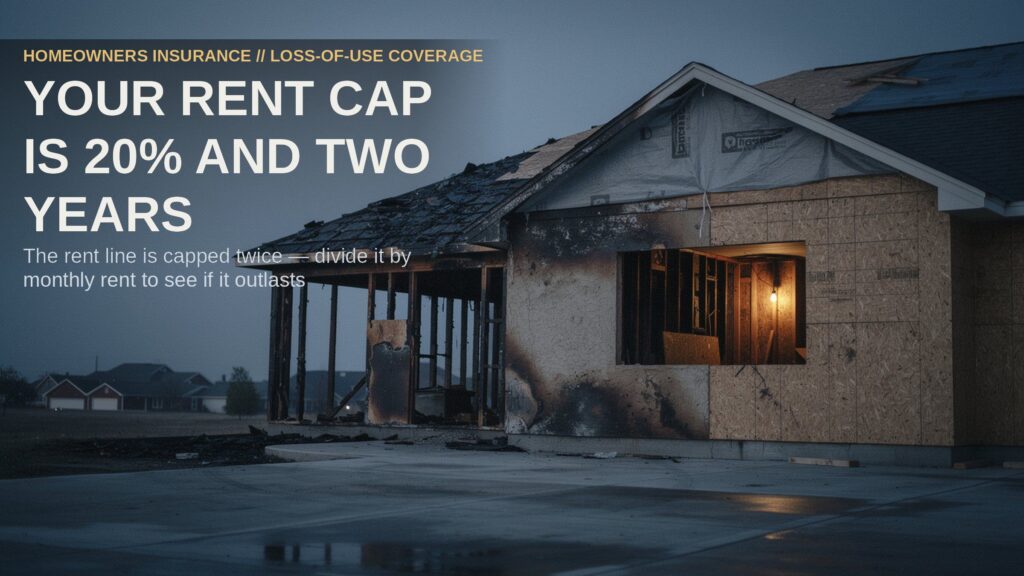
Your Rent Cap: 20% and Two Years
At a glance
Loss-of-use coverage, also called additional living expenses (ALE), pays what living away from home costs beyond your usual bills. State regulators cap it two ways: a dollar limit near 20 percent of the dwelling limit, and a 12-to-24-month clock. One division tells you whether the money outlasts the rebuild.
Cap by cap, then one division
A displacement claim runs into the dollar cap first. The Texas Department of Insurance tells owners the line “might be limited to 10 to 20% of the amount of the dwelling coverage” [1]. Washington’s insurance commissioner prints the usual range as 20 to 30 percent [2]. On a $100,000 dwelling limit, Washington’s own worked example puts the cap at $20,000 [2]. Virginia’s consumer guide lands on the typical figure: “up to 20% of the policy limit on your dwelling” [3].
The second cap is a calendar. The same Washington guidance says “the time limit is usually 12 to 24 months” [2]. It also names what pushes a rebuild past that window: contractor shortages, debris removal, permitting, environmental testing [2]. Colorado wrote the calendar into statute. Its Division of Insurance tells owners that many policies carry only 12 months, “but State law requires that the companies offer you 24 months of coverage” [4].
I read the two caps three times before seeing they are one number. Coverage D dollars divided by monthly rent gives the months of displacement the policy funds. The rule underneath is narrow: the coverage pays only the extra cost of living away, above your normal living costs [3]. That rule carries a quiet consequence. The mortgage on the damaged house keeps running inside your own column, not the policy’s.
By the numbers
- $173,111 per fire claim: the average paid on a non-catastrophe homeowners fire loss in 2024 [5].
- 20% of the dwelling limit: the typical loss-of-use cap, so a $400,000 limit carries about $80,000 [3].
- 12 to 24 months: the time limit displacement coverage usually carries [2].
Where the math bites
Fire is the claim that turns this into a lease. The industry’s loss table puts fire at a 0.13 claim rate per 100 house-years in 2024 [5]. That is roughly one home in 770 in a year. Severity prices the risk more than the rate does. A fire claim paid an average $173,111 in 2024, up 74 percent from 2020’s $99,613 [5].
The people closest to this claim already run the math. Washington’s guidance tells owners to “check your ALE limit against typical rental prices nearby” before any loss happens [2]. Colorado’s toolkit makes the 24-month offer an explicit checkbox at renewal [4]. Survivors report one failure mode again and again: conserving hotel and meal costs mid-claim for fear the money runs out. United Policyholders quotes a 2007 Witch Creek fire survivor who later found her policy carried no dollar cap at all — a discovery made after the fear had done its work [6]. The same registry records a family who settled their time away by taking the reasonable rental value of their destroyed home, multiplied by the two years their policy allowed [6].
My read: run the math at your desk before renewal, not in a hotel. Take the Coverage D dollar limit from the declarations page. Divide it by a real monthly figure — furnished rent near you, plus the utilities and restaurant overhead you would not carry at home. On a $400,000 dwelling at the 20 percent cap, that is $80,000 of rent money. At $2,200 a month it buys about 36 months; at $3,300 it buys 24. Compare that against how long a rebuild takes near you. Price any shortfall as a buy-up at renewal, the same trade the claim-or-self-pay calculator runs for one absorbed repair.
The catch
The range is the honest answer, not a single number. Texas prints 10 to 20 percent of the dwelling limit [1]. Washington prints 20 to 30 [2]. Virginia prints 20 [3]. My reading is that states regulate the offer, not the sizing, so the policy in hand governs. Two traps flank the math. An owner who moves in with relatives and adds no expense collects nothing — Virginia’s guide states that rule outright [3]. And Colorado’s statutory buy-up covers the clock but not the budget, so a wide dollar limit and a short calendar can still collide [4]. The division is the only check that prices both at once.
Related reading
- Your 70% Limit’s 12.5% Gap — more on Home Cost Decisions
- Your Ring’s Hidden 83% Gap — more on Home Cost Decisions
- Your 3rd Claim Counts, Storm Doesn’t — more on Home Cost Decisions
Sources
- [1] Texas Department of Insurance, “Personal property and homeowners insurance” (consumer guide cb025) — https://www.tdi.texas.gov/pubs/consumer/cb025.html
- [2] Washington State Office of the Insurance Commissioner, “Additional living expenses coverage” — https://www.insurance.wa.gov/insurance-resources/natural-disasters/disaster-recovery/additional-living-expenses-coverage
- [3] Virginia State Corporation Commission, “Virginia Homeowners Insurance Guide” — https://www.scc.virginia.gov/consumers/insurance/property-casualty-consumer/virginia-homeowners-insurance-guide
- [4] Colorado Division of Insurance, “Toolkit for Homeowners and HOAs on Insurance” — https://doi.colorado.gov/homeowners-hoainsurancetoolkit
- [5] Insurance Information Institute (Triple-I), “Facts + Statistics: Homeowners and renters insurance” (ISO/Verisk data) — https://www.iii.org/fact-statistic/facts-statistics-homeowners-and-renters-insurance
- [6] United Policyholders, “Survivors Speak: Additional Living Expense (ALE)/Loss of Use” — https://uphelp.org/claim-guidance-publications/survivors-speak-additional-living-expense-ale-loss-of-use